
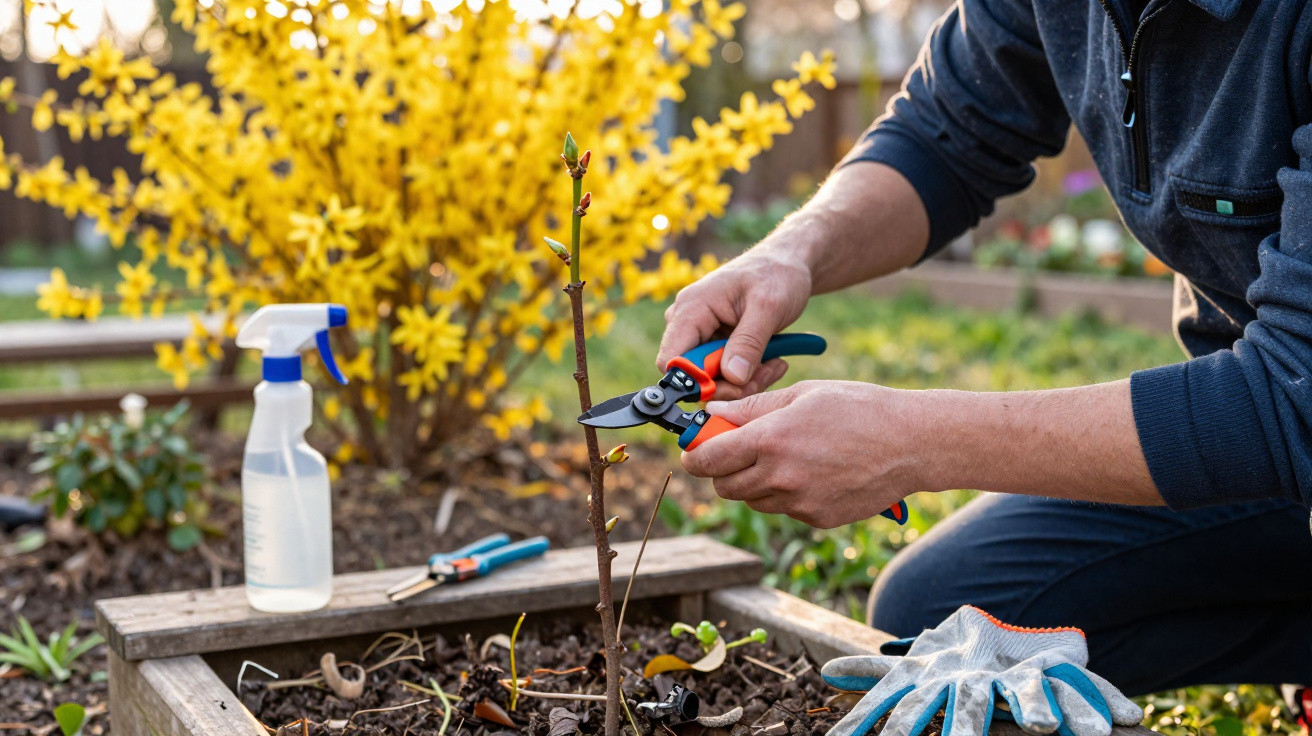
The shoots may look unruly and spring may be just around the corner, so it is tempting to quickly “tidy up” the rose bed. Yet this is precisely when mistakes occur that can leave entire bushes without a single flower later on. A slight error with the secateurs, poor timing or a few millimetres too much can bring the dream of roses to an abrupt end.
Why pruning roses in March is so delicate
Pruning brings the shrub out of its winter dormancy. The plant sends more sap into its shoots, and the buds are meant to produce vigorous new branches and flowers. However, if this happens too early and a hard frost returns, the rose is hit at its most vulnerable point.
Should temperatures fall back towards minus three degrees, water inside the cells freezes. The tissue bursts, the wood dies and fungi gain an easy foothold. Grey mould fungus, Botrytis cinerea, is among those that use frost and pruning damage like an open doorway.
“In extreme cases, pruning too early can cost almost an entire season’s flowering.”
For this reason, experienced rose gardeners pay less attention to the calendar than to signals from the garden. One particularly dependable indicator is a yellow-flowering shrub that almost everyone has seen before: forsythia.
The garden’s secret clock: what the forsythia shrub tells you
Once the vivid yellow bells of the forsythia shrub begin to open, severe frosts have usually passed. This often happens in March, although it may be slightly earlier or later depending on the region. Reaching for the secateurs at this point is considerably safer than rigidly following a date.
In some years, the weather behaves unpredictably: warm spells in February followed by a cold snap in March have already destroyed around 40 per cent of the flowers on early-pruned roses in England. The shrub appeared healthy but produced almost no blooms.
- Prune roses only once forsythias are clearly in flower.
- Avoid pruning when night frosts are forecast.
- It is better to wait a few days than to start too early.
The most common cardinal error: the “stub” above the bud eye
This mistake even has a name in rose gardens: the “chicot”, meaning a stub of old wood. It occurs when too much stem is left above the final bud. Instead of one to eight millimetres, gardeners often leave five, ten or even more centimetres.
This remaining piece receives an increasingly poor supply, dries out, turns dark and gradually dies back. In the worst case, decay travels downwards and eventually reaches the healthy bud that should have produced new growth.
“The result is apparently vigorous, green shoots – but not a single flower bud throughout the summer.”
You can identify such stubs by looking for:
- dark brown, dry ends;
- cracks or shrivelled textures in the wood;
- knobbly transitions to the still-green section.
Cut these remnants back decisively to just above a live bud with green tissue. If the damage extends deep into the wood, you may sometimes need to cut much further back than you would like – but this saves the plant in the long term.
The second major mistake: flat cuts as if made with a ruler
A smooth, horizontal cut is at least as deceptive. It may look neat, but it causes problems for roses. Rainwater remains on the surface, runs directly over the bud beneath it and leaves the area waterlogged. Cold weather or fungal spores then have an ideal point of attack.
Roses react sensitively to such moisture and frost traps. A single rotten cut can make one shoot unusable. Making many cuts like this effectively creates a fungal motorway for the rose bush.
What a good cut on roses looks like
- The cut surface should slope slightly, at roughly 45 degrees.
- The slope must run away from the bud, never towards it.
- Leave around five to seven millimetres between the cut and the bud.
This lets rainwater drain away from the cut without reaching the young bud. At the same time, enough wood remains to prevent the bud from drying out or being injured while pruning.
The rule of three eyes: simple guidance for every amateur gardener
Professionals use a straightforward rule of thumb to prune roses reliably: the so-called rule of three eyes. Here, “eyes” means the buds along a shoot – the small swellings from which new branches later emerge.
“Count upwards from the base of the plant – the third eye determines the cutting point.”
Proceed as follows:
- Cut out all dead, black or fungus-affected wood completely.
- Remove weak, thin or inward-growing branches.
- Retain three to five strong, well-positioned main shoots.
- On each main shoot, count the buds from the bottom and cut just above the third one.
- Ensure that this third bud faces outwards, away from the centre of the shrub.
This opens the shrub like a bowl. Air and light can reach its centre, while leaves dry more quickly after rain. Fungal diseases such as rust, black spot and powdery mildew then find it much harder to establish themselves.
Tools, hygiene and timing: what makes the difference
The tools you use matter just as much as the pruning technique. Sharp, well-maintained garden tools reduce damage to the plant and create smooth wound edges that can heal properly.
- Use bypass secateurs, with two cutting blades, rather than anvil secateurs.
- Disinfect the blades with alcohol or boiling water before pruning.
- Prune on a dry day whenever possible, so wounds dry quickly.
Anyone who has previously had fungal problems in the rose garden should take disinfection particularly seriously. Spores adhere easily to metal surfaces and can otherwise be carried from plant to plant.
What should you do if pruning has gone wrong?
Mistakes can often be corrected, provided the damage has not travelled too far into the wood. If you notice long stubs or horizontal surfaces, then:
- Make a fresh cut a few millimetres above a healthy, outward-facing bud.
- Remove dead wood entirely, even if this makes the shoot substantially shorter.
- Inspect the plant in the following weeks for newly developing black or brown discolouration.
Severe frost damage can sometimes require more drastic action. Although this may seem daunting, practical experience shows that many old-looking stumps will regrow all the more strongly after a bold cutback, as long as enough healthy root mass remains.
Further details: location, rose type and common misunderstandings
Not every rose should be pruned in the same way. Floribundas, hybrid teas and shrub roses generally tolerate a harder cutback to just a few eyes. Climbing roses and historic varieties are often more sensitive; prune these more moderately and mainly remove old wood that no longer flowers well.
One common misunderstanding is that many amateur gardeners prune too cautiously because they are afraid of cutting back too much. They leave long, ageing shoots in place even though they scarcely flower any longer. A bolder cutback usually encourages stronger, more floriferous new growth and extends the life of the entire bush.
Often underestimated risks – and how to minimise them
Growth that is too dense and incorrect pruning often lead to a whole range of follow-on problems: stagnant air inside the shrub, leaves that remain wet and fungal diseases that spread rapidly. Anyone who has spent a summer battling powdery mildew or black spots will understand how much prevention begins in late winter.
Mechanical damage is another concern. Shoots that rub together or cross can injure one another, creating entry points for pathogens. Systematically removing these branches during pruning greatly reduces the risk.
In practical terms, this means:
- Check the shrub regularly from the inside, not merely from the outside.
- Always remove crossing shoots in favour of the better-positioned one.
- Plan an inspection after heavy rain and storms.
Anyone who combines these principles with the rule of three eyes while avoiding stubs and flat cuts has mastered the crucial measures. The reward will not be visible immediately, but weeks later, when short, unassuming shoots develop into strong flowering canes and the rose bush truly turns the patio or front garden into a sea of blooms.




Comments
No comments yet. Be the first to comment!
Leave a Comment