
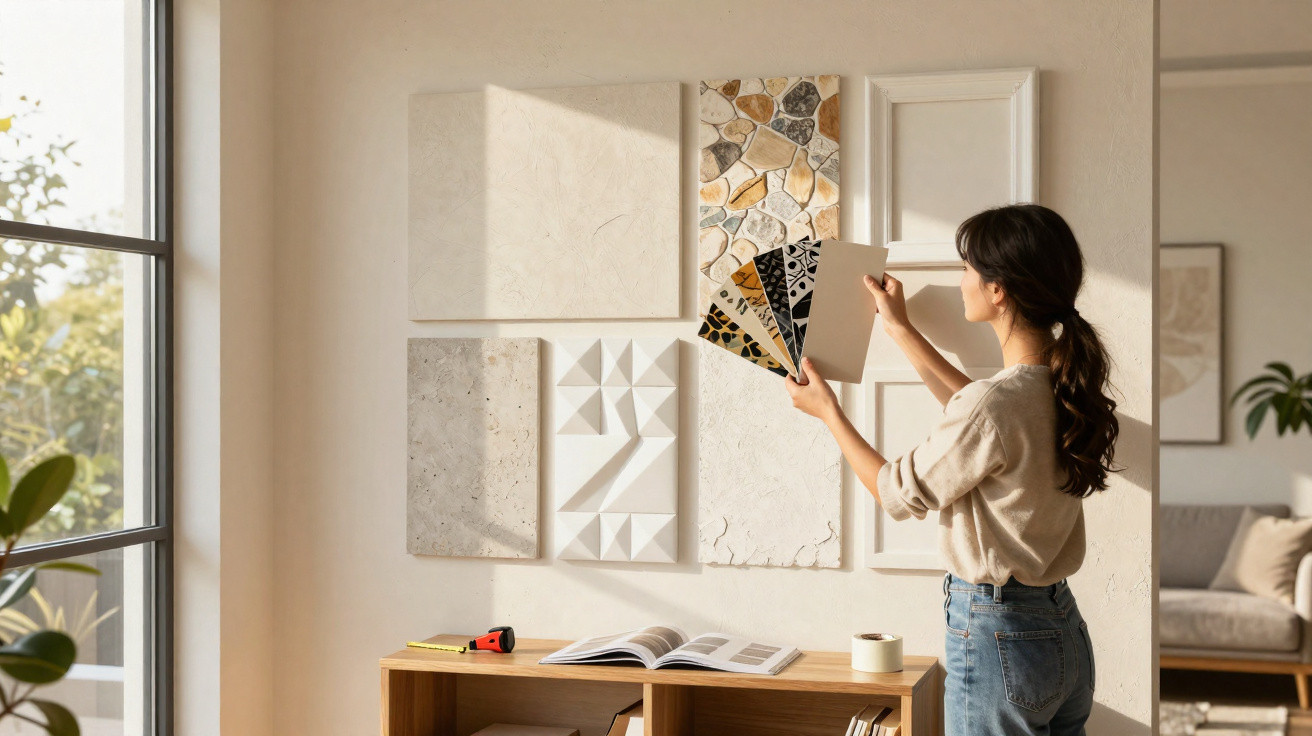
Wood panelling is no longer the only way to make a living-room, bedroom or dining-area wall stand out. Slim coverings, textured finishes, mouldings and wallpaper can alter colour, relief and depth without the need for major building work, offering five alternatives suited to very different interior styles.
Which materials can replace wood panelling?
The possibilities range from seamless finishes, such as textured plaster, to options fixed straight onto the wall, including wallpaper and 3D wall coverings. Slim stone finishes and timber-and-moulding arrangements also belong on this list, making it possible to create a focal point without covering the entire surface in traditional wood panelling.
Each choice has a markedly different visual effect. A pale texture makes the surface appear more even, whereas stone and relief finishes introduce shadow and depth. Wallpaper, meanwhile, makes it possible to use patterns and colours without adding noticeable thickness to the room.
How do textured plaster and stone change a wall’s appearance?
Textured plaster delivers a handcrafted-looking finish and can replace completely smooth surfaces without requiring large panels to be fitted. Stone, in contrast, brings variations in tone and texture; artificial, ultra-thin or self-adhesive versions can make installation considerably simpler than with heavier traditional cladding.
- textured plaster for subtle relief and a continuous finish;
- natural stone to emphasise the material’s texture and inherent irregularities;
- artificial stone to recreate this look with lighter pieces;
- slim or self-adhesive coverings to minimise work on the wall.
Why have mouldings and 3D wall coverings become popular in interior design?
Mouldings applied directly to the surface can divide a wall into geometric panels without fitting conventional wood panelling. Rectangles, squares and symmetrical layouts add relief with only a few pieces, particularly when the mouldings and wall are painted in the same colour.
3D wall coverings follow a similar principle but create more pronounced volume. According to the selected design, room lighting casts shadows throughout the day, giving a monochrome wall movement without relying on patterns or numerous decorative objects.
Timber mouldings and wallpaper provide two very different options
Those who still enjoy the look of timber do not have to give it up altogether. One alternative is to use it only for mouldings, details or smaller arrangements, while wallpaper suits those seeking a quick change with a broader choice of patterns. Removable designs are also available for people who plan to update their décor more often.
- timber mouldings for headboards and feature walls;
- geometric arrangements to reduce the amount of timber used;
- plain wallpapers to focus solely on colour and texture;
- patterned designs to create a focal point in the room;
- removable options for anyone intending to change the décor later.
How can you choose the best alternative for refreshing a wall?
Before replacing wood panelling, consider the condition of the surface and the intended result. Wallpaper generally requires an even base, while textures and wall coverings must be compatible with the existing finish. Stone and 3D pieces also add thickness, which is an important consideration near sockets, doors, furniture and skirting boards.
There is no need to update every wall at once. A single surface behind a sofa, bed or dining table can feature texture, stone, mouldings or wallpaper and become the room’s focal point. In this way, colour, relief and material can shape the overall scheme without necessarily involving demolition work or a full refurbishment.



Comments
No comments yet. Be the first to comment!
Leave a Comment