
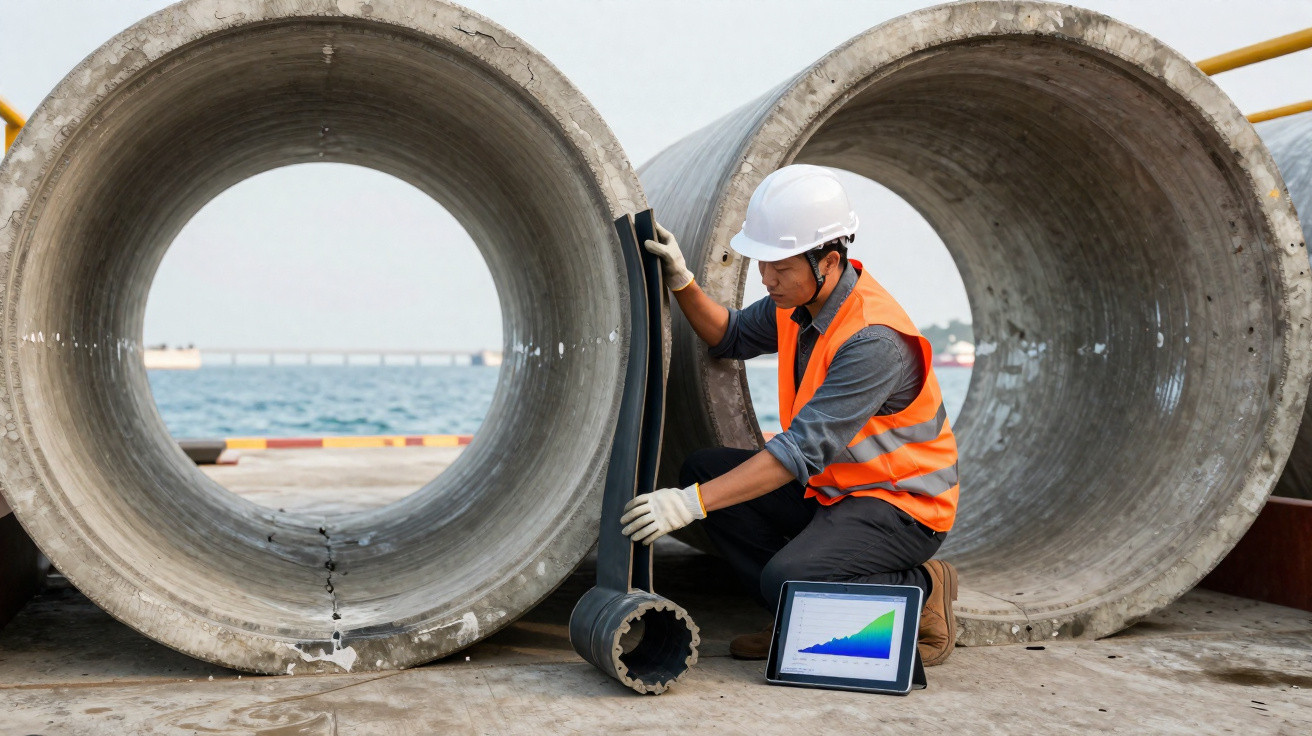
The safety of major underwater tunnels relies on unseen components that withstand immense pressure beneath the ocean. Research indicates that elastic seals, essential for preventing leaks, undergo premature chemical degradation, undermining their anticipated service life and making continual rigorous monitoring necessary.
How do rubber seals withstand premature deterioration underwater?
Thick rubber components known as GINA gaskets play a crucial role in maintaining underwater connections. These durable barriers carry the crushing weight of huge concrete sections while continuously preventing the destructive ingress of highly saline water.
Material assessments after extended operation revealed a substantial loss of almost seventy per cent of their original elastic capacity. This concerning effect significantly changes preventive maintenance planning and is driving the creation of new guidance on structural stability:
- Continuous monitoring: Periodically assess the rubber's internal elasticity.
- Saltwater resistance: Examine the ocean's long-term chemical effects on the material.
- Design reviews: Update compression calculations for new underground works.
What did earlier tests fail to assess about this compression?
Older models based their projections solely on the chemical action caused by saltwater. However, specialists overlooked the harmful impact of continuous crushing imposed by heavy reinforced-concrete structures on the rubberised ring over the coming decades.
This persistent physical force speeds up internal material deterioration, changing the safety parameters previously estimated for large underground structures. Once compressive force is included, the projected sealing pressure falls alarmingly, altering acceptable technical indicators.
Why can material hardening conceal a structural failure?
During routine visual inspections, increased rubber stiffness may give on-site engineers a false impression of safety. This surface hardening conceals the progressive breakdown of internal molecular chains, reducing the flexibility required by this vital structural mechanism.
Invisible material degradation
The hidden danger beneath hydrostatic pressure
The loss of molecular resilience prevents the gasket from returning to its original state after dynamic deformation.
Over time, this stiffness weakens the elastomer's internal structure, creating a route for dangerous microcracks.
The loss of elasticity directly reduces the polymer compound's ability to expand, creating serious long-term structural risks. Without the required pliability, the system cannot respond to subtle movements in structural joints, leading to the following critical consequences:
- Excessive damp appearing on the internal walls of underground galleries.
- Exponential increases in maintenance costs and complex emergency repairs.
- Faster corrosion of the project's internal metal reinforcement.
Which points are most vulnerable in these major underwater works?
Practical studies show that hydrostatic forces are not distributed evenly around the entire sealed circumference. The lower edge of the elastic ring experiences less contact force, rapidly becoming the initial critical point.
When the physical gap between modular sections reaches levels beyond those planned, the risk of severe leaks rises exponentially. This spatial variation destabilises the original hydraulic seal, requiring detailed inspections focused as a complete priority on the following vulnerable elements:
- The lower edge of elastic gaskets, where contact force decreases.
- Connection joints subject to rotation caused by tidal movement.
- Geological transition zones experiencing continuous differential settlement.
How can the safety of these passages be ensured over the coming decades?
An immediate review of preventive maintenance schedules is the first step in reducing the impact of premature material fatigue. Public-sector managers must adopt modern continuous-monitoring technologies to ensure structural support remains intact over the long term.
Incorporating new elastomeric chemical compounds into future projects will help counter accelerated degradation in severe conditions. Taking preventive action avoids excessively costly corrective work, ensuring underwater transport continues to operate with maximum technical efficiency and complete operational protection.
References: Aging mechanism and life prediction of GINA gasket on immersed tunnel under the combined action of compression load and seawater environment: A multi-scale experimental analysis – ScienceDirect




Comments
No comments yet. Be the first to comment!
Leave a Comment