
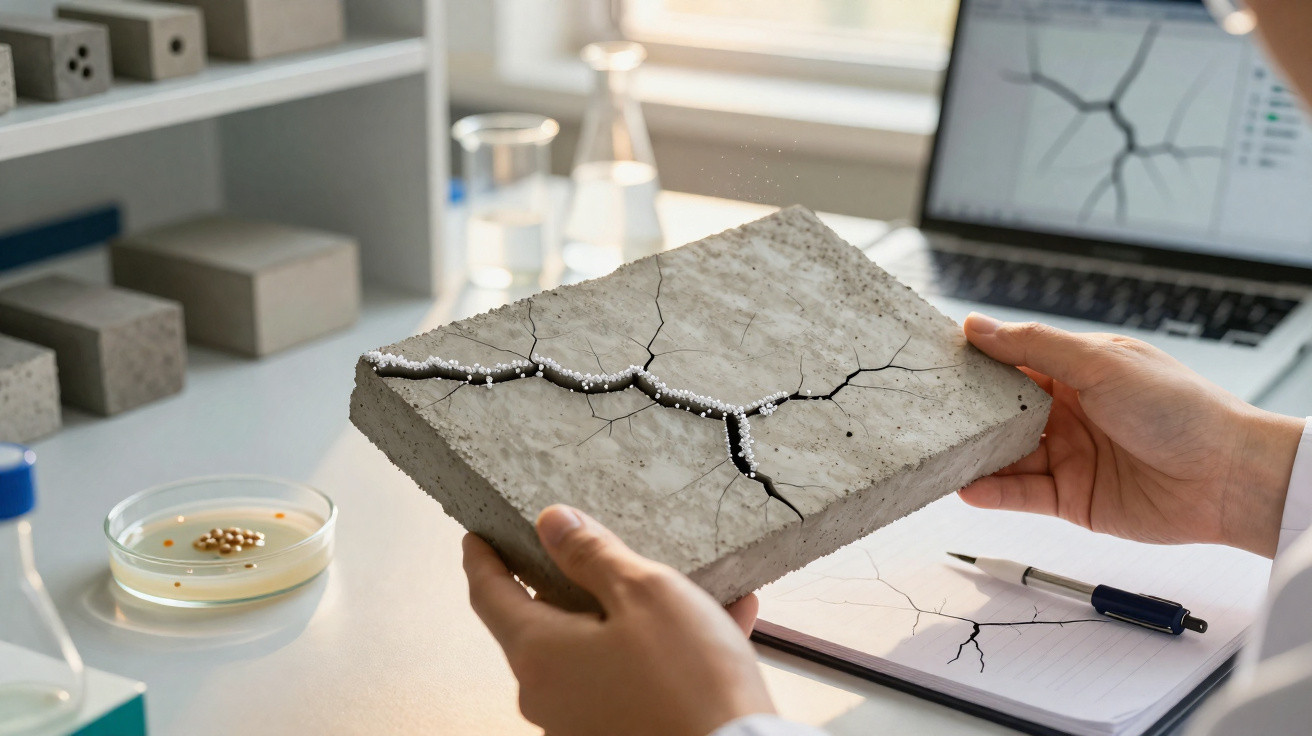
Fine cracks in concrete can almost close on their own when bacteria deposit minerals within them. Broader and diagonal cracks can cut water leakage by up to 80%.
These findings indicate that crack geometry is central to concrete self-repair. The result shifts a promising concept towards a system that engineers can begin to forecast and use.
What the cracks revealed
In test blocks containing vertical, diagonal, wide and hairline fractures, repair began most rapidly where minerals could anchor to uneven internal surfaces.
By examining these surfaces, Yongchao Zhou, an associate professor at Chang’an University, connected every crack pattern with a distinct healing outcome.
At Chang’an University’s School of Highway, Zhou found that results varied markedly by crack type rather than improving uniformly across all damage.
For tunnel linings and bridge decks, this means failure may develop along particular vulnerable routes rather than through a single average crack assumed in theory.
How the minerals develop
When moisture entered an opening, bacteria initiated microbially induced calcium carbonate precipitation, creating a mineral deposit made up of hard crystals.
These fresh crystals collected along the crack walls, steadily narrowing the opening whenever new solution passed through the damaged area.
As the deposit is more compatible with concrete minerals than many resins, it can fill the space without producing a softer section.
This benefit matters to engineers seeking durability without applying an additional coating across newly damaged concrete.
Why concrete crack shape matters
Microbes did not gain the same purchase in every crack, as the geometry determined how long freshly formed minerals remained in position.
On diagonal paths, rougher surfaces slowed water flow, allowing more crystals to settle before the following wetting cycle.
Researchers call this winding route tortuosity, which measures how convoluted a path is within damaged concrete.
“Greater tortuosity and surface roughness of cracks significantly increase the rate of calcium carbonate deposition and self-healing,” Zhou wrote.
Tracking the leaks
Leakage measurements offered a more complete assessment than appearance alone, since surfaces that look sealed can still allow water to travel deep within.
For vertical cracks, surface healing increased alongside lower water ingress, providing engineers with a clearer warning indicator.
That relationship curved for diagonal damage, meaning similarly repaired-looking cracks did not necessarily prevent leakage to the same extent.
When deciding whether a repaired crack is safe, maintenance teams still require water testing rather than photographs alone.
Small cracks perform best
Hairline damage was the simplest to control because even a thin mineral layer can connect the two walls of a narrow opening.
In favourable conditions, the smallest openings achieved almost complete area repair before larger defects had fully closed.
Their advantage is purely one of distance: minerals require less accumulation before the opposing faces join and movement stops.
However, success with tiny cracks does not address every safety concern, as larger fractures still drive many serious failures.
Towards useful forecasts
Zhou’s paper goes further than demonstrating that healing occurs, beginning instead to estimate the recovery rate of different damage patterns.
Rather than viewing every break as identical, the researchers associated crack shape with repair speeds that change over time.
These estimates provide a practical link between laboratory findings and maintenance planning, where moisture, repair periods and risk all count.
Prediction nevertheless relies on controlled conditions, although the study reduces the gap between an eye-catching finding and a design rule.
What earlier research found
Previous experiments had shown that bacteria survived concrete more effectively when protected within carriers rather than added without shielding.
One paper reported that diatomaceous earth protected bacteria much more successfully in cement slurry, allowing them to continue depositing minerals.
A later study used recycled aggregate as a carrier and repaired wider cracks than could be achieved through direct bacterial addition.
Developments in carriers prepared the ground for Zhou’s paper, which considers the more difficult issue of shape rather than simply proving the concept.
Where challenges remain
The harsh chemistry of concrete can still endanger bacteria well before a crack opens within a structure.
Curing heat, scarce food and drying may reduce bacterial survival before the healing process properly begins.
A case study of encapsulated spores showed that carrier design was still essential, particularly as temperatures rose during hardening.
At present, self-repair concrete remains largely confined to testing rather than routine use in pavements, towers or bridge replacements.
Concrete cracks and bacteria
If cracks close before crews arrive, structures may leak less, corrode more slowly and need less emergency patching.
Reducing emergency repairs could ease traffic disruption, shorten closures and extend the service life of existing concrete.
As cement manufacture has a high carbon cost, maintaining material already in place for longer can be as important as creating new designs.
Even so, the technology does not claim that entire structures can repair themselves; instead, it suggests earlier intervention for smaller damage.
By demonstrating that crack shape affects healing rate, leakage and closure, the research makes self-repair concrete more predictable.
The next task is to test these living repairs beyond controlled environments, where load, weather and time rarely align.



Comments
No comments yet. Be the first to comment!
Leave a Comment