
Time moves in only one direction, bringing deterioration with it.
We construct buildings and infrastructure to endure for as long as we can make them, yet even the most robust materials will ultimately fracture, lose strength and break down.
Ancient Roman concrete, however, followed a somewhat different path.
Researchers have known for many years that concrete made under the Roman Empire appears to become more robust as it ages. Earlier work indicated that its remarkable endurance largely resulted from a reaction involving quicklime and volcanic ash, known as pozzolan. This process formed highly resilient minerals throughout the concrete.
Scientists have now identified another contributing factor: the gradual, persistent interaction of atmospheric carbon dioxide with the material.
"While the pozzolanic reaction is of fundamental importance," says engineer Paulo Monteiro of UC Berkeley, "our findings suggest that carbonation over a long period of time also enhances the durability of concrete and can help it seal cracks as it ages."
Described in Science Advances, the team’s findings offer fresh respect for comparatively ordinary Roman constructions that still reflected considerable engineering skill.
Roman concrete and enduring engineering
A striking feature of Roman engineering is the number of its structures that remain in very good condition, while countless buildings from the same era have been reduced to ruins.
Rome’s Pantheon is the best-known case: a 2,000-year-old temple topped by a vast dome made from unreinforced concrete, and the world’s largest structure of this type.
Yet Monteiro, co-lead researcher Xiaohong Zhu of Beijing University of Technology, and their collaborators looked to a far less spectacular source in their search for the secrets of Roman concrete.
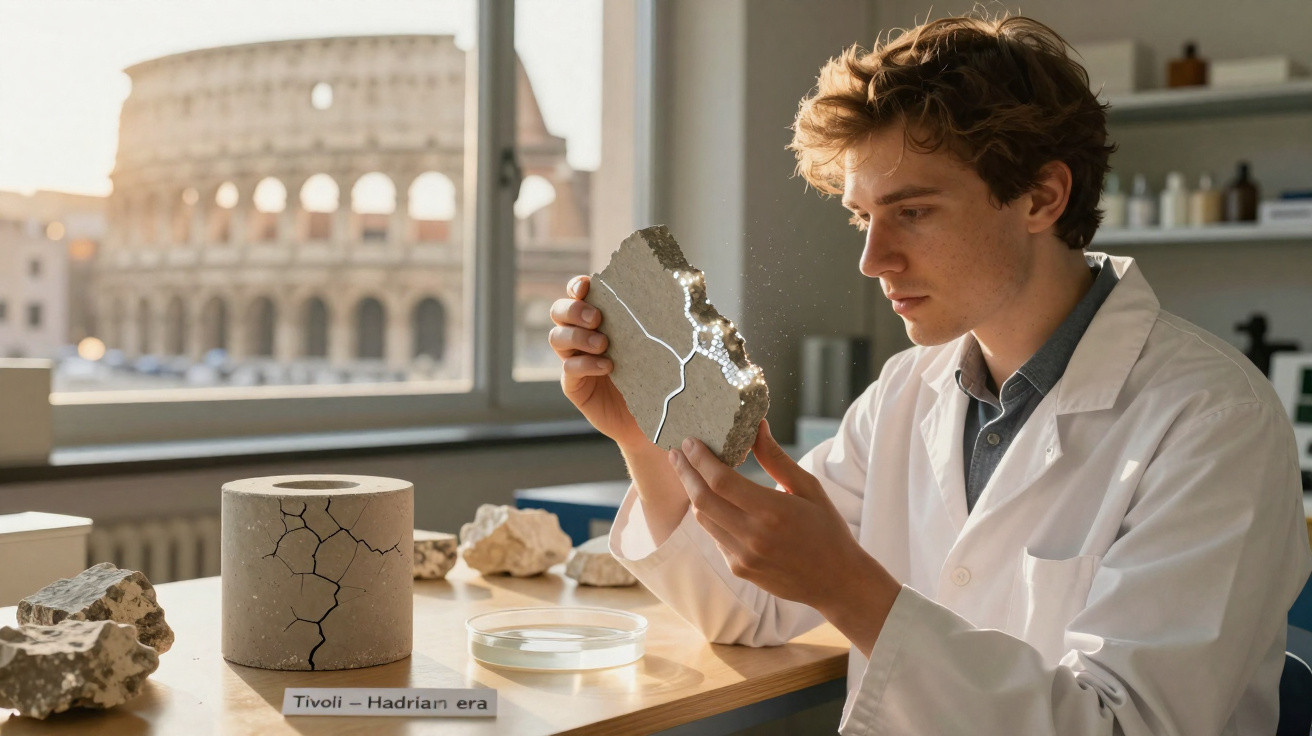
During the 2nd century CE, Emperor Hadrian maintained a villa in Tivoli, Italy, and much of it is still standing - as you might expect. The scientists removed a small concrete sample from a shared lavatory that had once borne the weight of imperial occupants.
Using an array of high-resolution imaging methods, they studied this sample at the nanoscale.
As anticipated, their analysis revealed the pozzolanic reaction, in which lime and volcanic ash combine to produce exceptionally durable minerals in the concrete.
It also revealed an additional process.
Carbonation strengthens Roman concrete
Across the centuries, carbon dioxide in the atmosphere had interacted with residual lime in the concrete, creating calcite - the mineral also present in limestone.
The researchers determined that this was not simply an incidental result of ageing.
Instead, calcite seems to have reinforced the concrete. It formed crystals in minute pores and fractures, increasing the material’s density and progressively closing flaws that might otherwise have enlarged with time.
Previous research had found calcite in Roman concrete, but it had neither examined the mineral in three dimensions nor charted its structure.
According to the team, calcite may therefore have had an underappreciated part in the exceptional lifespan of Roman concrete. It does not supersede the established role of the pozzolanic reaction, but appears to act in combination with it.
Scientists were already attempting to recreate Roman concrete. Carbonation occurs naturally in lime-based concrete regardless of whether it is recognised, but knowing how it functions could offer researchers another means of developing concrete that is more durable and produces less carbon.
"Understanding how calcium carbonate crystallization dynamics bind concrete together and contribute to its long-term durability could provide new insights into the long-term mineralogical evolution and natural carbonation of lime-based binders," Monteiro says.
Sustainable concrete for modern construction
From the imposing Pantheon to Hadrian’s modest lavatory, ancient Roman structures provide astonishing evidence of concrete that has stayed structurally sound for thousands of years.
This does not mean that construction can simply return to Roman methods.
Today’s buildings impose substantially greater demands on their materials, while reinforced concrete must overcome an issue Roman engineers did not face: corrosion affecting the steel rebar contained within it.
Rather, the latest results may support researchers working to create longer-lasting, more sustainable concrete for the future.
"This study shows how exploring ancient engineering techniques can lead to important revelations," Monteiro says.
"We hope that by unlocking Roman secrets for enhancing concrete durability, we can someday attain sustainable modern infrastructure development."
The study was published in Science Advances.
This article was fact-checked by Rachel Garner and edited by Clare Watson. Although we take pride in our process, we are only human. If you notice an error, please let us know.



Comments
No comments yet. Be the first to comment!
Leave a Comment