
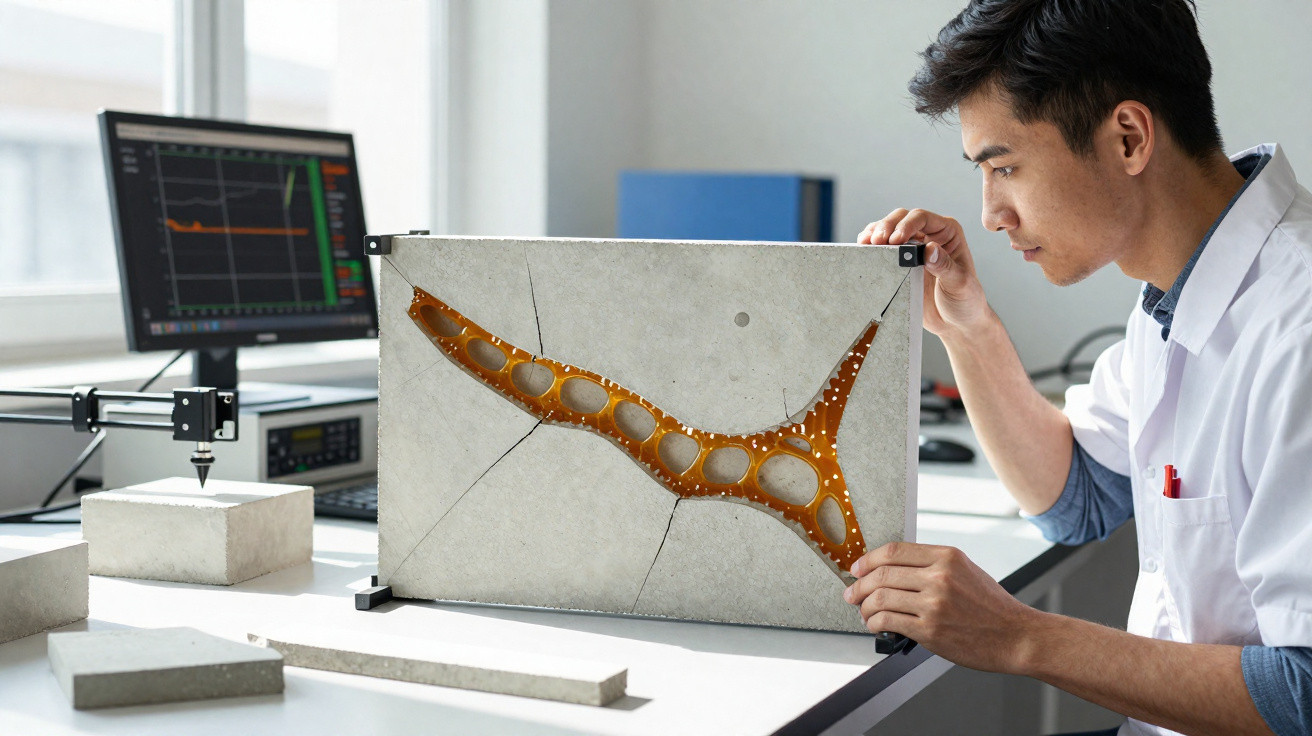
Embedding a polymer grid during the printing process has turned 3D-printed concrete into a material able to support 41% higher loads and flex 552% further before it fails.
This development moves the technology beyond brittle showcase components towards structural parts that can take up stress rather than fracture.
Strength during printing
Rather than being laid on top after printing, the flexible mesh was positioned between adjoining layers beneath the weight of fresh concrete.
At the University of South Australia (UniSA), researchers adapted a printer so reinforcement became an integrated part of its print route.
The system fed the mesh through a second nozzle immediately behind the concrete nozzle, which pushed it into position as each layer was deposited.
However, incorporating reinforcement during printing introduced a more difficult compromise: tougher plates could still have less robust layer joints.
Why printed concrete fails
When a crack forms, unreinforced printed concrete tends to fail suddenly, as its layered structure offers little resistance across the opening.
Steel reinforcement addresses this problem in conventional concrete, but reinforcing bars are difficult to incorporate into an active print and may corrode over time.
Flexible fibre-reinforced polymer-a plastic composite reinforced with fibres-does not rust and can pass through printing machinery more readily.
Despite these benefits, dependable reinforcement has remained an unresolved challenge for printed concrete.
Tailoring the concrete mix
The plates did not use a single concrete mix throughout; instead, they were made with functionally graded concrete, in which separate layers use mixes suited to different purposes.
The bottom layers, where bending forces are greatest, used a fibre-rich mix, while an upper slag-based, lower-carbon mix helped reduce emissions.
Previous tests by the same team found that adapting the mix between layers can cut carbon emissions without sacrificing bending performance.
In this arrangement, effective reinforcement became even more important because the surrounding concrete was already assigned a specific role.
From manual to automatic
Previous research using polymer grids had shown that 3D-printed concrete plates could gain considerable bending toughness.
Yet placing the grids by hand interrupted the process and undermined the aim of a fully automated build.
Passing the grid through the printer itself was important because faster construction offers limited value if workers need to halt the process to insert every strip.
Solving that limitation brought a downside, as automation also introduced fresh forms of internal layer damage.
What the plates did
Once bending began, the key difference was how long reinforced plates continued to bear load after cracking.
Two of the strongest arrangements achieved almost identical near-failure performance, although one used only half as much grid.
Several reinforced specimens continued to build resistance even after the initial crack appeared, rather than declining straight away.
While plain plates fractured abruptly, reinforced versions provided additional time before failure-a crucial requirement for structural safety.
Where layers turned weak
Problems emerged at the interfaces between printed layers, since the grid reduced the area where fresh concrete came into contact with fresh concrete.
Across the mixes, splitting tests found that grid-containing seams lost 43.6%, 33.1%, and 35.5% of their pull-apart strength.
A delay between dissimilar layers could also dry the surface and create a cold joint, meaning a weak seam caused by delayed bonding.
Strong layer-to-layer adhesion is essential, because reinforcement can only distribute stress effectively when neighbouring layers remain bonded rather than separating.
Pores steered the cracks
Scans of the printed layers revealed increased porosity-the volume of empty space within a material-once the grid had been added.
Reinforced samples had substantially more pores larger than 1.016 mm, with these voids extending in the direction of printing.
The larger spaces redirected cracks upwards and sideways, helping to account for the more irregular fracture routes observed along reinforced layer seams.
When these weak areas aligned, failure took the path of least resistance through them instead of distributing damage more uniformly.
Bond slip ruled failure
Pull-out testing confirmed that the grid adhered to the concrete, although the bond remained limited and the strands began slipping.
Of the concretes examined, the fibre-rich mix provided the strongest hold, whereas the blended and lower-carbon mixes allowed the reinforcement to slip earlier.
Slip along the grid-concrete bond focused deformation at one primary crack, since stress no longer travelled far enough to initiate numerous smaller cracks.
Wider strips delivered unexpectedly strong results, indicating that future designs may benefit more from improved geometry than from merely adding more material.
Why the idea matters
By integrating reinforcement directly into the print, the approach could enable construction components requiring fewer interruptions and less manual labour.
A UniSA project supported by a $402,221 Australian Research Council grant set out to print reinforcement from the outset.
“This is the first research project in the world to see if it’s possible to simultaneously print fibro reinforced polymer along with concrete,” said Prof. Yan Zhuge, structural engineer at UniSA.
Although the new paper does not complete that goal, it demonstrates that the concept now functions in hardware rather than only in sketches.
What comes next
Reinforcing concrete as it is printed now appears feasible, with the benefits for bending resistance clearly demonstrated.
Before larger structures can be relied upon, researchers must improve bonding between layers and develop reinforcement that crosses layers rather than merely sitting between them.






Comments
No comments yet. Be the first to comment!
Leave a Comment