
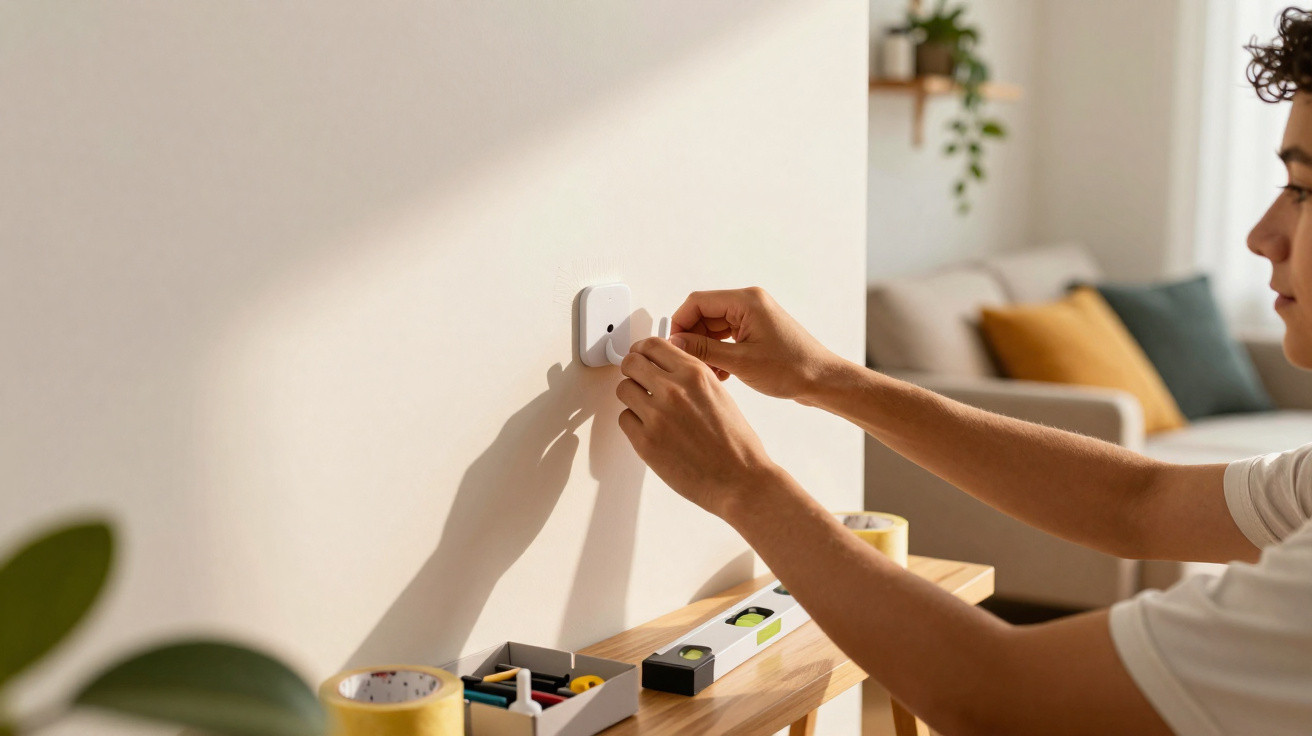
Fitting a wall hook is usually straightforward, yet minor mistakes can cause it to come loose the first time it is used. In many situations, it can be secured using only a household trick and a few readily available materials, without relying on a drill or specialist tools. The key is to identify the wall type, select the right hook and strengthen the fixing point so that it can safely hold weight in places such as bedrooms, kitchens, bathrooms and utility rooms.
How can you install a wall hook with a household trick?
Installing a wall hook with a household trick can work on masonry and plasterboard surfaces, provided the weight limit is observed. One widely used method involves filling the hole with a material that sets hard and forms a solid base for the screw, such as filler, white glue mixed with plaster powder, or small wooden sticks.
First, establish whether the wall is brick, concrete or plasterboard, avoiding areas that are weak or excessively damp. Next, make a small starter hole with a nail, screwdriver or another pointed object, only deep enough for the screw to fit. The household trick is then applied by filling the space around the hole, increasing friction against the metal.
- Mark the position where the hook will be fitted.
- Make a small starter hole without widening the opening too much.
- Put the household reinforcement material, such as filler, the mixture or wooden sticks, into the hole.
- Insert the hook screw while the reinforcement is still wet, tightening it until secure.
- Allow it to dry for the required time before hanging anything from it.
Watch a video on the YouTube channel Let’s Evandro about the types of modern fixing hooks and how to apply them to smooth surfaces so they can hold weight without coming unstuck over time:
https://www.youtube.com/watch?v=X2mB_7V9_kI
Which wall hook type is best for each use?
The hook selected directly affects both its load capacity and the security of the fixing, particularly on walls that are already weakened. There are self-adhesive models, screw-in hooks, “J” hooks, double holders and retractable designs, each suited to particular rooms and weights, including towels, keys and pans.
On smooth ceramic or tiled walls, high-strength double-sided adhesive hooks work well for lightweight items, as long as the surface is clean and dry. For heavier objects, including backpacks, metal utensils or tools, metal screw-in hooks remain the best choice, often used with wall plugs or household reinforcement.
- Adhesive hooks: suitable for light weights and smooth surfaces.
- Screw-in hooks: recommended for medium and heavy loads.
- Folding hooks: useful in compact spaces because they can be folded away.
- Multiple holders: suitable for organising several items in one place.
What mistakes cause a wall hook to come loose under weight?
Certain common errors can make a hook give way during its first few uses, especially if the wall is fragile or very damp. One of the main issues is failing to assess the wall type and fixing directly into the plaster finish without a wall plug or reinforcement, which can lead to cracks, crumbling and holes that widen over time.
It is also common to use a screw that is too thin for a wide hole, reducing friction and making it easier for the hook to turn or pull free. In constantly humid areas, such as inside a shower enclosure, unsuitable materials quickly lose their grip. On hollow walls such as plasterboard, fixing only into the board without a suitable wall plug concentrates the load on a weak point and can cause tearing.
- Check the weight capacity stated by the hook manufacturer.
- Use wall plugs suitable for the wall type, whether masonry, plasterboard or hollow block.
- Use the household trick only as additional reinforcement, never as a replacement for structural fixings.
- Do not hang weights greater than those intended for that fixing point.
- Check regularly that the hook remains secure and that there are no cracks around it.
Is installing a wall hook without a drill genuinely safe?
Installing a wall hook without a drill can be safe for simple household purposes, such as hanging towels, keys, aprons or small utensils. This approach reduces noise and dust, while avoiding the need for power tools, making it a practical option for people living in flats or with little DIY experience.
However, this technique is not a substitute for robust anchors in situations requiring high load capacity, such as bicycle brackets, deep shelves or heavy plant pots. When the procedure takes account of the wall type, the correct hook choice and properly applied reinforcement, the fixing is more likely to last longer, making the household trick a useful everyday tip.


Comments
No comments yet. Be the first to comment!
Leave a Comment