
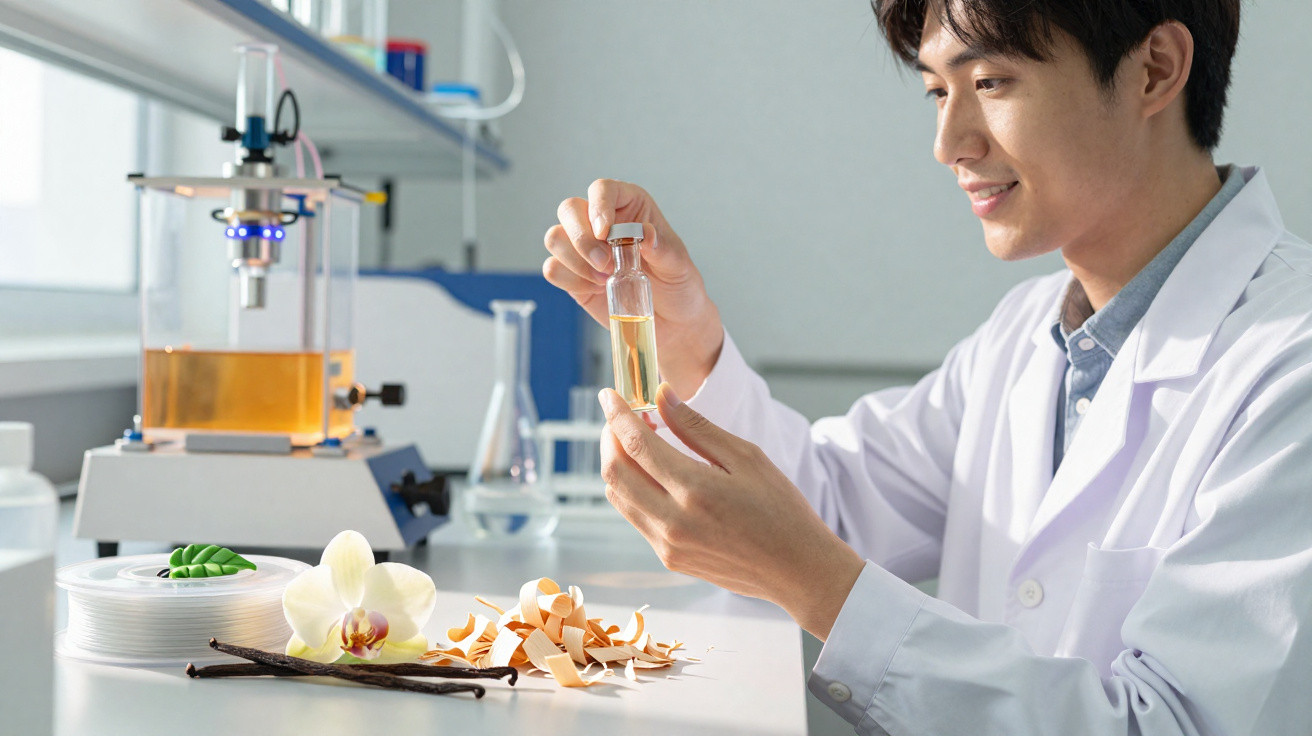
Cheap vanilla and industrial plastic appear to belong to entirely separate worlds. One is used in ice cream and perfume, while the other is extruded into 3D-printing filament. Neither seems to have an obvious relationship with the wood-pulp waste accumulating at paper mills.
Chemistry has connected them. Processing one batch of wood waste in a light-driven reactor produced the flavour molecule, while the remaining material became an additive that strengthened plastic.
The lignin waste problem
Lignin, a robust polymer that helps trees remain upright, is found in every plant on Earth. It is the plant kingdom’s second most plentiful structural component after cellulose.
The paper industry removes lignin from wood in vast quantities and generally burns it afterwards. Roughly 50 million tonnes accumulate each year, with a review finding that only about 2% is used for anything more valuable than low-grade fuel.
Its chemistry is the obstacle. Lignin forms a complex, uneven network, and separating it into pure components has traditionally required high temperatures, high pressure and aggressive solvents. That energy-intensive process typically wipes out any potential profit.
A milder light-powered reactor
A group headed by Néstor Guijarro, a chemist at the University of Alicante (UA) in Spain, aimed to avoid the heat by making light carry out the difficult work.
Its reactor consists of a transparent tube filled with a photocatalyst, a material that takes in light and uses that energy to break chemical bonds. Lignin in solution passes through the tube beneath a lamp at room temperature and normal pressure.
By flowing the liquid over the catalyst instead of enclosing it in a batch reactor, the researchers could operate at gram scale. That marks a meaningful advance for an approach that is normally limited to test-tube quantities.
Breaking the right lignin bonds
Several types of chemical connection hold lignin together. One specific bridge is especially common, and breaking it precisely releases small, valuable molecules without fragmenting them.
The light-activated catalyst targeted that bridge almost exclusively, preserving the rest of the structure. When used with wood-derived lignin, it extracted vanillin, the molecule responsible for vanilla’s aroma and flavour, at around 7% by weight.
That yield is not particularly high. However, for vanillin obtained directly from raw lignin, it is close to the best results reported.
Previous light-based techniques made different molecules, meaning that vanillin had not previously been released so cleanly in this way.
Vanilla flavour from sawdust
The flavour aspect makes the research easy to relate to. Nearly all vanilla flavouring currently sold is synthetic, and much of it is made using a chemical extracted from petroleum. Only a small proportion originates from wood.
Chemists have spent years trying to obtain more vanillin from lignin because, as one paper explains, the polymer contains many of the necessary chemical rings. The challenge has been preserving those rings during the process.
This offers a greener production route. Vanillin produced in this manner could carry a “from wood” label rather than a petrochemical label, which may appeal to food and fragrance producers.
A dependable supply from waste material might also reduce the price volatility that affects natural vanilla.
A second use for lignin residue
Splitting lignin to obtain vanillin leaves behind substantial larger fragments: a sticky residue that most processes simply treat as waste. Guijarro’s group found another purpose for it.
The team mixed the fragments into polylactic acid, or PLA, a widely used bioplastic that is made into much of the world’s 3D-printing filament. PLA is inexpensive and compostable, but its stiffness and brittleness restrict its applications, according to a review.
As a plastic additive, the fragments made the material less rigid, increasing flexibility and toughness without damaging its printability.
The mixture also displayed shape memory: it could bend out of shape before returning when heated.
Using the entire molecule
The key distinction of the method is that it leaves almost nothing unused. Both the high-value flavour molecule and the larger residual material become products, rather than producing one useful output alongside a heap of waste.
Guijarro’s team completed the entire process at gram scale and obtained commercially plausible quantities of both the flavouring and the plastic additive. In a field that often remains at milligram scale, that is notable.
The light-driven process also addresses a gap. Other light-powered techniques generally produce a different family of chemicals, so a system designed to yield vanillin expands the range of materials that this chemistry can extract from wood.
What happens next
Until now, nobody had demonstrated a room-temperature, light-powered reactor that converts raw lignin into vanillin, or one that uses the leftovers in plastic at gram scale.
The research brings together two sides of a problem that are usually addressed independently.
If scaled up, it could give papermakers and biorefineries an incentive to recover lignin rather than burn it, transforming waste into two marketable products. That could change the economics that have left lignin underused for decades.
The method is already covered by a patent, suggesting that the researchers see potential beyond the laboratory.
It is still unclear whether vanilla flavouring or printed parts will eventually be made from wood waste at commercial scale, but the chemistry is now available.


Comments
No comments yet. Be the first to comment!
Leave a Comment