
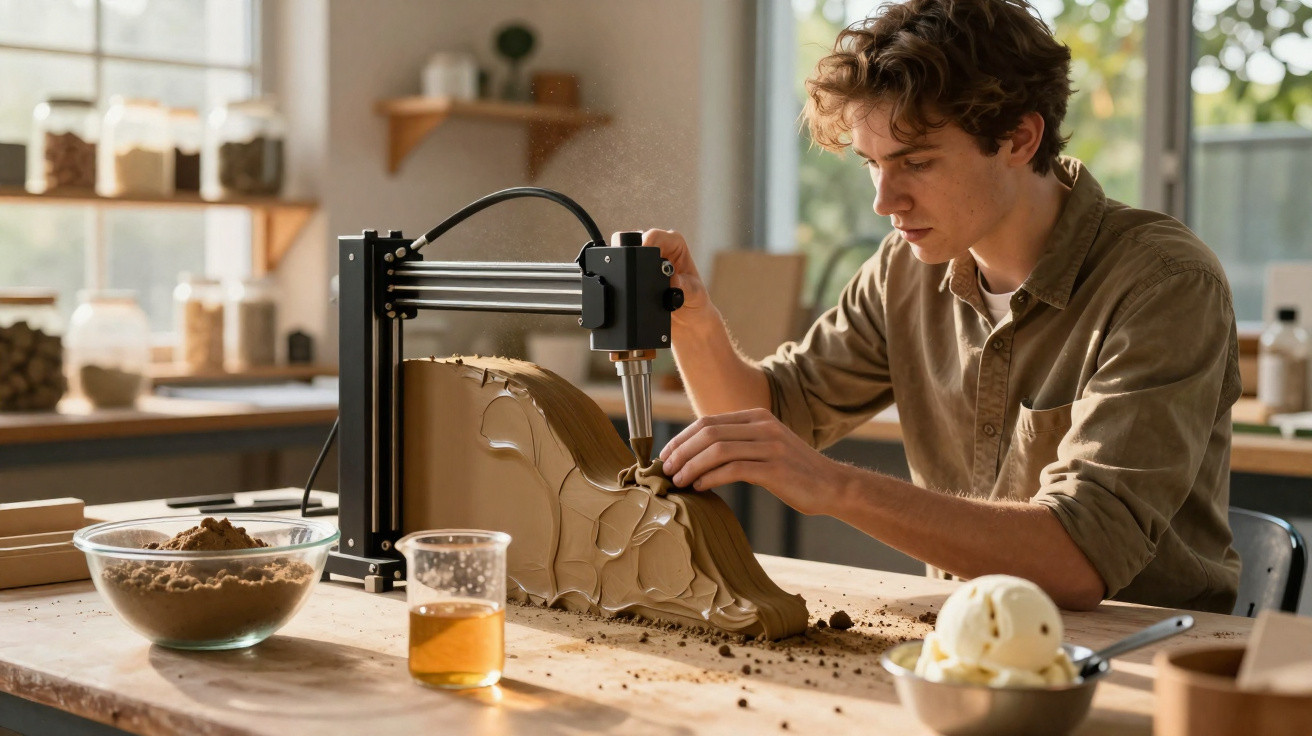
The biopolymer responsible for ice cream’s smooth, creamy consistency could soon enable builders to transform soil into walls.
A University of Colorado Boulder (UC Boulder)-led team has discovered that sodium alginate, a widely used food thickener, makes clay and sand much easier to form using a 3D printer.
The findings suggest a future in which construction waste can be repurposed as a building material with a far smaller environmental impact. Rather than being sent to landfill, locally sourced soil could be turned into walls.
Nature already has the formula
Termites construct towering mounds from loose earth. Wasps create intricate nests, while honeycomb worms form reef-like coastal walls.
Cement is not used by any of these natural builders. Instead, they use biopolymers - large biological molecules, often found in saliva, that act as a glue to join soil and clay into solid structures.
“From termite mounds to adobe buildings, humans and animals have been building with earth since the dawn of time,” said Wil Srubar, professor in the Department of Civil, Environmental and Architectural Engineering.
“But there hasn’t been a lot of science to how earthen builders design the materials. So, we wanted to use scientific knowledge and tools to understand it.”
A food additive moves into construction
Srubar’s team, which included researchers from Columbia University in New York, set out to identify a biopolymer capable of binding earth into walls while remaining suitable for printing.
They took inspiration from nature before putting the idea to the test in the laboratory.
The objective was straightforward in principle but difficult in practice: the material had to be sufficiently strong to retain its form, while also being smooth enough to pass through a narrow printer nozzle.
Five binders put to the test
In total, the researchers examined five biopolymers. Three were derived from legumes: guar gum, locust bean gum and cassia gum. These are the types of thickeners used in salad dressings to keep oil and water combined.
Sodium alginate comes from seaweed and is a familiar ice cream additive, helping to stabilise the food and create a creamier texture. Xanthan gum, another food-product binder, is produced by fermenting sugar.
Once combined with the clay and sand used for wall construction, every biopolymer performed differently.
Electrical charge improves 3D printing
Locust bean gum strongly held the earth together, joining soil particles into a more robust network. However, that same strong bond made the mixture resistant to being pushed through the printer.
Sodium alginate produced the reverse effect. Rather than behaving as a glue, it altered the electrical charges on clay particles, causing them to repel each other like two magnets with matching poles.
That subtle alteration was crucial. It kept the particles suspended in a stable mixture, yet allowed the material to flow readily from the nozzle.
Sand was not merely a filler
Engineers have long regarded sand as an inactive bulk material. The latest research indicates that it plays an active role in controlling the behaviour of the entire earthen mixture.
The charge on its surface affects both the way biopolymers bind and the movement of particles. As a result, sand becomes an important design tool rather than a secondary ingredient in the mix.
A small amount makes a major difference
The researchers next searched for the optimum quantity. They mixed only 0.12 percent sodium alginate into natural earth excavated from a granite quarry near Golden, Colorado.
The resulting material was durable as well as printable. Compared with untreated earth, it withstood 25 percent more pressure and printed 33 percent faster.
The formulation also reduced drying shrinkage by roughly three quarters. Reduced shrinkage means fewer cracks as a printed wall dries and sets.
Ice cream biopolymer supports tilted walls
To demonstrate the potential of the formulation, the team printed a wall around eight millimetres thick that projected outwards at steep angles. The structure remained upright even when tilted to 60 degrees.
This is a sharper angle than that of the Leaning Tower of Pisa. Although the present research focuses on printability, Srubar said the same method could be used to assess other biopolymers for improved strength and durability.
Earth helps keep homes comfortable
“There are some good indoor environmental benefits of having earth in a building,” said Samuel Armistead, a research associate in the Department of Civil, Environmental and Architectural Engineering.
“It can regulate indoor moisture and uptake air pollutants. It can also serve as a thermal insulator, keeping things cool in the summer and warm in the winter.”
These features mean earthen walls offer more than a strong outer structure. They can also help maintain stable indoor conditions as seasons change.
Construction waste gets a new use
Excavating foundations, basements and parking structures produces vast quantities of soil. Much of this material is ultimately discarded in landfill.
“Our study suggests that there are ways to reuse waste earth material onsite, and that could largely reduce the environmental footprint of construction,” Armistead said.
Ice cream science may help construct walls
Clay and sand are found in almost every place where people live. This allows builders to make use of materials already beneath their feet.
“Clay and sand are among the most abundant building materials on Earth,” Srubar said. “The science and engineering we’re developing can be applied almost anywhere in the world.”
The same framework may eventually inform other earth-building techniques, including rammed-earth walls and compressed earth blocks. Builders could soon form sustainable homes from the ground on which they stand.


Comments
No comments yet. Be the first to comment!
Leave a Comment