
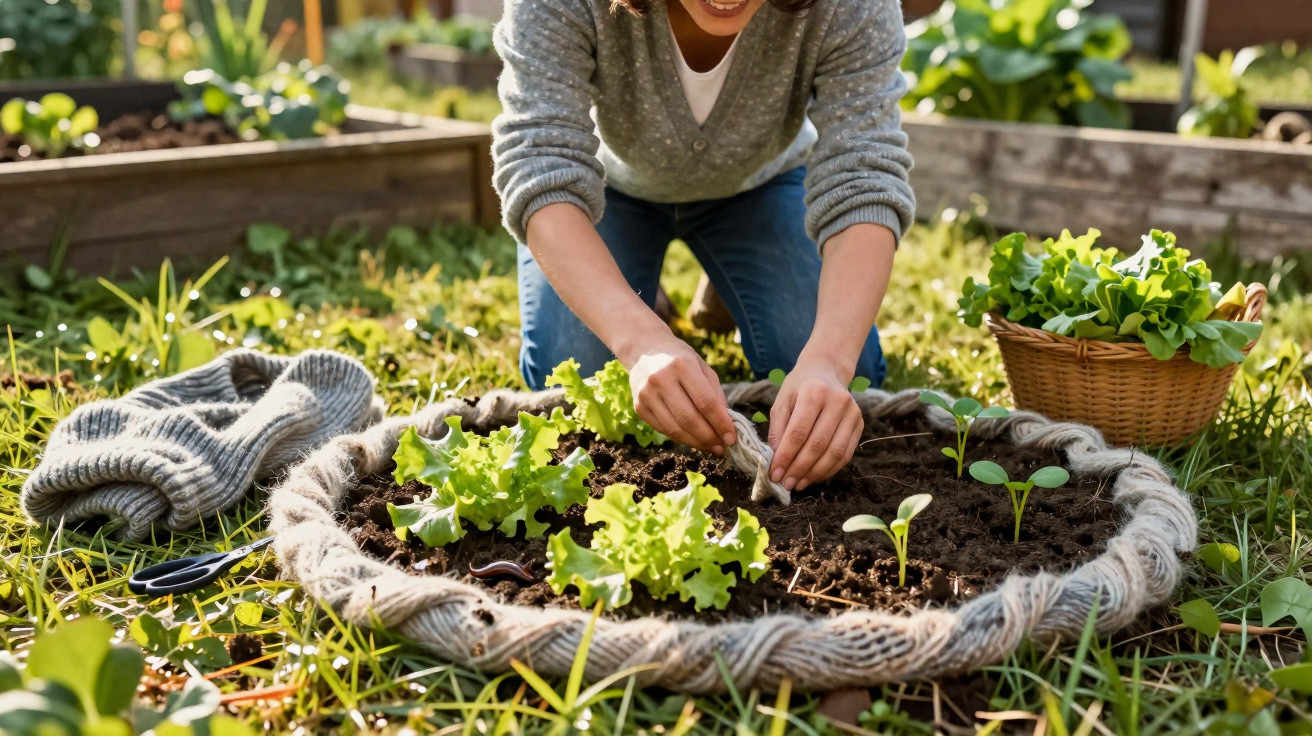
Many amateur gardeners know the familiar disaster: newly planted lettuces, young brassicas or delicate dahlias are in place one day, then reduced to a nibbled skeleton by the next morning. Rather than reaching immediately for poison or costly specialist products, the answer in this case comes from the laundry basket: old, damaged wool jumpers. It may sound like an eccentric gardening hack, but in practical use it proves to be a tough, sustainable barrier against hungry slugs.
Why wool stops slugs
Wool does not work as a chemical treatment; its effect is entirely mechanical. That is a major benefit for anyone wanting to avoid pesticides in their beds. The secret lies in the structure of its fibres.
Wool fibres have tiny scales and can absorb a remarkable amount of moisture – up to around 30 per cent of their own weight. Slugs travel on a film of slime that lubricates their movement. When this slime reaches the wool, the fibres effectively draw in its moisture.
“The slug loses its gliding film, gets stuck, needs more effort – and ideally simply turns around.”
Placed on the soil, wool strips therefore act like a kind of ‘light barbed wire’ for slugs: unpleasant and exhausting, yet entirely non-toxic and biodegradable. The barrier is harmless to plants, soil life and pets.
The golden rule: a continuous ring, not a patchwork barrier
One requirement is essential, otherwise even the best wool will achieve little: the protection must form a fully sealed circle. Any small gap can quickly become the ideal entry point for unwelcome slimy visitors.
In practice, the wool strip needs to create one unbroken ring around a plant or a small group of plants. There should be no gaps, interruptions or raised ends. The closer the wool sits against the ground, the more difficult it is for slugs to crawl underneath it.
Anyone who has used ash will recognise the principle: it too has to form a ring to provide protection. Ash, however, is extremely vulnerable to rain and watering. Wool has a clear advantage here, as it dries out again after a shower and remains scratchy.
Turning an old jumper into a long-lasting slug barrier
Choosing the right jumper
Not every knitted jumper is equally suitable. Its fibre content is what matters:
- At least 80% wool (virgin wool, merino, cashmere, alpaca and similar types)
- Little or no polyester, acrylic or other synthetic fibres
- Holey, felted or stretched garments are ideal – as long as they are genuine wool
Before cutting it up, check the label. The higher the wool content, the more effectively the fibres will deter slugs later on. There is no need to wash the jumper specially: its natural smell, including traces of lanolin, may cause further irritation to the animals.
Cut, fit and lay the strips
The garment becomes a garden tool in the next stage. Gardeners can take this practical approach:
- Unpick or remove large seams and very thick cuffs.
- Cut off all plastic or metal components, including buttons, zips and labels.
- Cut strips roughly 10 to 15 centimetres wide from the plain knitted sections.
The required length depends on the planting group. A single lettuce only needs a short strip, while the ring can be considerably larger for courgettes, squashes or dahlias.
Lay the wool directly on soil or mulch. Position the strip flat and close to the ground in a complete circle around the plant. This technique is particularly useful for:
- young courgette and squash plants
- dahlias, hostas and other slug magnets in ornamental gardens
- lettuces, spinach and tender brassicas in vegetable gardens
Simple anchors will stop the ring from moving: small stones, U-shaped bent wire, wooden sticks or metal pegs all work well. Add a fixing point roughly every 20 centimetres so that the strip is not shifted by the wind.
“A carefully laid wool collar can remain in the bed for six months or longer – including rain showers and summer storms.”
How does wool compare with ash and copper?
There are plenty of suggestions for dealing with slugs. Three options appear particularly often:
| Method | Advantages | Disadvantages |
|---|---|---|
| Wood ash | free if you have a fireplace; works well in dry conditions | washes away immediately in rain; needs constant replacement |
| Copper tape | tidy, durable and neat to install | comparatively expensive; requires precise fitting without ‘bridges’ |
| Wool strips | reuses old textiles; remains usable after rain; biodegradable | works only with a high wool content; the appearance will not suit everyone |
From an environmental perspective, wool performs especially well: there is no need to buy anything new when discarded clothing is already available. Ready-made wool tapes are sold commercially, but many amateur gardeners consider self-cut jumper strips equally effective. Over time, the fibres slowly rot down in the soil and even add organic material.
How long wool slug protection lasts and what gardeners should check
In normal garden conditions, a properly placed wool ring remains effective for an entire season. For example, where courgettes are planted in the middle of May, the barrier will often still be serviceable into autumn. The fibres become increasingly felted over time, which tends to strengthen the mechanical effect rather than weaken it.
Even so, it is worth checking the ring from time to time:
- after intensive hoeing or weeding in the bed
- after heavy rainfall that may have displaced the material
- if animals such as cats or birds have been digging in the garden
If the ring tears or gaps develop, simply lay additional strips or add to the existing ones. Individual plants can then be given a kind of ‘wool collar’ that can be adjusted flexibly as they grow and their spacing changes.
Limitations, risks and clever combinations
The method is not without limitations. In exceptionally wet summers, slug pressure increases so dramatically that particularly hungry individuals may test the barrier and possibly cross it. Very greasy, smooth and shiny wool blends are also less effective than rougher qualities.
If a garden is home to many hedgehogs, toads or runner ducks, arrange the barriers so these helpful animals can still access open areas. Wool is not a substitute for wildlife-friendly garden design; it merely complements it.
The approach works well as part of a broader set of measures, for example:
- wool rings directly around especially vulnerable plants
- broad mulched paths that create dry zones between beds
- shelters for toads and ground beetles that eat slugs
- targeted hand-picking in particularly at-risk areas during the evening
Why it is worth reaching for an old wool jumper
Many people hesitate to throw away clothes that are too holey for everyday wear but still seem too good for the bin. In the vegetable garden, such fabric gets a second life with a genuinely useful purpose. It slows slugs without spreading poison and without repeatedly buying new products – an appeal not only for environmentally minded gardeners, but also for anyone simply trying to save their harvest.
Anyone who has seen a strip of felted wool protect lettuces and courgettes for months will look at worn winter jumpers differently. Instead of going into a textile recycling bag, they can be placed straight in the bed as an unobtrusive but remarkably persistent slug barrier.





Comments
No comments yet. Be the first to comment!
Leave a Comment