
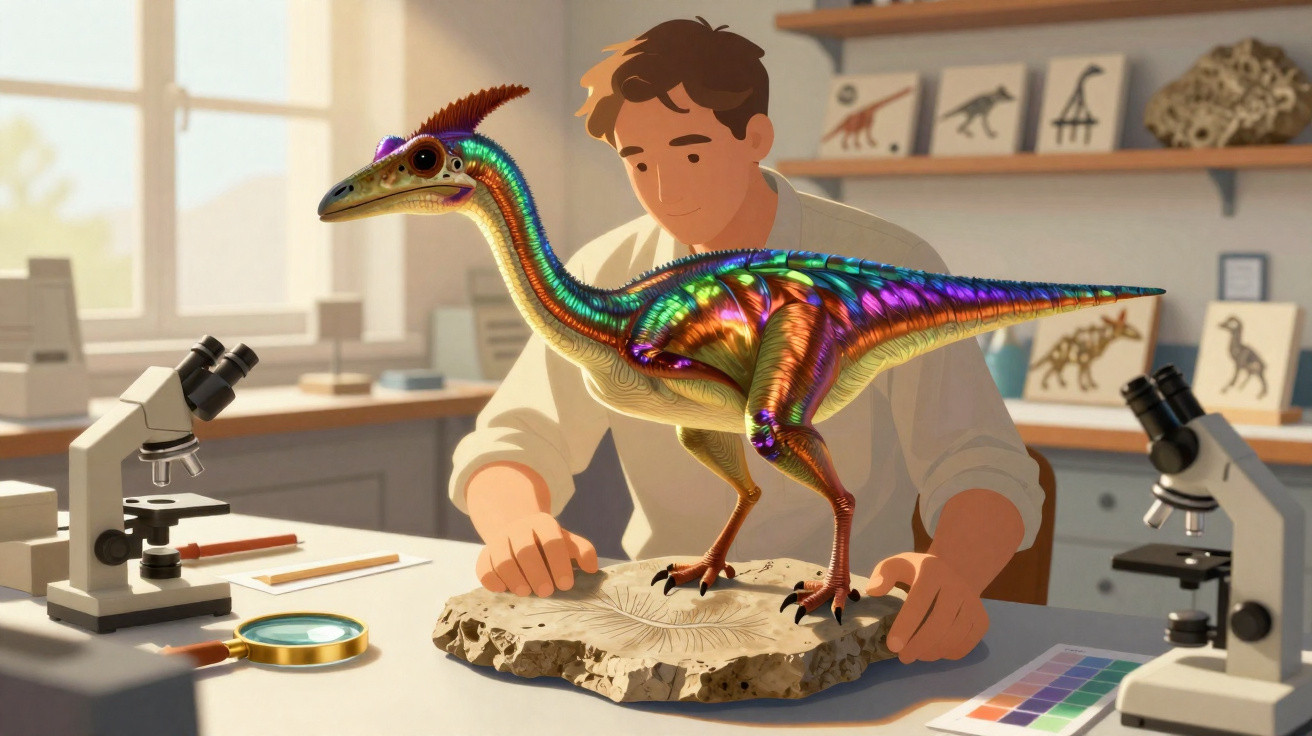
At least one pterosaur species appears to have had body coverings able to create glittering, iridescent colours, a new analysis suggests.
Those colours may have changed from green to magenta when viewed from different angles.
The research is available as a preprint on BioRxiv and has not yet undergone peer review, a process that could reveal further caveats and limitations.
Corwin Sullivan, a University of Alberta professor who was not involved in the research, discussed the results with Earth.com.
The study “makes a compelling case that iridescent structural color existed in the pycnofibers of the pterosaur Sinopterus dongi, features resembling simplified versions of bird feathers,” Professor Sullivan told Earth.com.
Iridescent appearance in some pterosaurs
Pterosaurs were flying reptiles that occupied the skies alongside dinosaurs.
Earlier studies of melanosomes - cellular organelles that contain melanin, the pigment responsible for colour - had already shown palaeontologists that certain feathered dinosaurs and early birds possessed iridescent plumage.
Scientists had established that pterosaurs were covered with hair-like filaments known as pycnofibres. What remained uncertain was whether pterosaur pycnofibres could generate similarly shimmering structural colours.
To explore the animal’s appearance, scientists from the China University of Geosciences studied an exceptionally well-preserved specimen of the tapejarid pterosaur Sinopterus dongi, from China’s Early Cretaceous Jehol Biota.
Using advanced imaging methods, the researchers assessed 16 fossilised pycnofibre filaments. Two of the 16 contained highly organised layers of rod-shaped, pigment-bearing melanosomes.
The researchers then ran computer simulations to assess how light would have interacted with these structures.
Contrasting pterosaur colour patterns
The models indicated that, according to viewing angle, colours could range from green and blue to deep magenta, with the shade changing as the angle shifted.
“What this preprint shows is that some of the melanosomes were arranged in regular arrays that would have caused the pycnofibrr to interact with light of particular wavelengths in ways that couldn’t be predicted from the pigment color alone, resulting in an iridescent appearance,” Sullivan explained.
The analysis further showed that skin preserved close to the animal’s head crest held striped concentrations of melanin. This suggests that the crest may also have displayed contrasting colour patterns.
Combined with iridescent body plumage, these findings suggest that certain Sinopterus individuals could have been far more visually showy than previously believed.
Iridescence as a social signal
“The iridescence would definitely have affected the coloration of the pterosaur, so it’s very plausible that iridescent pycnofibers played a role in courtship behaviour,” Sullivan told Earth.com.
He also considers it possible that producing strong iridescence served as a social signal of health and genetic quality, traits that may have been attractive in a mate.
“I would agree that courtship is the most obvious hypothesis here, but one can imagine other functions, which wouldn’t necessarily have been mutually exclusive with courtship,” he said.
In some living animals, particularly insects, iridescence is also thought to aid camouflage against particular backgrounds.
The palaeontologist noted that, if Sinopterus dongi was territorial, its iridescent colours may have helped it defend territory more easily.
This would be because signalling health and quality could have made the animals appear more formidable to others of their own species.
Detecting colour in fossils
However, Sullivan stressed that “the team looked at 16 monofilament pycnofibers, and found evidence for iridescent structural coloration in only two,”
He pointed out that it remains unclear whether just a small fraction of pycnofibres were iridescent when the animal was alive.
Alternatively, the melanosomes may have been too poorly preserved to establish whether structural colour had originally existed.
“The specimen discussed in the preprint is terrific in providing evidence of structural color in those two cases, and in providing other information about the anatomy of both the skeleton and the pycnofiber plumage, but it’s an incomplete, largely disarranged skeleton with soft tissue preserved here and there in patches,” Sullivan told Earth.com.
Limitations of the study
Professor Sullivan proposes that the pterosaur’s body may have been damaged and decayed before burial and fossilisation, with those processes potentially causing further distortion.
Other palaeontology specialists were also doubtful about the reliability of the findings.
One expert in the field said the research presumes that microscopic structures within the fossil have been retained almost exactly as they were during the animal’s life.
Yet 120 million years of burial, pressure and chemical alteration may have displaced or changed those structures.
If they are no longer arranged as they originally were, the reconstructed shimmering colours may be less dependable than the authors indicate.
The study has been published on BioRxiv.





Comments
No comments yet. Be the first to comment!
Leave a Comment