
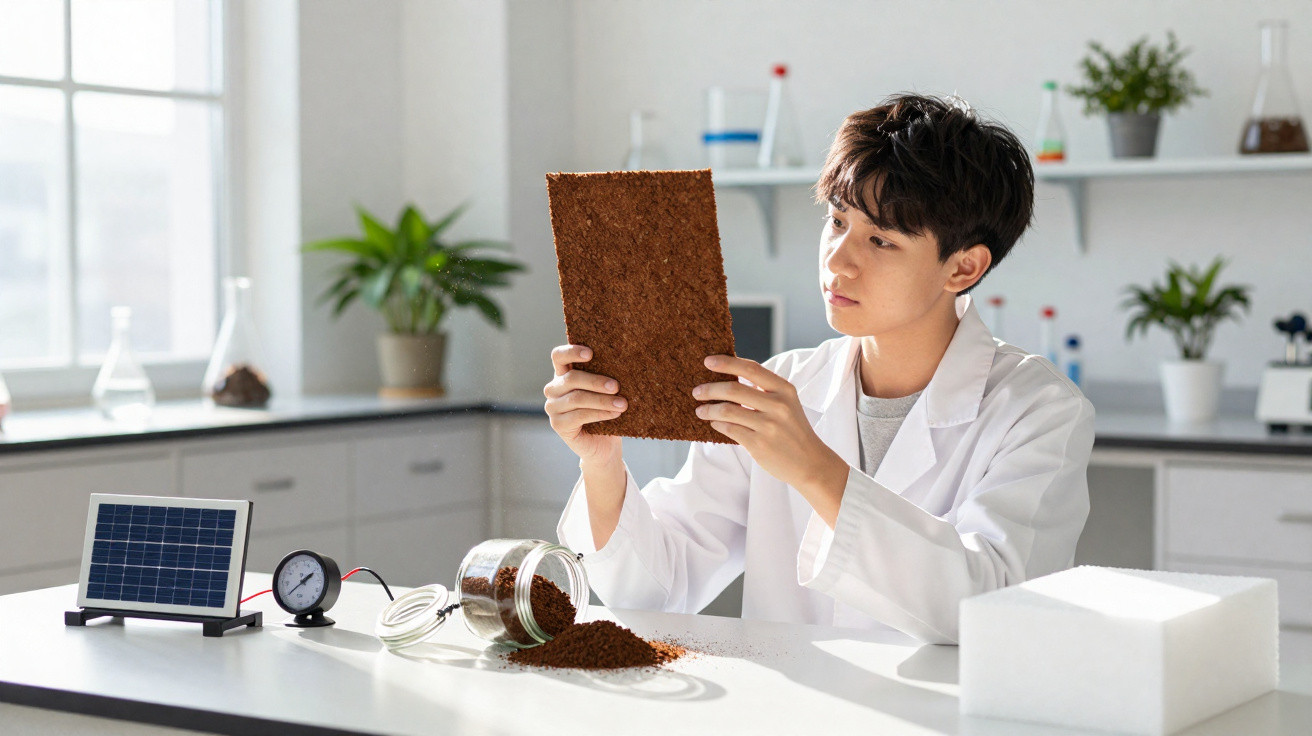
Scientists in South Korea have identified an inventive use for old coffee grounds: insulation.
A research team at Jeonbuk National University (JBNU) transformed coffee waste into a material that insulates as effectively as products already used in construction.
Unlike conventional alternatives, the new material comes from renewable feedstocks rather than fossil fuels and is biodegradable at the end of its useful life.
“Coffee waste is produced on a massive scale worldwide, yet most of it ends up in landfills or is incinerated,” says Seong Yun Kim, materials engineer at JBNU.
“Our work shows that this abundant waste stream can be upcycled into a high-value material that performs as well as commercial insulation products while being far more sustainable.”
Worldwide, people consume roughly 2.25 billion cups of coffee each day, generating an enormous volume of used grounds. Most is either incinerated or sent to landfill, environmental outcomes no better than pouring it down the drain.
Researchers are instead increasingly uncovering practical uses for spent coffee grounds. Earlier studies have examined incorporating them into concrete and other paving products, using them to remove herbicides from the environment, and even obtaining potential drug compounds from the waste.
Coffee grounds as thermal insulation
For the new study, the JBNU researchers assessed the potential of coffee grounds as a thermal insulation material.
They began by oven-drying spent coffee grounds at 80°C for one week. The grounds were then heated at substantially higher temperatures to create biochar, a carbon-rich material.
The biochar was subsequently treated using environmentally friendly solvents - water, ethanol and propylene glycol - before being combined with ethyl cellulose, a natural polymer. Lastly, the powdered blend was pressed and heated to form a composite material.
The polymer provides stability to the biochar, while the solvents stop the polymer from blocking the material’s pores. These pores are crucial because they hold air, which is highly effective at insulating against heat.
Thermal conductivity is measured in watts per metre per Kelvin: in essence, it indicates how much thermal energy, in watts, passes through a material of a given thickness, in metres, for the temperature difference, in Kelvin, across its two sides.
Materials with a conductivity of less than 0.07 watts per metre per Kelvin are usually classed as insulators. The best-performing coffee-based composite made by the JBNU team recorded a thermal conductivity of only 0.04 watts per metre per Kelvin.
Performance against commercial insulation
During laboratory testing, the scientists positioned several insulating materials, including their coffee-based composite, under a solar cell. They then measured the air temperature in a small chamber beneath the cell.
This small bench-top set-up modelled the way insulation prevents surplus heat radiated by solar panels from passing through roofs and warming homes.
The chamber containing the new material remained consistently cooler than the version without it.
Its performance matched that of expanded polystyrene, one of the most effective commercial insulation materials currently on the market.
However, polystyrene is a fossil-fuel-derived synthetic polymer, meaning that both its manufacture and its eventual disposal cause considerably greater environmental harm.
In biodegradability testing, the coffee-based composite lost over 10 percent of its mass in only three weeks. By comparison, polystyrene was virtually unchanged over the same period.
The team suggests the material may be particularly suited to building insulation, helping interiors remain cool while rooftop solar cells operate intensively.
“This approach not only improves material performance but also contributes to a circular economy,” says Kim.
“By turning waste into a functional product, we can reduce environmental burdens while creating new opportunities for sustainable materials.”
The study was published in the journal Biochar.




Comments
No comments yet. Be the first to comment!
Leave a Comment