
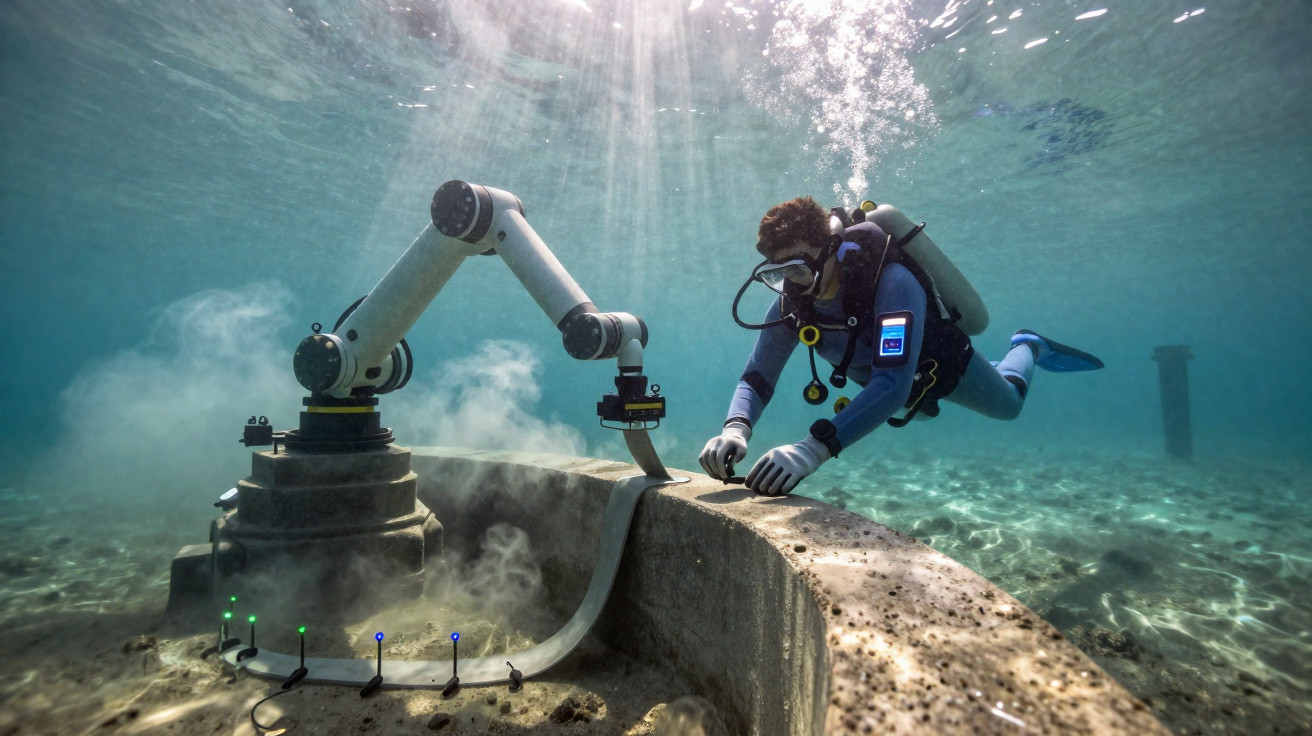
Repair work on underwater structures has traditionally been slow, costly and disruptive. To mend existing assets, teams frequently require substantial equipment, sealed work areas and extended project schedules.
Researchers have now identified an alternative method that could transform how construction tasks are carried out beneath the waterline.
A new study demonstrates that concrete can be 3D-printed underwater into stable forms, potentially enabling quicker and less disruptive repairs to ports, bridges and pipelines.
Testing underwater 3D concrete printing
In a submerged testing tank, the first printed arches retained their form as newly applied layers settled on top of one another.
Building on these initial trials, researchers at Cornell University demonstrated that the material could be placed underwater without dispersing into the surrounding water.
The advance followed the team’s adaptation of a large concrete-printing robot so it could operate while continuously submerged, rather than only in dry environments.
However, holding the form was only part of the challenge: each deposited layer also had to be placed accurately and bond sufficiently well to support genuine structural loads.
Why 3D printing underwater is hard
Water can damage uncured concrete at its most vulnerable stage, while the mixture remains soft and its particles have yet to bind together.
Engineers refer to this as washout, when water removes cement before it can set, and the deterioration may begin almost immediately after printing starts.
“When you add those chemicals, it makes your mixture really viscous, and you can’t pump,” said the study’s co-author, Dr. Sriramya Nair, an assistant professor of civil and environmental engineering at Cornell University.
A practical mix therefore needed to flow readily through hoses before rapidly becoming firm enough to prevent the stacked layers from separating or sagging.
Seafloor sediment changes everything
The Defense Advanced Research Projects Agency (DARPA) made the task more demanding by requiring a mixture composed largely of sediment from the seafloor.
This condition was intended to reduce transport needs and disruption, as locally sourced material could replace barge shipments otherwise needed at the location.
Treating the seabed as a source of raw material altered the scientific challenge, because factors including particle size, salinity and organic content influence print performance.
As a result, what appeared to be a supply-chain advantage became a design challenge, making an adaptable printer essential.
Control at the final moment
A recent paper outlined a two-stage printer that allows the mixture to remain pumpable inside the hose before altering it at the nozzle.
That control immediately before placement is important because underwater concrete requires conflicting properties: it must be easy to pump first, then quickly form a stable shape.
The team printed overhanging test pieces both in air and underwater, showing that on-demand adjustments could address difficulties that older systems had struggled to overcome.
This degree of control may explain why Cornell’s method could prove more scalable than relying on intensive chemical modification alone, and it naturally brings sensing into focus.
Sensors solve murky conditions
When sediment on the seabed is disturbed, visibility can disappear rapidly, turning a precise printing operation into guesswork in seconds.
Researchers call this loss of clarity turbidity: water laden with suspended particles that can conceal defects before they are detected from above.
A 2026 review concluded that underwater printing can work only if material behaviour and robotic control are developed as an integrated system.
For the Cornell team, this involved incorporating sensors into the robotic arm, allowing the machine to adjust its route without requiring divers to descend.
Where underwater printing fits
The potential applications are specific rather than theoretical, including pier foundations, damaged supports, seawall repairs and other difficult-to-access structures.
DARPA presents underwater printing as a means of repairing bridges and reinforcing coastlines directly where the work is needed.
For such projects, building in situ could eliminate cofferdams, barges and repeated lifting procedures, which often account for much of the programme duration.
Nevertheless, the most straightforward early applications are likely to be repairs and relatively small structures rather than vast tunnels or seafloor foundations.
Building directly underwater
On-site printing changes the equation by enabling crews to place only the quantity of material required, precisely where the design specifies.
A 2024 comparison showed that water penetration has a major effect on the bond between printed layers, making accurate placement vital.
“We want to be constructing without being disruptive,” said Dr. Nair, explaining the benefit of deploying a remotely operated vehicle rather than large work crews.
Her observation was practical rather than futuristic: reducing the amount of equipment above the water causes less disturbance at the site.
Limits of underwater printing
Conditions at sea are far more severe than those in test tanks, as currents, waves, pressure and uneven seabeds can all move a print away from ideal conditions.
A 2025 analysis found that concrete printed in seawater can come close to the strength achieved in air, although the behaviour of its layers still differs.
Durability over the long term also remains unresolved, because salt, abrasion and repeated loading could damage weak interfaces long after the printing process has finished.
Until these factors have been assessed beyond controlled tanks, underwater printing should be regarded as promising infrastructure technology rather than established construction practice.
How deadlines shape innovation
Cornell’s work progressed under a one-year, $1.4 million DARPA grant, while five competing teams pursued the same targets.
At the Bovay lab, researchers produced several underwater samples every week, using fast feedback cycles to refine the balance of chemistry, hardware and control.
Architecture, robotics, materials science and civil engineering all needed to progress together, or the entire system would cease to advance.
The tight timeframe creates both optimism and restraint: the technology is moving rapidly because failures are revealed early.
At the same time, Cornell has demonstrated not only that concrete can be printed underwater, but that material design and machine feedback can be coordinated in those conditions.
Should the next stages demonstrate durability in real marine settings, underwater 3D-printed concrete could develop from an ingenious demonstration into a standard tool for repairs.





Comments
No comments yet. Be the first to comment!
Leave a Comment