
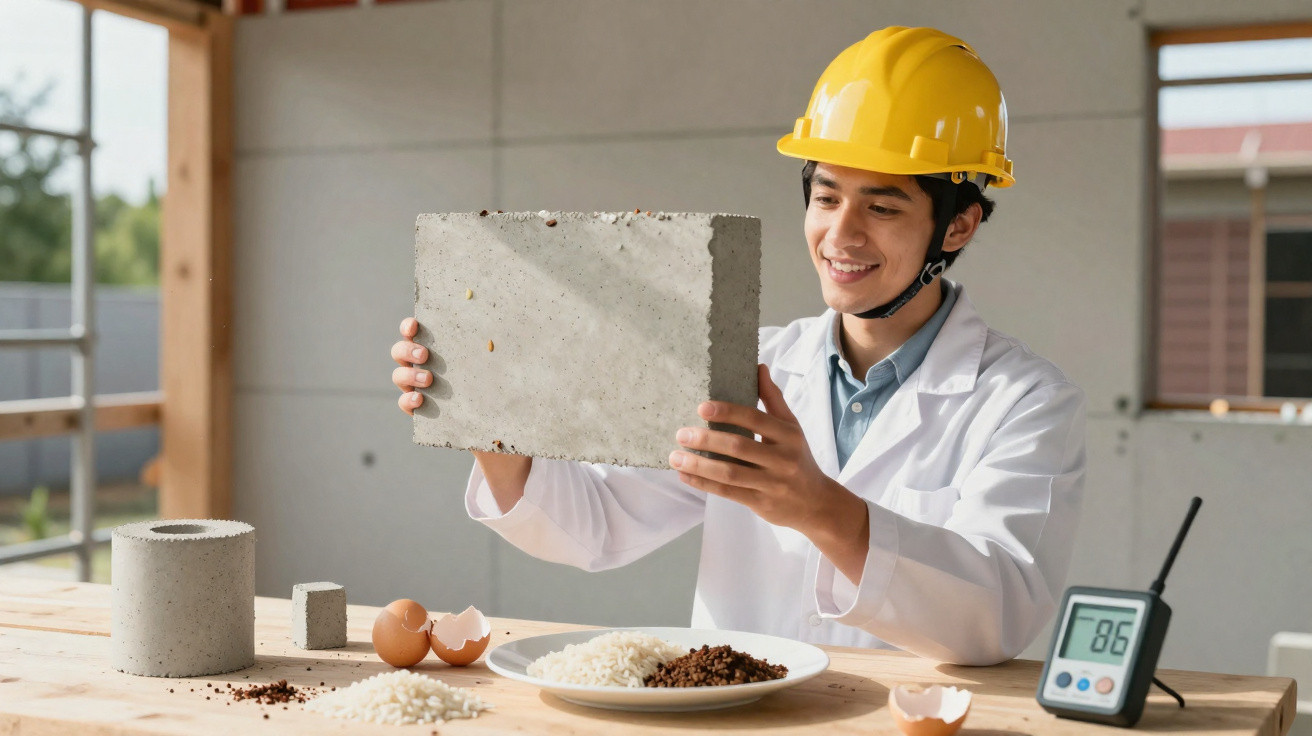
What has until now seemed entirely at home on the dinner plate could soon be found in walls, ceilings and façades. International research teams are testing an everyday food as an innovative construction material, with striking results for strength, the climate and costs. The concept may sound absurd at first, but the evidence behind it deserves serious attention.
From plate to wall: what is behind the hype?
The central principle is straightforward: certain foods contain fibres, proteins or starches that can reinforce building materials or even replace part of them. Their potential is being explored primarily in cement and concrete, but also in insulation products and interior fit-out boards.
Climate protection is one of the researchers’ main motivations. Conventional cement is among the world’s largest sources of CO₂ emissions. Replacing part of it with plant-based or organic components can substantially reduce its environmental footprint.
“Construction materials made from an everyday food could cut emissions – without changing residents’ comfort in any way.”
There is another advantage: many edible raw materials are inexpensive, frequently available as waste products and readily sourced locally. This reduces reliance on energy-intensive construction materials and global supply chains.
Why researchers are choosing an everyday food
The food product examined in many studies offers several benefits:
- a high proportion of stabilising fibres or starches
- effective binding properties when mixed with water and mineral ingredients
- widespread availability, with many already processed on an industrial scale
- components that arise as by-products, making them ideal low-cost raw materials
Laboratory trials indicate that these ingredients can be used to produce mixtures remarkably similar to conventional building materials. Some samples can withstand compressive and bending loads that would be entirely sufficient for residential construction.
How the everyday food product changes conventional concrete
Its use in cement-based materials is particularly promising. Researchers add selected components of the food product to cement in powdered or fibrous form. This can lead to:
- cracks developing more slowly or remaining smaller
- improved overall strength
- better moisture regulation
- a lower requirement for purely mineral cement content
A further benefit is that parts of this material alter the material’s microstructure. For engineers, this means less fatigue over time and, consequently, a longer service life for building components.
Eco-building material with a climate benefit
The construction sector is responsible for around eight per cent of global CO₂ emissions, with cement and concrete accounting for a major share. This is precisely where the research is focused.
When a building material delivers the same strength with less “conventional” cement, several benefits follow:
- Lower energy consumption during production
- Reduced emissions from cement manufacture
- Partial use of residual materials instead of primary raw materials
“What may appear to be a disposable or mass-market product can become a building block for more climate-friendly construction – in the literal sense.”
Rapidly expanding cities in Asia, Africa and Latin America, in particular, urgently need more affordable and sustainable solutions. A construction material based on a familiar food may initially seem less exotic there than high-tech materials developed in laboratories.
How safe is this construction material in practice?
The key question remains: can the material withstand the same loads as conventional concrete, bricks or boards? Initial test results have been surprisingly positive, although the research is still at an early stage of development.
Engineers are assessing the new material for:
- compressive strength under high loads
- resistance to moisture and frost
- fire performance and smoke production
- durability over decades
Fire safety is considered the most demanding test. A material derived from food must be treated sufficiently to ensure it is not flammable and does not release toxic substances in a fire. Laboratories and industry are addressing this through specialised coatings and combinations with mineral layers.
Durability and the risk of mould
Biological stability is another consideration. An edible starting material naturally raises the question of whether bacteria, fungi or insects could break it down.
To prevent this, manufacturers remove or chemically modify certain components before the granules or fibres are incorporated into the construction material. The finished product should retain only the structural performance of the original material, rather than its “food character”.
Practical applications: where the material could be used first
Even if this new construction material is not yet suitable for high-rise buildings, there are numerous areas where the innovation could be tested realistically:
- internal walls and partition walls in homes
- insulation boards and acoustic elements
- prefabricated components for tiny houses and modular buildings
- composite boards for furniture manufacture or shopfitting
The prospects are particularly favourable in precast factories, where production conditions can be controlled precisely. New mixtures can be tested at controlled temperatures before being supplied on a larger scale.
At the same time, pilot projects are under way in smaller structures, including public pavilions, school projects and university test houses. These allow researchers to gain practical experience of how the material responds to heat, frost, driving rain and extreme temperature fluctuations.
Economic opportunities for agriculture and industry
If the everyday food establishes itself as a credible construction material, it could reshape entire value chains. Farmers would no longer produce solely for the dinner table, but also for cement works and building-material manufacturers.
The use of residual materials is especially important. Skins, fibres, damaged goods and production surpluses are often more suitable as raw materials for construction materials than for direct consumption. This reduces food waste while creating new sources of income.
| Sector | Potential benefit |
|---|---|
| Agriculture | Additional buyers, less dependence on food prices |
| Building materials industry | Lower-cost raw materials, a greener image, lower CO₂ costs |
| Consumers | Potentially lower construction costs, improved energy performance of buildings |
Risks, unanswered questions and what this means for self-builders
As appealing as the idea sounds, it will not happen automatically. Several issues remain unresolved:
- How stable will prices remain if a food suddenly becomes a construction material?
- Is there a risk that farmland will shift from food production to building-material production?
- Which standards and approvals will the material require in Europe?
- How complex and costly will recycling be at the end of a building’s life?
Strict building regulations apply particularly in German-speaking countries. Before the new material can be used in a family’s detached home, it must pass testing and certification. Securing building-control approval is a process that takes several years.
For private self-builders, it could become an attractive option once the first certified products are available. These construction materials could reduce costs, particularly in insulation, interior fit-out and modular construction, while also offering the reassuring sense of building with less CO₂.
What non-specialists should understand by “food-based construction materials”
Anyone picturing a wall made from bread, cheese or muesli is, of course, mistaken. In practice, researchers do not use the food as a whole; instead, they separate it into its constituent parts. What remains is a technical raw material that looks more like conventional granules, flakes or powder.
Nothing of this origin is visible in the completed building. The components look like ordinary boards, bricks or blocks. Only the laboratory report still records where the material came from.
What is particularly intriguing is how profoundly this approach changes the way we view everyday food. What appears unremarkable on a supermarket shelf today could tomorrow form part of a new climate-friendly construction standard. Many researchers are already working to make further food components usable in similar ways and to combine them with recycled construction materials.
For construction practice over the coming decades, a trend is beginning to emerge: homes could increasingly be built from a blend of mineral components, residual materials and intelligently used food fibres. The journey from plate to wall no longer appears to be science fiction, but a realistic future scenario.





Comments
No comments yet. Be the first to comment!
Leave a Comment