
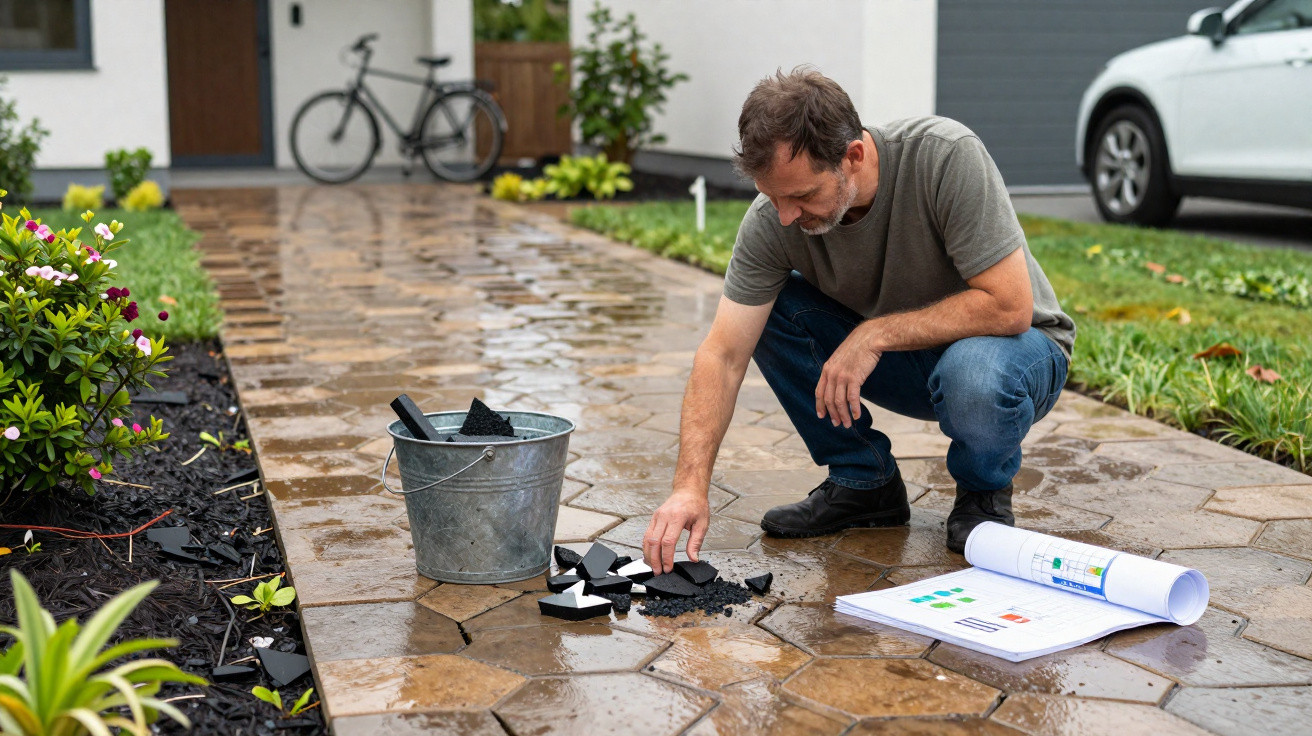
Many homeowners are now asking whether they really need to pour another heavy concrete slab. The climate crisis, tighter rules on sealed surfaces and cracked older driveways are drawing attention to an alternative: modern recycled asphalt mixes made from old roads, which have long proved themselves in professional use.
Why concrete driveways have become a problem
For years, concrete was seen as virtually indestructible, low-maintenance and simply the obvious choice outside detached homes. In reality, however, it often tells a different story: hairline cracks, sunken sections, puddles that remain for days, and a surface that becomes intensely hot in midsummer while tracking every mark of dirt into the hallway when it rains.
Cement lies at the heart of the issue. Its production requires raw materials to be fired at extremely high temperatures, usually using fossil fuels. Globally, this industry accounts for a noticeable share of greenhouse-gas emissions within the construction sector. Homeowners who improve their property's energy efficiency, install a heat pump and fit solar panels may understandably feel uneasy about leaving a large, impermeable concrete slab at the front of the house.
There are everyday technical drawbacks too. Concrete responds rigidly to movement in the ground. Frost, poor ground preparation or incorrectly installed expansion joints can quickly result in visible damage. Small repairs are conspicuous, while extensive refurbishment is costly.
The supposedly “unbreakable” concrete driveway often turns out to be an expensive, climate-damaging and inflexible solution.
Depending on the region and specification, a decorative concrete slab with an attractive finish can readily cost around €70 to €120 per square metre. By comparison, conventional asphalt surfacing generally falls within a range of roughly €30 to €70 per square metre, including installation.
Recycled asphalt: turning old roads into a new driveway
The most interesting alternative comes from a field that has traditionally been associated mainly with road construction. Old asphalt layers are not simply discarded; instead, they are milled off, crushed and used again. In technical terminology, this material is often called RAP (Reclaimed Asphalt Pavement).
At its core, RAP contains aggregates such as gravel and sand, which are processed with a binder-usually bitumen-to create a durable surface. The result is a dense, load-bearing finish that can comfortably withstand both cars and pedestrians.
Its key benefit is that reusing old road surfacing conserves raw materials, lowers energy and water consumption, and reduces transport distances because existing material remains within the region. This substantially cuts environmental impact compared with a completely newly produced surface.
Anyone replacing their driveway with recycled asphalt is effectively giving old road surfacing a “second chance” - with a significantly lower climate impact.
North American comparisons place a recycled-asphalt driveway at around $7.50 per square foot, or approximately €6.90. Concrete can cost up to $20 per square foot there. Broadly, this means a cost of just under one third to one half, depending on the specification.
RAP is said to last for 15 to 30 years. A high-quality concrete driveway may last around ten years longer. However, the balance shifts when repairs are needed: concrete is expensive and awkward to repair, whereas asphalt surfaces are far easier to renew in individual sections.
Permeable surfacing: when rainwater enters the ground rather than the drain
Alongside the CO₂ debate, another issue is gaining prominence: sealed ground surfaces. Many local authorities are placing strict limits on the number of square metres around a home that may be made completely impermeable. The reasons include overloaded drainage networks, local flooding and declining groundwater levels.
This is where permeable, or free-draining, surfaces come into play. They allow part of the rainwater to soak directly into the ground rather than sending it all into the drainage system. Technically, these are specialised asphalt mixes with more voids between the aggregate particles. Water can drain downwards through these pores.
Such surfaces usually cost 15 to 25 per cent more than conventional dense versions. In return, they support a better microclimate around the property, reduce puddling and ease pressure on the drainage network.
- conventional asphalt: dense, affordable, but fully sealing
- recycled asphalt: similarly durable, but considerably more resource-efficient
- permeable surfacing: allows water to soak away, reducing puddles and pressure on the drainage system
Plant-based binders: less petroleum in the ground
Traditionally, asphalt uses bitumen, a petroleum-based material, as its binder. Manufacturers are now developing mixes in which part of this bitumen is replaced by components of plant origin. These binders may, for example, be based on agricultural by-products.
Combined with recycled aggregates, they create mixes that can achieve a recycled content of 30 to 35 per cent while also reducing petroleum demand. This further lowers the CO₂ footprint per square metre.
These options are still slightly more expensive than standard products, but they are clearly aimed at private customers who want an environmentally conscious approach to designing their grounds and are prepared to spend a little more on a visibly “greener” surface.
How homeowners can plan a recycled surfacing project
Anyone wishing to replace an old concrete driveway should prepare the change carefully. Thorough groundwork is essential; otherwise, settlement and cracking can occur later, whatever material is chosen.
Specialist contractors experienced in recycled asphalt have a clear advantage here. Customer reports indicate that a large proportion of the firms approached had already worked specifically with these surfaces. This makes advice easier, especially where drainage questions or combinations with other types of paving are concerned.
Before signing a contract, it is worth examining three points closely:
- Recycled content: What percentage of the material genuinely comes from processed road surfacing?
- Layer thickness: What thickness is specified for the intended use, particularly for areas that will be driven over regularly?
- Water management: Will the surface be installed as permeable, and how will drainage work during heavy rainfall?
Asking specifically about recycled content, layer thickness and drainage avoids unpleasant surprises later - and makes quotes easier to compare.
Typical mistakes that cost money and patience
Many driveway problems arise not from the material itself, but from inadequate planning. Common pitfalls include:
- a sub-base that is too thin beneath the surface
- missing or incorrect falls, so water runs towards the house rather than away from it
- no clear separation between vehicle areas and footpaths
- turning radii that are too tight, which can lead to wheel ruts
Anyone cutting costs at this stage will pay twice later. A reputable contractor explains how the sub-base will be built, what gradient is planned and exactly how the surface will look-from aggregate grading to the connections at the front door, garage and garden path.
How environmentally friendly driveway surfacing performs in daily use
Many interested homeowners first ask about scratches, wheel ruts and cleaning requirements. Recycled asphalt is robust in everyday use, provided the construction is correct. Oil stains and fallen leaves can be treated much as they are on conventional surfaces: by applying sand, brushing carefully, and, if necessary, carrying out localised repairs.
One benefit that should not be underestimated is that the surface often appears slightly darker and more textured than a pale concrete slab. Minor marks and cracks are therefore less noticeable, giving the driveway a calmer visual appearance. Permeable versions reduce standing water, which lowers slipping risk and slows moss growth.
In high summer, black surfaces do become hotter than pale, cooler concrete. At the same time, they dry more quickly after a summer shower. Those seeking more moderate surface temperatures can counter this with lighter chippings in the surfacing or planted strips along the sides.
When switching to recycled asphalt is especially worthwhile
Changing to recycled, permeable surfacing is particularly suitable in the following situations:
- the old concrete slab is badly cracked or has sunk
- local authorities require sealed surfaces on private land to be reduced
- the grounds are to form a coherent overall concept as part of an energy-efficiency refurbishment
- the cost of a new concrete slab exceeds the available budget
Anyone who also considers heavy rainfall, groundwater recharge and summer heat soon realises that a driveway is far more than a parking space outside the front door. It affects the microclimate, drainage and, ultimately, the value of the property.
Terms such as “permeable asphalt”, “recycled content” and “plant-based binder” may initially sound technical, but they represent tangible effects: lower flood risk, a smaller CO₂ footprint and more economical use of raw materials. Homeowners who do a little research and compare quotes can make their driveway significantly more climate-friendly while keeping it practical for daily use-without having to invest in high-tech construction materials.


Comments
No comments yet. Be the first to comment!
Leave a Comment