
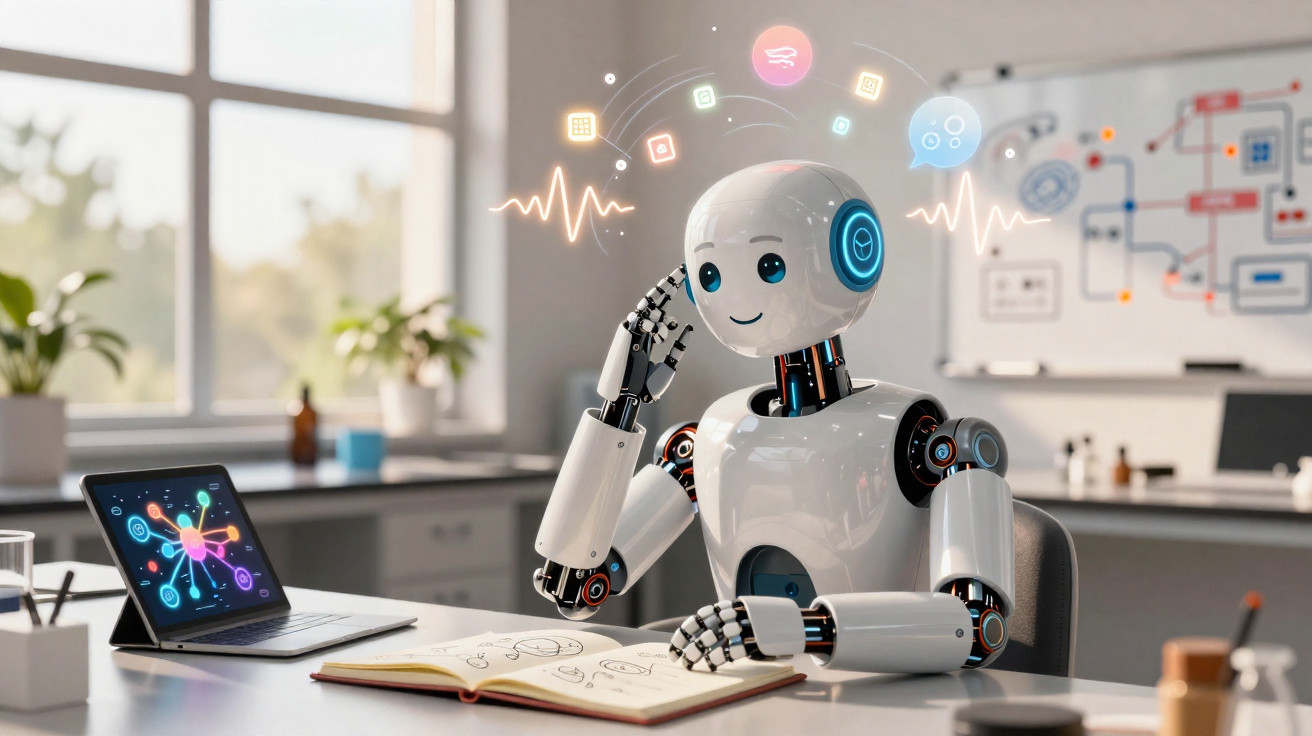
An artificial intelligence system acquired new tasks more consistently when it produced its own internal self-talk while working through problems.
This additional layer of private language altered the way the system transferred knowledge between problems, enabling it to adapt without further training.
Self-talk improves learning
The multitasking learning system made its greatest improvements when internal self-talk operated together with short-term memory during live problem solving.
At the Okinawa Institute of Science and Technology (OIST), Jeffrey Queisser showed that models which internally verbalised their goals remained focused when moving between tasks.
Rather than relearning procedures, the system preserved its performance on unfamiliar tasks by reusing operations it had already learned.
However, the gains in performance had definite boundaries, raising doubts about whether internal self-talk can scale as tasks become more complex.
The role of memory slots
People use working memory to retain instructions while working out what action to take next.
In OIST simulations, models equipped with two memory slots could keep task goals separate from pattern information while carrying out a task.
This division enabled the system to reverse sequences before recreating them, without blending steps from rival tasks.
A one-slot configuration was more likely to overwrite its own contents, imposing a limit on its ability to manage unfamiliar combinations.
Training with self-talk
In a fresh simulation, the system carried out memory exercises while producing brief self-directed statements during the task.
These statements served as inner speech: a silent form of self-talk that identified goals and allowed the network to pause before selecting its next action.
“By structuring training data in a way that teaches our system to talk to itself, we show that learning is shaped not only by the architecture of our AI systems, but by the interaction dynamics embedded within our training procedures,” said Queisser.
Repeating self-talk was particularly valuable for tasks with numerous stages, helping plans remain stable during multitasking.
Learning in AI systems
Many AI systems advance only after processing enormous datasets, leading researchers to seek less resource-intensive methods of learning.
Self-talk supplied the model with additional training signals, while the memory slots ensured that every task goal remained accessible throughout lengthy sequences.
Together, these elements enabled generalisation: applying earlier learning to new circumstances even where the training data remained limited.
Since the trials were restricted to controlled tasks, the method still requires validation in unpredictable environments such as real robots.
Stable goals, changing patterns
The system was built to learn and alternate between tasks, rather than to forecast words or conduct conversations.
Instead of processing huge text datasets, the model learned from structured tasks requiring goals to remain fixed while patterns changed.
Its internal language acted as a control signal, arranging actions and priorities instead of representing meaning.
This difference illustrates that flexible learning may result from structure and memory, not scale alone.
Layers handle different speeds
Within the network, distinct layers began to process different timescales, providing the system with an internal sense of sequence.
Rapid layers followed the shifting stream of patterns, whereas slower layers held the task goal constant from beginning to end.
This separation of timing allowed the memory modules to retain information without also having to manage control decisions.
If this internal rhythm did not emerge, the identical architecture lost its advantage and behaved more like a basic copier.
The system predicts and adjusts
The tasks used active inference, a control approach that revises predictions at every stage to reduce error.
At each stage, the system predicted the expected next event, then changed course if the result did not match.
The self-talk outputs returned to the system as new input, enabling the controller to reassess its goals during a run.
As the framework favours consistent predictions, unexpected events may demand swift revisions that could place pressure on the same memory resources.
Humans use self-talk too
A 2015 review followed inner speech from childhood into adulthood, connecting it with planning and self-control.
People frequently use silent self-talk to keep an objective in mind and to correct themselves when distractions arise.
Because inner speech can name emotions and decisions, it also aids emotional regulation and considered decision-making in everyday life.
The AI model adopted this concept only in a limited sense, and readers should not regard it as a mind.
Can robots use self-talk?
Domestic and agricultural machines must cope with changing instructions, slippery items and continual disruptions, meaning inflexible training can fail rapidly.
“By exploring phenomena like inner speech, and understanding the mechanisms of such processes, we gain fundamental new insights into human biology and behavior,” concluded Queisser.
Robots that learn in this manner might require fewer pre-programmed scripts, although engineers would still need to assess safety with care.
Combining self-talk with working memory gave the simulated learner authority over its own process, rather than merely over its final responses.
It remains unresolved whether this benefit will persist in noisier real-world environments – and in physical machines.






Comments
No comments yet. Be the first to comment!
Leave a Comment