
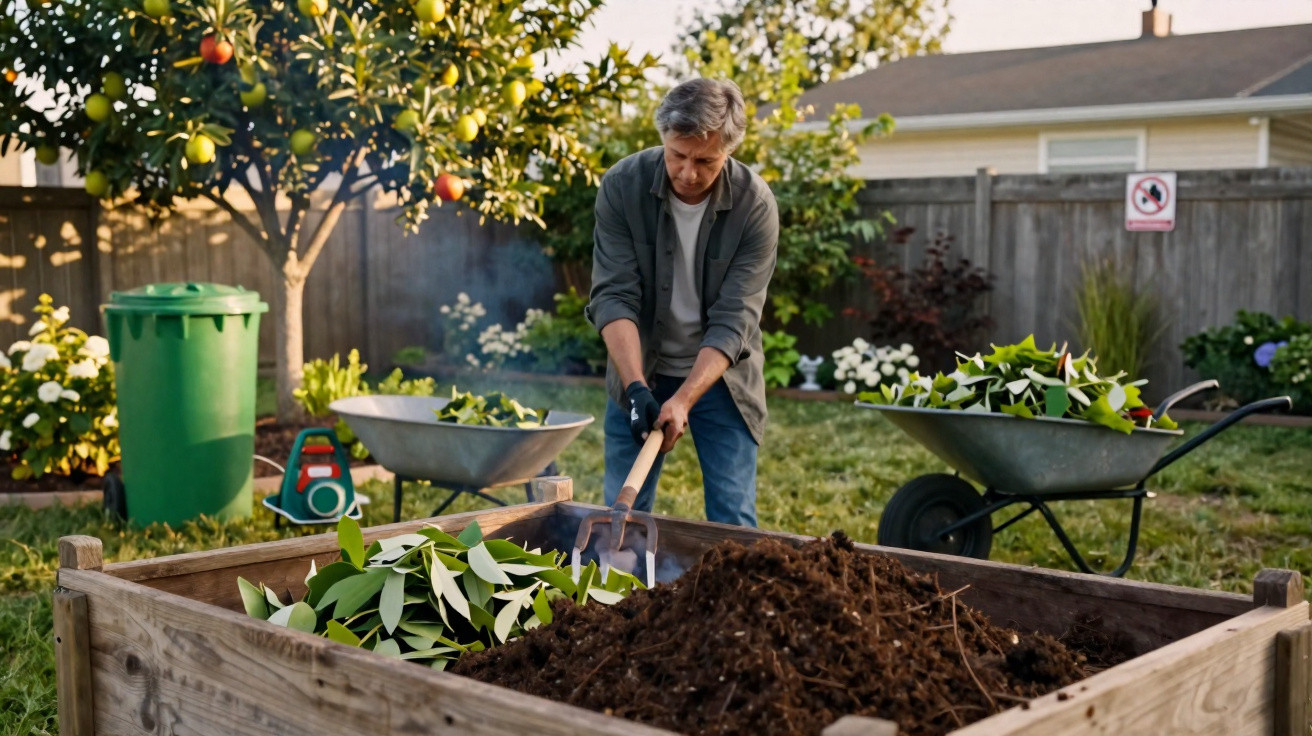
In many local authorities, a deadline expires at the end of March that has so far given gardeners some flexibility. Anyone acting without checking the rules now risks not only disputes with neighbours but also substantial fines. At the heart of the issue is an activity once seen as entirely routine but now regarded as a major source of air pollution.
What is no longer permitted in many gardens after 31 March
The key gardening task is burning leaves, branches and other green waste. Many districts and local authorities have limited exemptions: until 31 March, and in some places until mid-April, householders may still burn garden waste under controlled conditions on their own land. Once that period ends, however, it is prohibited under nationwide rules.
Legally, burning garden waste is generally prohibited in Germany; only local exemptions relax the ban for short periods.
The basis for this is the Circular Economy Act, which has required organic waste to remain within the material cycle since 2015. Burning conflicts with that principle because it destroys valuable resources and pollutes the air. For this reason, many councils now allow garden fires only during a narrow springtime window, if they allow them at all.
Why garden fires face increasingly tight restrictions
Garden fires can appear harmless: a few dry branches, a small pile of leaves, a quick burn, and the job is done. In practice, the situation is different. Burning damp or mixed green waste releases fine particulate matter, soot particles and nitrogen oxides. The smoke can quickly become a burden for allergy sufferers, children, older people and those with respiratory conditions.
There is also a factor that many people overlook: from a circular-economy perspective, garden waste is a valuable resource. Branches, leaves and grass cuttings contain nutrients that should return to the soil as compost, rather than being released into the air as smoke.
- Fine particles and smoke irritate the airways and may worsen asthma.
- The smell often drifts into neighbouring homes and causes arguments.
- Embers create a fire risk during dry conditions.
- Nutrients that are badly needed in garden soil are lost.
Each restriction is intended to achieve several aims: improved air quality, greater climate protection and more efficient use of organic waste. In densely built-up residential areas in particular, there is now little prospect of approval for open fires.
Mecklenburg-Vorpommern takes action – complete ban from 2029
The scale of this development is illustrated by Mecklenburg-Vorpommern. Agriculture Minister Till Backhaus has announced that burning garden waste will be banned completely from 1 January 2029. From then on, no exemptions will be available.
From 2029, the rule in Mecklenburg-Vorpommern will be: garden fires involving leaves and green waste are prohibited – regardless of the season or quantity.
The move is justified by the need to protect air quality and the climate, as well as to align with federal waste law. Open fires in private gardens no longer fit modern approaches to waste prevention and recycling. Other federal states are considering similar measures, although most currently retain time-limited exemptions.
How federal states and local authorities regulate garden fires differently
Although the legal framework applies nationwide, the precise rules are set by federal states, districts and local authorities. As a result, the regulations vary considerably. Here is a broad overview:
| Region / example | Current practice | Direction of travel |
|---|---|---|
| Saxony-Anhalt | Still permitted in many local authorities until 31 March, then prohibited | Increasing restrictions and more inspections |
| Mecklenburg-Vorpommern | Some exemptions still apply in certain areas, but a full ban begins in 2029 | A clear tightening of rules is planned |
| Urban areas, such as large cities | Often already subject to complete bans with no exemptions | Strict approach, focused on food-waste bins and recycling centres |
| Rural districts | In some cases, springtime periods run until 31 March or 15 April | Exemptions are being shortened or removed entirely |
Anyone intending to light a garden fire before the deadline should not rely on neighbourhood hearsay. The decisive factor is always the by-law of their own local authority or district.
How gardeners can check the current rules
The public order office or the local authority website is the most important source of information. These will either state outright bans or provide specific regulations on open fires. Common wording includes “burning plant waste outdoors” or “small traditional fires”.
- Search the local authority website for “garden waste” or “burning”.
- Call the public order office if the information is unclear.
- Check the dates carefully: many rules end on 31 March.
- Establish whether permission is required: in some areas, every fire pile needs individual authorisation.
Those who disregard the rules breach waste legislation and local by-laws. The consequences include fines, with higher penalties possible for repeat offences. Neighbour complaints are also common, especially in densely built-up areas where fires are a reliable trigger for conflict.
What can happen if burning continues after the deadline
A longer period in which fires are permitted may sound appealing, but the situation becomes risky once the deadline has passed. Even a small pile of dry leaves can create a legal issue if it is set alight without authorisation.
Anyone who continues to burn garden waste after the cut-off date risks substantial fines and, in serious cases, call-outs for the fire brigade and police.
The exact level of penalties differs by region, but three-figure sums are realistic in many federal states. If a fire gets out of control or causes harm to people’s health, compensation claims may also arise.
An emergency call from angry neighbours rarely has no consequences either. Even where the fire brigade only checks the site and then leaves, the person responsible may be charged for the deployment in some regions.
Legal alternatives: where should leaves and green waste go?
Giving up a garden fire initially creates a practical question: where should all that material go? The good news is that several lawful options are available, and they are often more useful than a quick blaze.
Composting in your own garden
The most obvious answer is a compost heap or compost bin in the garden. Leaves, grass cuttings, small twigs and perennial cuttings are all well suited to composting. With a little basic knowledge, they can become valuable humus for beds and lawns within a few months.
- Mix leaves with coarser material to prevent the heap from becoming slimy.
- Cut up or shred thick branches first.
- Add a little soil or mature compost from time to time to encourage micro-organisms.
Those without room for a large heap can choose enclosed composters or modern thermal composters. They speed up the process and keep odours contained.
Food-waste bins, recycling centres and composting facilities
Many local authorities provide separate food-waste bins for organic garden material. Larger quantities, such as those produced after pruning fruit trees, can often be taken to recycling centres or municipal composting facilities free of charge or for a small fee.
One benefit of this approach is that the waste is processed professionally, often into high-quality compost that may later be sold. This completes the cycle referred to in the legislation.
What gardeners should do now
Anyone living in an area with an exemption should use March strategically. That does not automatically mean burning everything as quickly as possible. A better approach is to make a plan that respects the legal requirements and improves the garden over the long term.
- Check local authority rules and note the cut-off date.
- Use only dry, permitted material if fires are still allowed.
- Set up a composting area or improve existing systems at the same time.
- Find out about recycling-centre disposal options, including opening times and charges.
People who switch to composting early soon notice the benefits: less need for fertiliser, improved soil structure and looser beds. Even in small gardens, a compact composter can be enough to deal with most waste.
Why the trend towards garden-fire bans will continue
The shift towards stricter rules is unlikely to be reversed. Air quality, health protection and climate action are becoming ever more important. As local authorities gain positive experience with alternatives each year, acceptance of open fires in private gardens declines.
For garden owners, this means that anyone who becomes accustomed to modern disposal methods now will be ahead of the curve. In a few years, burning leaves and green waste is likely to be only a memory of earlier times – much like heating a living room with coal.
In the long term, the gardens themselves benefit most. Soil regularly supplied with home-made compost retains water more effectively, has a more crumbly structure and withstands periods of heat better. A looming ban can therefore become an opportunity to make a garden more sustainable and resilient.

Comments
No comments yet. Be the first to comment!
Leave a Comment