
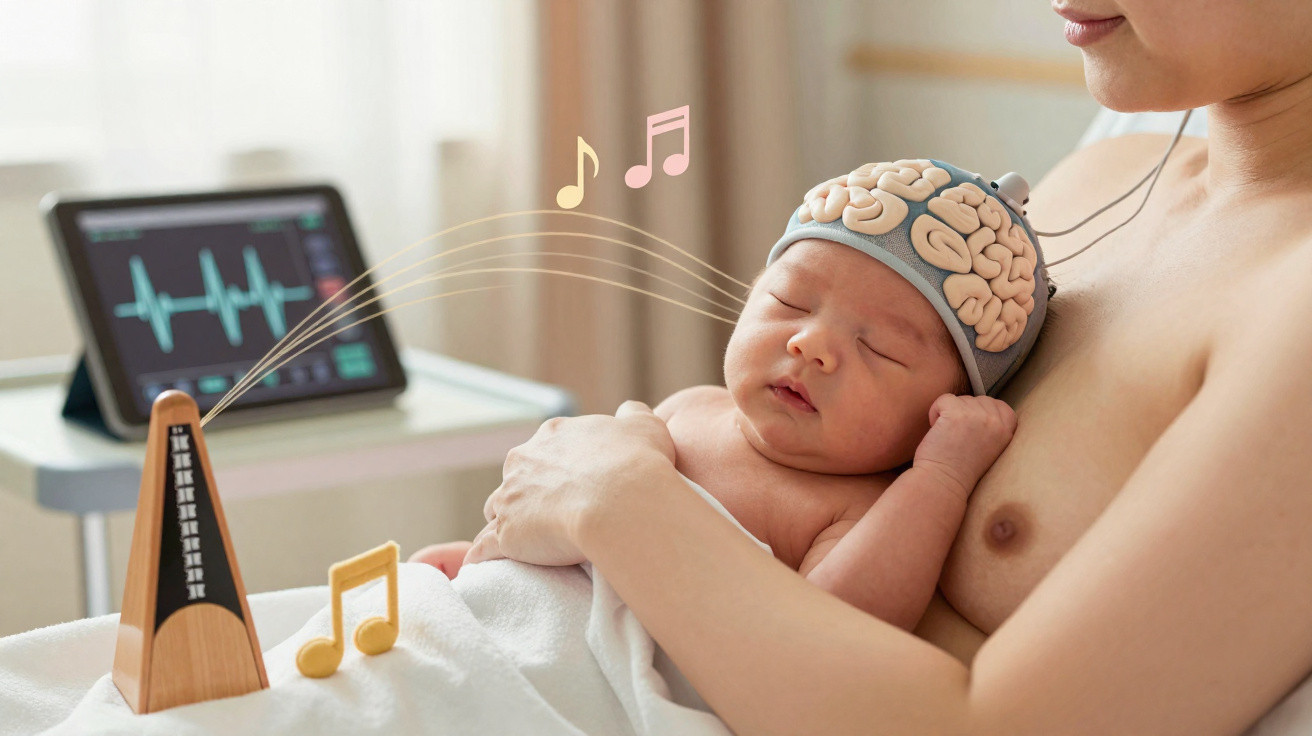
New research suggests newborns may listen more actively than previously thought. Even during their first days of life, their brains appear able to predict musical rhythm.
A newborn brain can anticipate when sounds are likely to occur, including when it hears unfamiliar music.
The finding changes scientists’ understanding of the earliest phase of listening. Rather than melody taking the lead, rhythm seems to provide the brain’s first system for arranging sound.
This framework offers infants an inbuilt structure for interpreting their surroundings long before they develop language or musical experience.
Newborn brains favour rhythm
The earliest evidence appears in the subtle electrical activity of sleeping newborns as they hear structured piano music.
At the Italian Institute of Technology (IIT), Dr. Roberta Bianco and her colleagues monitored changes in infant brain activity when expected timing patterns were maintained or disrupted. Their findings showed that brains only days old can already anticipate when sounds are due to happen.
The signals changed consistently when musical timing departed from the expected pattern, whereas comparable alterations to the tune did not produce the same effect.
This difference indicates that rhythm has a distinctive role early in life, enabling the brain to organise sound before babies can grasp words or meaning.
Dr. Bianco, a cognitive neuroscientist, investigates how newborn brains start identifying patterns in sound while the auditory system is still developing.
Her team’s findings suggest that these small bursts of brain activity offer early signs of expectation, providing a rare view of listening at the very beginning of life.
Babies react to rhythm
The researchers looked for a brain signal that rises when the mind anticipates one event but hears something different.
Using electroencephalography, which uses small sensors to measure electrical activity, they tracked EEG responses across the scalp.
When a note arrived too early or too late, the EEG pattern increased, indicating that the infant had predicted its timing.
As the babies did not have to respond, the signal represented automatic listening rather than learning, training or intentional attention.
Rhythm leads, melody follows
To examine newborn responses to musical structure, the IIT team used Bach’s simple piano passages to separate timing patterns clearly from pitch patterns.
The researchers played ten original pieces and four modified versions to 49 sleeping newborns during their first two days of life.
The altered recordings retained the same notes and volume but rearranged timing and pitch, so the usual musical rules broke down. This approach ensured that any brain response reflected genuine pattern learning, rather than a reaction to random sounds.
The findings revealed a marked distinction between rhythm and melody. When timing patterns were interrupted, newborn brains responded strongly, creating a burst of neural “surprise” in EEG recordings. Yet they remained mostly quiet when the tune itself changed unexpectedly.
The difference implies that infants follow the when of sound before the what, suggesting that melody prediction probably emerges later.
Crucially, the result does not suggest that babies cannot hear pitch – only that this form of natural music did not yet produce melody-based expectations.
Brains predict rhythm automatically
The finding is based on the straightforward principle that the brain continually estimates what will happen next. Scientists describe this as statistical learning: the brain detecting patterns in repeated events, even while asleep.
As Bach’s music progressed from one note to the next, the infants adjusted those probabilities, making an incorrectly timed note immediately noticeable.
Melody may need a longer period of exposure because pitch-based rules rely more heavily on cultural and language experience.
Earlier signs of beat
A 2009 study found that newborn brains synchronise with rhythm in sound, well before a child can sing along.
In that research, scientists removed an expected beat from a regular drum sequence, and the EEG response showed that the missing timing had been detected.
That earlier work relied on a basic pulse, whereas the IIT study examined whether infants could track more detailed timing changes within real music.
By taking rhythm tracking into longer, natural musical pieces, the new findings indicate that prediction may withstand complexity from the outset.
Learning starts before birth
A Finnish experiment found that repeatedly hearing a tune before birth can produce an effect that remains for months.
Mothers frequently played the same short melody, and newborns later showed stronger EEG responses when they heard that melody again.
That response resulted from familiarity, whereas Dr. Bianco’s team used unfamiliar music, setting a more demanding test for real-time prediction. The comparison suggests that melody may not be fully developed at birth, although brains can still retain a repeated tune early on.
The womb amplifies rhythm
Before birth, babies spend months surrounded by regular pulses – a heartbeat’s rhythm, the cadence of footsteps and the ebb and flow of everyday movement.
Within the womb, subtle pitch details become muted, while timing patterns pass through more clearly, allowing beats to stand out more than fine shifts in tone.
This early auditory environment may prime newborn brains to attend first to when sounds occur, with pitch sensitivity developing later as hearing continues to become sharper after birth.
The present data were recorded while infants slept, meaning future research must establish whether awake babies show stronger tracking of pitch as well as rhythm.
Rhythm shared with primates
Research involving other primates adds a broader evolutionary context to the newborn findings, showing similar timing-based tendencies across species.
When the IIT team compared its results with previous research in monkeys and adults, it found that the newborn response closely resembled the animal patterns.
“Rhythm seems to be built on very ancient auditory abilities that we share with other primates, while melody appears to depend on human brain specializations that are shaped by learning after birth,” said Dr. Bianco.
In practical terms, the team proposes that rhythm belongs to the brain’s inherited sensory toolkit, while sensitivity to melody develops gradually through experience.
The newborn findings also suggest that prediction starts with timing, supplying the brain with a framework for organising sound before substantial musical exposure.
Future research may identify when melody predictions start to appear and investigate whether early musical experiences can alter that developmental timetable for different babies.





Comments
No comments yet. Be the first to comment!
Leave a Comment