
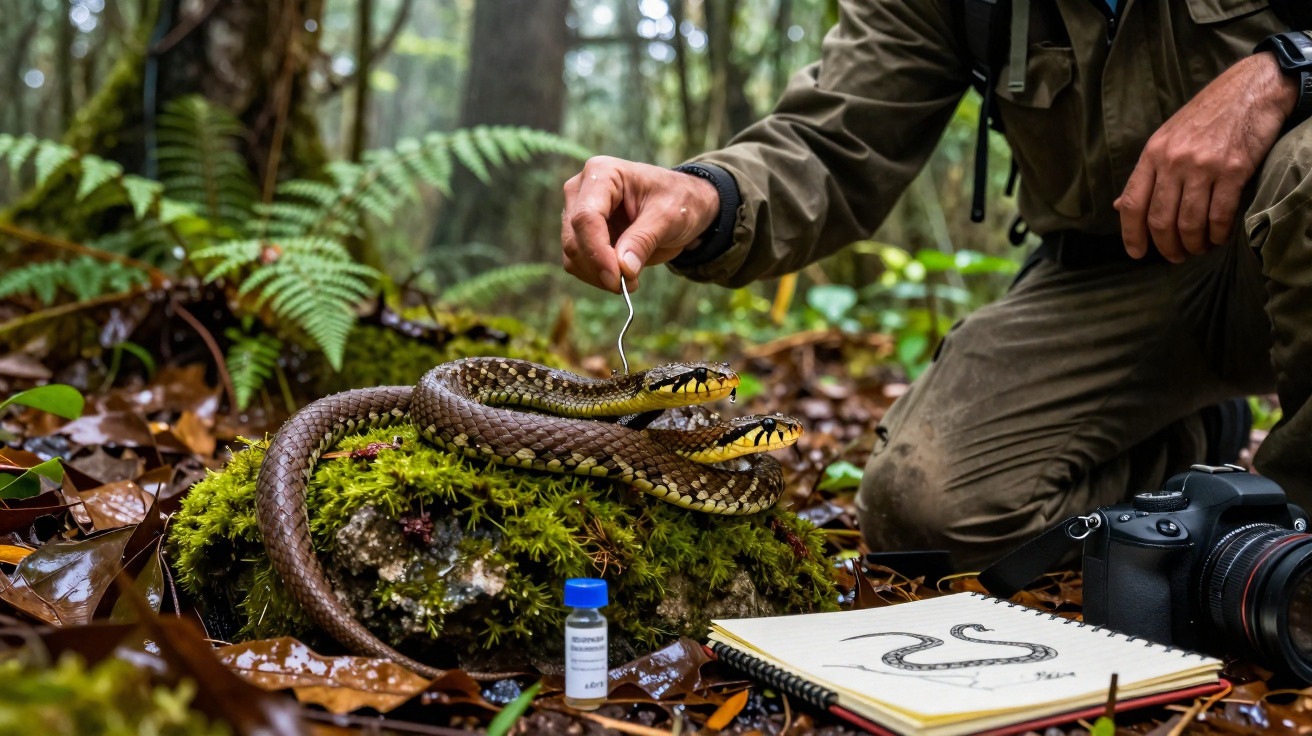
Scientists have described a previously unknown species of venomous pit viper from the clouded mountain forests of Medog County, in China’s Xizang Autonomous Region. The finding adds to the region’s abundant, yet still only partly understood, wildlife.
For years, the snake went unrecognised because researchers considered it part of a species already known across much of Asia. That view shifted when scientists assessed both its DNA and physical characteristics.
The results demonstrated that the Medog snakes were not merely a regional form of a well-known species. Instead, they formed a distinct evolutionary lineage that had escaped notice despite years of fieldwork.
This pit viper discovery underlines how many reptile species may still await discovery and formal documentation in the eastern Himalayas.
Identifying Ovophis medogensis
The genus Ovophis comprises medium-sized venomous pit vipers distributed from Japan and southern China through to Nepal.
For decades, researchers thought that one species, Ovophis monticola, occurred across most of this extensive range. More recent genetic studies, however, have revealed that this interpretation was overly simple.
What had once been regarded as a single broadly distributed species actually consists of several distinct species.
Earlier records in China’s Xizang region had placed at least two separate Ovophis snakes under one name, prompting the need for a renewed assessment of the genus.
A closer examination of a familiar pit viper
Scientists recognised the new pit viper species through genetic testing combined with a close examination of its physical traits. This method is becoming ever more important as researchers identify species that look alike externally but differ genetically.
Named Ovophis medogensis, the snake inhabits tropical monsoon rainforests at elevations of roughly 700 to 1,800 metres. It can be distinguished by a particular combination of characteristics.
Its dorsal scales are arranged in a 23(25)-23-19 pattern, while it has 132 to 138 ventral scales and 39 to 49 subcaudal scales. The majority of its subcaudal scales are paired.
The snake’s colouring also sets it apart. Its back is dark brown and patterned with irregular butterfly-shaped blotches. A brownish-orange stripe extends behind each eye, while its cream to orange-red eyes feature a single vertical black bar across the pupil.
White markings run along the upper surface of the tail to its very tip, a trait absent from its nearest relatives.
Genetic evidence confirms the identification
Genetic findings were similarly decisive. Mitochondrial cytochrome b gene analysis identified the snake as the sister lineage of Ovophis monticola from Nepal and Nyalam County.
The uncorrected pairwise genetic distance was 5.5 percent, exceeding the threshold commonly applied to distinguish snake species.
Phylogenetic analysis further returned a Bayesian posterior probability of 1.00 and an ultrafast bootstrap value of 100, reinforcing its status as a distinct evolutionary lineage.
A long-standing mystery explained
“We kept finding these snakes in Medog and noticing they just didn’t look right for Ovophis monticola,” the authors said.
“The color patterns were off, the scale counts didn’t match, and when we finally got the DNA data back, the differences were undeniable. This wasn’t just a local variant – it was a whole new species that had been hiding in plain sight.”
The research team included scientists from the Chengdu Institute of Biology, Chinese Academy of Sciences, and collaborators at Jianghan University, China West Normal University, the University of Chinese Academy of Sciences, and Nepal’s Prithvi Narayan Campus.
According to the researchers, the eastern Himalayas remain among the least investigated areas for reptile diversity.
“Every time we go out into the field, we find something unexpected. Medog is turning out to be a real hotspot for cryptic species,” they said.
Why the pit viper discovery is important
The discovery brings the number of recorded Ovophis species in Xizang to three, alongside O. monticola and O. zayuenis.
Researchers suggest that further pit viper species could remain undiscovered as DNA research progresses in parallel with conventional assessments of body form and scale arrangements.
The finding has practical significance beyond taxonomy as well. Accurate identification of venomous snakes allows scientists to better understand variations in venom composition. Such knowledge aids the development of more effective antivenoms and strengthens snakebite management.
With deforestation continuing across South Asia’s lowlands, the researchers say further field surveys will be needed to establish the full distribution of Ovophis medogensis and assess its conservation status.
The complete study appeared in the journal Asian Herpetological Research.






Comments
No comments yet. Be the first to comment!
Leave a Comment