
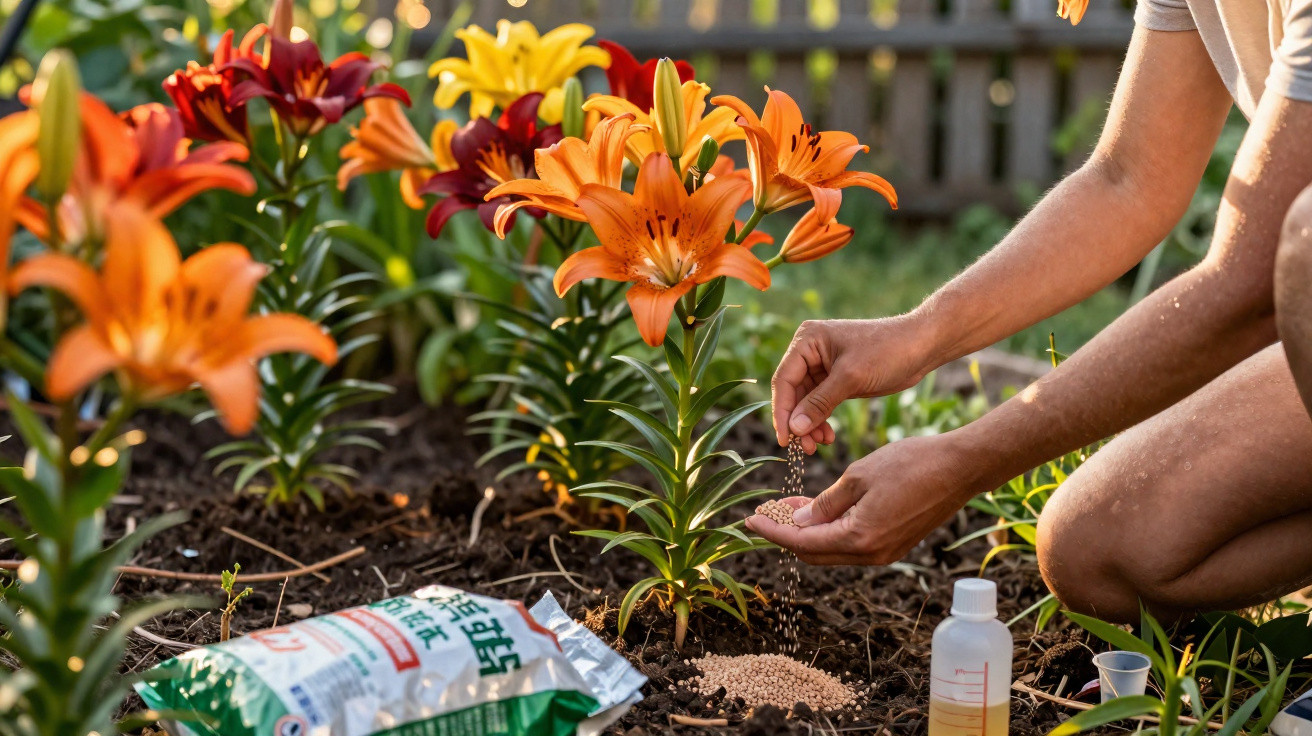
Many keen gardeners plant exotic lilies with high hopes, only to face disappointingly small flowers in summer. The answer is not an expensive specialist product, but the right balance of nutrient mix, timing and application method. Once you understand the principle, your bulbs can produce a real display of flowers year after year.
What Asian lilies really need
Asian lilies put huge amounts of energy into producing large, fragrant blooms. Their nutritional requirements therefore differ slightly from those of many perennials and foliage plants.
"The ideal fertiliser for Asian lilies provides plenty of phosphorus and potassium, but only moderate amounts of nitrogen."
In practical terms, this means:
- Nitrogen (N): encourages leafy growth and shoots. Too much produces tall, soft stems with few buds.
- Phosphorus (P): supports root development and flower formation. Without enough phosphorus, buds remain small or may fail to develop altogether.
- Potassium (K): strengthens plant tissue, improves water regulation, flower colour and disease resistance.
For lilies, formulations around 5-10-10 or 10-10-10 have proved effective. These figures represent the proportions of nitrogen, phosphorus and potassium. Small variations are not an issue, provided nitrogen is not the dominant nutrient.
Timing matters: match fertiliser to the growth stage
The timing of feeding is just as important as the formulation. Asian lilies respond noticeably to when they receive nutrients.
| Growth stage | Recommended NPK formula | Frequency | Main benefit |
|---|---|---|---|
| Early growth | 5-10-10 | every 2 weeks | strengthens roots, supports sturdy stems |
| Vigorous growth | 10-10-10 | every 2–3 weeks | balanced nutrition, healthy foliage |
| Bud formation | 5-10-10 | every 2 weeks | large buds, intense colours |
| After flowering | 0-10-10 | monthly | replenishes bulb reserves, builds strength for the following year |
A straightforward schedule for everyday gardening:
- Start in spring: apply the first feed when shoots reach 10–15 centimetres tall.
- During the season: feed again every 2–3 weeks, until the buds begin showing colour.
- Stop before flowers open: once blooms start opening, do not use any more nitrogen-rich fertiliser.
- After flowering: continue light feeding with phosphorus- and potassium-led products until the foliage gradually dies back.
Granules, liquid feed or organic options: suitable products
Controlled-release fertiliser as an easy foundation
Many gardeners get good results from granular controlled-release fertiliser. These pellets release nutrients steadily over several weeks, making them gentle on sensitive lily roots. Typical choices include controlled-release fertilisers for flowers or vegetables, applied in spring.
"Controlled-release fertiliser feeds lilies consistently without ‘burning’ the bulbs – making it ideal as a base feed."
A practical approach:
- Work in one application of controlled-release fertiliser when planting or in early spring.
- Add liquid fertiliser selectively during the main growing period.
Liquid fertiliser for a quick boost
Water-soluble flowering fertilisers are useful when you want nutrient applications that can be adjusted quickly. Standard products from a garden centre are entirely sufficient, as long as the NPK ratio has “more P and K than N”.
For container-grown plants, liquid fertiliser is almost essential because watering washes many nutrients out of the compost. A suitable routine is:
- use half strength every week, or
- apply the full dose stated on the pack every fortnight.
Organic fertilisers for patient gardeners
Those who prefer organic options can feed lilies very effectively with these established choices:
- Well-rotted manure: improves soil structure and releases nutrients evenly.
- Bone meal: an excellent source of phosphorus for strong roots and plenty of buds.
- Fish fertiliser: provides readily available nitrogen and trace elements in moderate quantities.
Organic fertilisers act more slowly, but improve the soil over the long term. This is particularly noticeable in established perennial lily plantings: sturdier stems, more resilient plants and more reliable flowering.
How to apply fertiliser correctly
Many problems arise not from using the “wrong” fertiliser, but from applying it incorrectly. A few simple measures prevent scorched roots and weak growth.
"Never pile fertiliser directly against the stem – always apply it in a ring away from the plant."
- Keep your distance: scatter granules in a circle roughly 15 centimetres from the stem.
- Water thoroughly: give plants a generous watering after every application so nutrients dissolve and spread through the soil.
- Avoid hot spells: do not feed during intense heat or drought stress, as nutrients will otherwise remain unused in the soil.
- Watch the plants: pale leaves, weak stems or distorted growth can indicate underfeeding or overfeeding.
- Take care in the planting year: feed newly planted bulbs at a reduced rate, around one third of the usual amount.
Soil and pH: the commonly overlooked foundation
No fertiliser in the world will help if the soil does not suit lilies. Asian lilies prefer slightly acidic to neutral soil, with an ideal pH of between 6.0 and 6.5.
A simple soil test from a garden centre will show your starting point. If the reading is considerably higher, plants absorb certain nutrients less efficiently. In practice, this can make it seem as though no fertiliser has been applied at all.
Useful adjustments include:
- mixing slightly acidic potting compost with garden soil
- incorporating compost regularly
- adding sand or fine grit to very heavy soils so water drains more freely
Mulch, microorganisms and care after flowering
Mulch made from bark chippings or compost creates a favourable root environment for lilies. A layer of two to three centimetres is generally enough:
- the soil retains moisture for longer
- temperature fluctuations are reduced
- organic matter breaks down slowly and supplies extra nutrients
Mulch supports soil organisms that break down organic material and turn it into fertiliser available to plants. Lilies benefit in two ways: they receive nutrients while also growing in a loose medium that roots can penetrate easily.
"After flowering, the lily does not enter ‘retirement’ – this is when the bulb replenishes its energy reserves."
Stopping fertilisation completely after flowering means missing an opportunity. It is better to continue gentle feeding with phosphorus- and potassium-rich products while the foliage remains green. During this period, the bulb stores energy for the following year.
Practical examples and common mistakes
Common day-to-day feeding mistakes include:
- using pure lawn fertiliser with a high nitrogen content – lilies become leggy and topple over
- applying heavy feeds late in high summer – plants produce soft growth and are more vulnerable in winter
- placing thick layers of manure directly against the bulb – rot is almost inevitable
A successful approach is much less dramatic: modest but regular applications, ideally combining controlled-release and liquid fertiliser, alongside organic additions in spring or autumn. Gardeners who photograph their lilies each year soon see how carefully planned fertiliser management affects the number, size and colour of blooms.
For balcony gardeners growing lilies in pots, monitoring is even more important. Potting compost becomes depleted more quickly, while salt levels build up more readily. Feed more often at lower strength, and occasionally water generously so that some water drains from the bottom of the pot. This keeps Asian lilies sturdy, free-flowering and surprisingly long-lived even in containers.

Comments
No comments yet. Be the first to comment!
Leave a Comment