
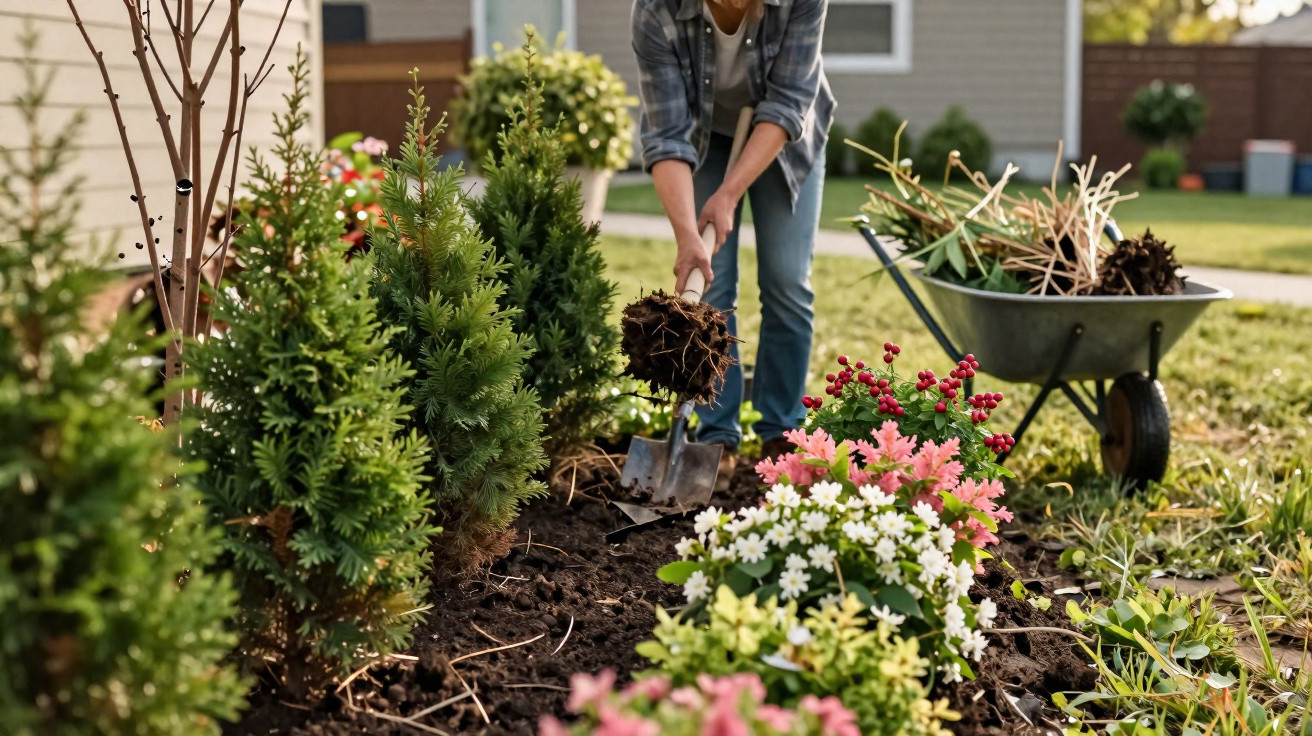
In countless terraced-house gardens and suburban streets, they have shaped the view for decades: ruler-straight, dark-green Thuja hedges used as inexpensive privacy screening. Yet these formerly favoured plants are now failing in large numbers. Experts warn that the issue goes beyond “just” dried-out branches, and increasingly advise removing conifer hedges altogether and replacing them with species-rich alternatives.
How Thuja changed from a garden favourite into a problem
Thuja, also widely known as arborvitae, was long considered the ideal answer: it grows quickly, remains dense all year and is easy to trim into shape. During the 1970s and 1980s, kilometres of these hedges were planted around new-build estates. What seemed to be the perfect privacy screen is now proving an ecological and horticultural dead end.
At the heart of the problem is Thuja’s very shallow root system. During summers with little rainfall, these roots rarely reach the deeper, moister soil layers. The plants quickly suffer drought stress, even where the owner waters regularly.
Studies show that Thuja hedges can use up to around 60 per cent more water than mixed hedges containing native woody plants.
This has long been an issue for local authorities and water suppliers. In several areas, planning rules and local regulations prohibit or restrict new Thuja hedges. Some places also offer grants that contribute towards removing old conifer hedges and planting diverse replacement hedges.
Why the green wall is often an ecological desert
From a biodiversity perspective, rows consisting solely of Thuja perform poorly. Their uniform greenery offers birds and insects little food and hardly any varied habitat. There are no flowers, nor are there fruits. For many animals, the hedge is simply of no interest.
At the same time, the dense roots, layer of fallen needles and shade suppress other plants growing nearby. The soil becomes depleted, often dry and compacted. Anyone trying to establish a border directly in front of or behind it frequently struggles with root competition and lack of water.
- Hardly any flowers – little food for insects
- No fruit – limited food for birds
- Dense shade – poor conditions for underplanting
- High water consumption – additional pressure during hot spells
Many towns and councils therefore want hedges that do more: provide shade, retain water in the soil more effectively, offer food and shelter for wildlife, and create greater visual variety.
Invisible enemy: beetles destroy drought-stressed Thuja hedges
Climate stress is compounded by another factor: a longhorn or jewel beetle related to bark beetles that has specialised in Thuja. Its larvae find ideal conditions in drought-damaged, weakened hedges.
The insects tunnel beneath the bark, damaging the vascular tissue that carries water and nutrients. As a result, the plant effectively dries out from within, even if the soil may still be damp.
Once a hedge is heavily riddled with larvae, specialist authorities often consider it beyond saving – there is no effective treatment.
If the damaged hedge remains in place, it becomes a breeding ground and a starting point for further damage in its own garden and neighbouring ones. Other conifers, including certain cypress species, may also be affected.
Warning signs that Thuja is failing
Garden and tree specialists identify several symptoms that require prompt action:
- Brown patches spreading from the inside out
- Branches that dry out but retain their brown scales
- Fine tunnels or cavities beneath the bark
- No new shoots on older woody sections
- A hedge that looks generally dull, sparse and brittle
Arborvitae does not generally reshoot from old wood. Once gaps form, they usually remain permanent. Trying to “rejuvenate” the hedge with drastic pruning typically creates even more bare patches.
When removal is genuinely necessary
Anyone noticing several of these types of damage should not delay for too long. The sooner a severely weakened or infested hedge is removed, the lower the risk of pests spreading extensively.
Specialist bodies recommend avoiding major clearance work and heavy pruning during the bird breeding and rearing season. The period from mid-March to the end of July is generally sensitive, as many birds nest in hedges then. Late summer, autumn or very early spring are often the best times for removal.
Anyone who is unsure should seek a brief assessment from the local horticultural authority or an arborist before felling – this can prevent problems relating to nature protection and neighbours’ rights.
Restoring soil after a Thuja hedge
Once the old hedge and its root stumps have been removed, the remaining strip of soil is often exhausted and compacted. For years, the shallow roots will have taken much of its water and nutrients. Replanting immediately can therefore quickly result in stunted growth.
To enjoy the replacement hedge over the long term, prepare the ground first:
- Thoroughly remove root remnants, thick layers of needles and stones
- Loosen the soil deeply and, where necessary, work in sand or fine grit
- Add plenty of mature compost and, on very poor soil, a little organic fertiliser
- Leave the strip to settle and be exposed to rain for several weeks, ideally covered with mulch
Those with enough space and time can sow a green manure crop for a year, such as clover, phacelia or lupins. These plants further loosen the soil and add organic matter.
Thuja hedge alternatives now in demand
Landscape planners now place much greater emphasis on mixed hedges made up of different shrub species. This so-called “living” or “country” hedge combines flowering plants, fruiting species and evergreen elements.
Popular components include:
- Laurustinus for winter flowers
- Photinia, with its red new growth providing a splash of colour
- Privet, a classic semi-evergreen plant that tolerates trimming well
- Hornbeam for dense, shapable hedges
- Hazel shrubs, which provide nuts and cover
- Dogwood and hawthorn for flowers, berries and bird protection
- Ornamental grasses such as miscanthus, adding movement and structure
These hedges usually need less water than solid conifer walls. Different rooting depths make better use of the soil, while fallen leaves and flowers bring more life into the garden. Measurements show that species-rich hedges can keep the soil noticeably moist for longer during hot periods.
More variety, more benefits for garden owners
Moving away from a uniform row of Thuja also changes the appearance of many gardens. Instead of a rigid green wall, a living structure develops, with differing heights, colours and flowering periods. Those who prioritise complete privacy can cleverly combine evergreen and deciduous species.
Maintenance is distributed differently: rather than regular, severe shaping cuts across the whole wall, individual shrubs need more selective, gentle pruning. Many amateur gardeners report that this means less cutting overall and more enjoyment from watching birds and insects.
Practical tips for changing your own garden
Anyone planning to part with a Thuja hedge often faces the question of where to begin. A planned approach helps keep costs and workload manageable.
- Check whether local grant schemes are available for hedge replacement
- Obtain quotations from landscaping firms for large hedges
- Divide the hedge length into sections and replace it gradually if the budget is limited
- Choose plants with different mature heights and flowering times
- Include as many native species as possible – they are resilient and valuable for wildlife
There is an additional benefit: replacing a monotonous conifer wall with a layered mixed hedge also improves the microclimate of the plot. Wind is broken up, heat builds up less, and the soil does not dry out as quickly. This can be particularly noticeable in densely built-up residential areas.
In the long term, it is not only birds, insects and soil organisms that benefit from saying goodbye to the Thuja hedge. Owners do too: the garden becomes more varied, more resilient in the face of weather extremes, and often far more interesting than the old, dark-green “fortress wall” of the 1980s.

Comments
No comments yet. Be the first to comment!
Leave a Comment