
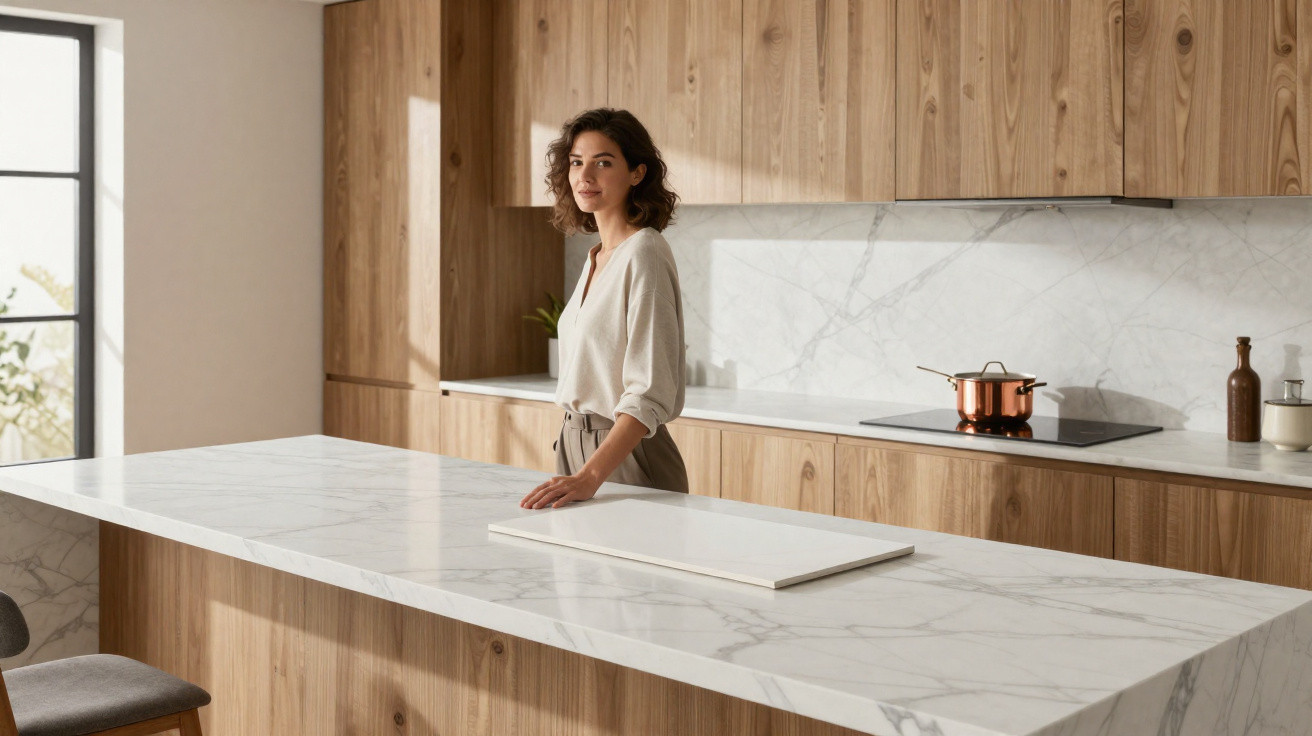
Large-format porcelain tiles have become increasingly common in 2026 kitchens because they create generous worktops with minimal joins and a look comparable to natural stone. The slabs can be used across the food-preparation area, island and even the wall, producing a visually seamless finish suited to open-plan kitchens and cleaner-lined schemes.
Why have large-format porcelain tiles become a trend?
Contemporary kitchens favour visual flow, matt finishes and fewer visible grout lines. With slabs exceeding three metres from some manufacturers, long sections can be clad without interrupting the veining pattern, making the worktop appear to be made from a single piece.
The material is also available in a broad selection of designs replicating marble, granite, concrete and other surfaces. As a result, the same pattern can be carried across the worktop, splashback and island, achieving a consistent arrangement without relying on large blocks of naturally quarried stone.
- Minimises the number of visible joins;
- Extends veining across different surfaces;
- Works well in kitchens open to the living room;
- Can cover the worktop, wall and sides of the island;
- Is available in matt, satin or polished finishes.
How do large slabs create a more seamless kitchen?
The size of the slabs makes it possible to plan larger cuts and locate joins in less noticeable places. This reduces the visual fragmentation caused by small tiles and frequent grout lines, an approach that also features in the 2026 trend for matt coverings and continuous kitchen surfaces.
- Select the veining layout before cutting begins;
- Plan the positioning of the sink and hob;
- Avoid joins in areas exposed to water continuously;
- Use the same pattern on the splashback to increase continuity;
- Specify the visual thickness of the edges within the design.
What is different from a marble worktop?
Porcelain is a low-water-absorption ceramic product, classified as having water absorption of 0.5% or less. This property helps account for its stain resistance and removes the need for the regular sealing usually associated with porous natural stones.
Marble contains calcium carbonate and may experience surface etching when it comes into contact with lemon, vinegar, wine and other acidic ingredients. Sealing limits liquid penetration, but it does not prevent this chemical reaction. Porcelain withstands these everyday contacts more effectively, although spills should still be wiped up promptly.
Installation determines the worktop's durability
Although the surface is hard, the slabs are thin and their edges may chip if they are transported, cut or supported incorrectly. Specialist installation must include a level base, accurate cut-outs and suitable support around the sink and hob.
- Hire professionals experienced in handling large slabs;
- Check that the structure can support the weight of the complete assembly;
- Protect exposed corners from impacts;
- Use blades and tools designed for porcelain;
- Follow the joints and products recommended by the manufacturer.
Is it worth replacing marble with porcelain?
Porcelain generally suits those seeking low absorption, straightforward cleaning and resistance to heat, stains and scratches in domestic use. It is not indestructible: heavy impacts can damage the edges, and knives should not be used directly on the surface. Chopping boards, pan trivets and cleaning with neutral products help preserve the finish.
In the 2026 kitchen, its key benefit is the combination of performance and a natural-stone appearance in a worktop with few visual interruptions. When the slab is properly specified and installed, it produces a continuous surface, does not require frequent sealing and copes better with daily contact with water, food and acidic ingredients.




Comments
No comments yet. Be the first to comment!
Leave a Comment