
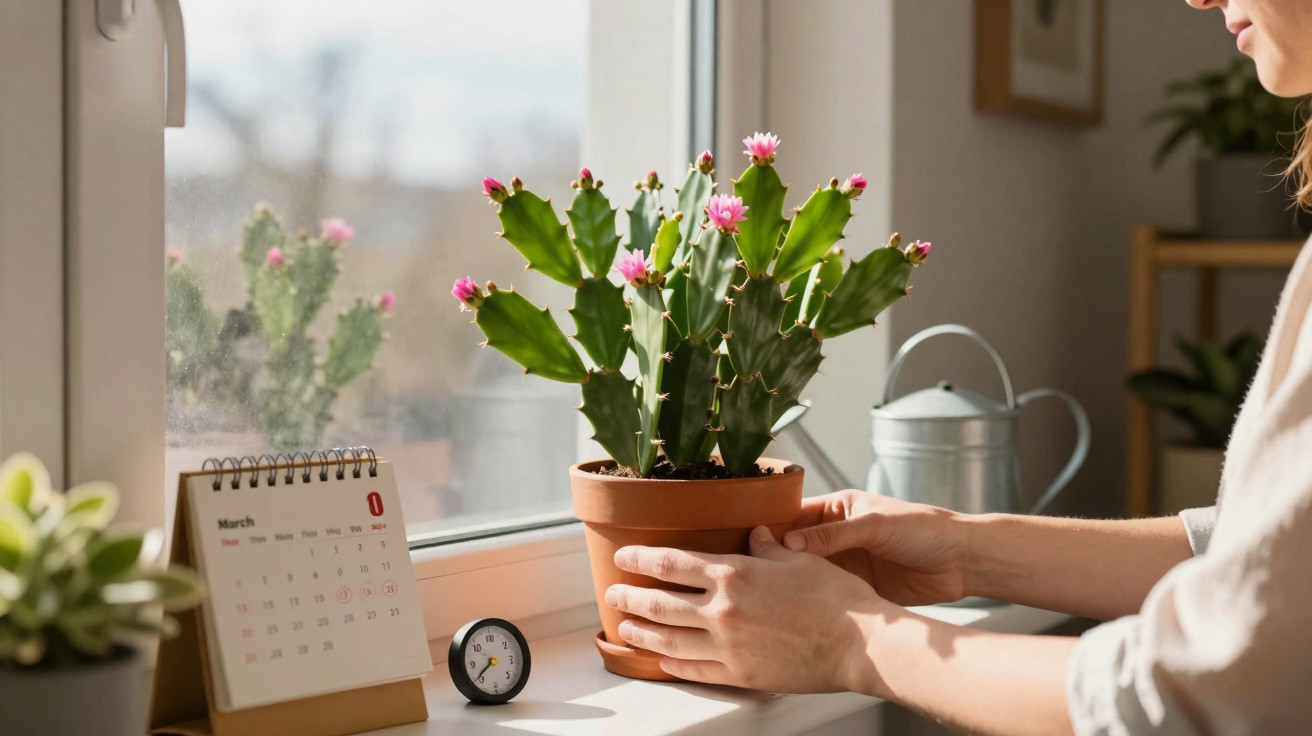
Many indoor gardeners are puzzled: their Easter cactus comes through winter in excellent condition, yet the hoped-for display of flowers fails to appear altogether.
The situation is familiar. In its first year, the pot was packed with colourful star-shaped blooms; the following spring, the plant looks healthy and richly green, but not a single bud emerges. The good news is that, in most cases, the Easter cactus is not ‘broken’ – it has simply been taken through winter incorrectly. Once you understand its natural annual cycle, you can reliably encourage it to flower in time for Easter.
What makes the Easter cactus special
The Easter cactus (usually classified botanically as Rhipsalidopsis) is not a desert plant. It originates from humid forests in South America, where it grows in the forks of branches as an epiphyte. This explains many of its care requirements.
- It prefers bright light, but not fierce, direct sunshine.
- It does better in loose, free-draining compost than in dense, heavy potting soil.
- It needs humidity, but cannot tolerate waterlogged roots.
In the home, it is happiest in a bright room with an east- or west-facing window. Keeping it slightly away from the glass protects it from harsh midday sun. Its natural flowering period runs from March to May, broadly coinciding with Easter.
Confusion with the Christmas cactus
Many plants receive unsuitable care on the windowsill because they are mistaken for Christmas cacti. The distinctions are easy to spot:
| Feature | Easter cactus | Christmas cactus |
|---|---|---|
| Flowering period | Spring (March–May) | Late autumn/winter (November–January) |
| Flower shape | Star-shaped and upright | Drooping sideways and multi-tiered |
| Stem segments | Fairly soft, with rounded edges | Toothed, with more pronounced points |
Treating an Easter cactus like a Christmas cactus can easily delay flowering or prevent it altogether.
The crucial factor: the Easter cactus annual cycle
“Easter cacti only form buds reliably if they receive a genuine winter rest period with cool temperatures and reduced light.”
Although the pot looks much the same throughout the year, the plant follows a clear internal rhythm. This can broadly be divided into three stages.
Stage 1: Growth in spring and summer
After flowering, the plant needs to rebuild its strength. It produces new segments and stores energy reserves.
- Position: Very bright, but out of intense midday sun.
- Temperature: 18 to 24°C is ideal.
- Watering: Every 7 to 14 days, once the top layer of compost has dried out.
- Feeding: Roughly every four weeks with a weakly diluted cactus fertiliser.
Problems during this period – such as permanently dry compost or extreme heat at a south-facing window – weaken the plant and can affect flower production months later.
Stage 2: Slowing down in autumn
From late summer onwards, gradually reduce the pace of care:
- Leave longer intervals between waterings.
- Slowly stop feeding.
- Move the plant to a slightly cooler, less brightly lit position.
This transition prepares the Easter cactus for its winter rest.
Stage 3: Cool winter rest triggers flowering
This is where the most common reason for green but flowerless plants lies. Many pots spend the whole winter in a living room at 20 to 23°C, often directly above a radiator. That may be comfortable for people, but for an Easter cactus it creates an endless summer with no break.
Instead, it needs 8 to 12 weeks under the following conditions:
- Temperature: Around 10 to 15°C, for example in a bedroom, stairwell or lightly heated hallway.
- Light: Only around eight hours of bright, indirect light each day.
- Darkness: At least twelve hours of proper darkness, without light from lamps in the evening.
- Watering: A small amount of water every three to four weeks is enough; the compost may dry out almost completely.
This combination tells the plant that it is in its winter rest period. It then initiates bud formation in late winter or early spring.
Common mistakes that prevent flowering
Wintering the plant somewhere too warm
This is the classic mistake: the pot stays in a warm living room all winter. The stems continue growing and become soft and elongated, but the plant does not set buds. Put simply, it does not ‘know’ that one season has ended.
Disruptive artificial light in the evening
Constant lighting matters too. If the Easter cactus is in a room where ceiling lights or bright television light remain on until late, it never receives an uninterrupted night period. This may block the formation of flower buds.
Too much water in winter
Another common error is watering on the same schedule as in summer out of habit. The roots then remain damp for months, sometimes even sitting in water in the saucer. The consequences include:
- Roots rot, making the plant unstable.
- Stem segments become translucent and soft, then drop off.
- There are no reserves left for flowering.
Moving it at the wrong time
As soon as buds become visible, the Easter cactus reacts sensitively. Moving it from a cool place to a very warm one, placing it directly above a radiator or exposing it to draughts while airing the room can cause buds to dry up or simply fall off.
“Basic rule: during the budding and flowering period, keep the Easter cactus exactly where it is doing well whenever possible.”
An ideal Easter cactus care schedule
If you want your Easter cactus to be flowering around Easter, use this annual plan as a general guide:
- March to May: Flowering and the beginning of growth; place it somewhere bright, water moderately and feed lightly.
- June to August: Growth period; if needed, it can also go on a balcony in partial shade, away from strong midday sunshine. Water regularly, but avoid waterlogging.
- September to October: Reduce the amount of water, phase out fertiliser and choose a slightly cooler position.
- November to January: Cool rest period at 10 to 15°C; water very sparingly and make sure it has a dark place in the evenings.
- February: Gradually return it to a warmer, brighter spot and increase watering slightly – this is when buds form.
If you buy an Easter cactus from a garden centre when it already has buds or is flowering, you are effectively starting halfway through stage two or three. In that case, check the label, as retailers often provide its origin and approximate care guidance.
The right compost and humidity
Compost is an often underestimated factor. Ordinary potting compost holds too much moisture and compacts over time. A loose, airy mix works better:
- around two thirds good-quality, peat-free houseplant compost or cactus compost
- around one third mineral material such as perlite, pumice, coarse sand or broken expanded clay
- optionally, a little fine pine bark to mimic its epiphytic nature
When it comes to humidity, Easter cacti do not appreciate dust-dry air from central heating. Placing the pot on a tray of damp clay pebbles improves the microclimate. Crucially, the pot itself must not stand in water, or rot will again become a risk.
What if it does not flower again this year?
If you have already missed the rest period and now see only green stems in spring, there is no need to give up. You can ‘programme’ the plant for the following year. Give it good but not excessive care through spring and summer, reduce care in good time during autumn, then keep it consistently cool in winter.
Many hobby gardeners report that their Easter cactus responds to a strict, cool winter rest with dozens of star-shaped flowers – sometimes even on plants that had stubbornly remained flowerless for years. The key is to take the rest period seriously for the first time.
If you own several plants, you can test different locations: for instance, keep one in a cool bedroom and another in an unheated hallway. This quickly reveals which temperature and light conditions in your own home produce the most reliable flowering.



Comments
No comments yet. Be the first to comment!
Leave a Comment