
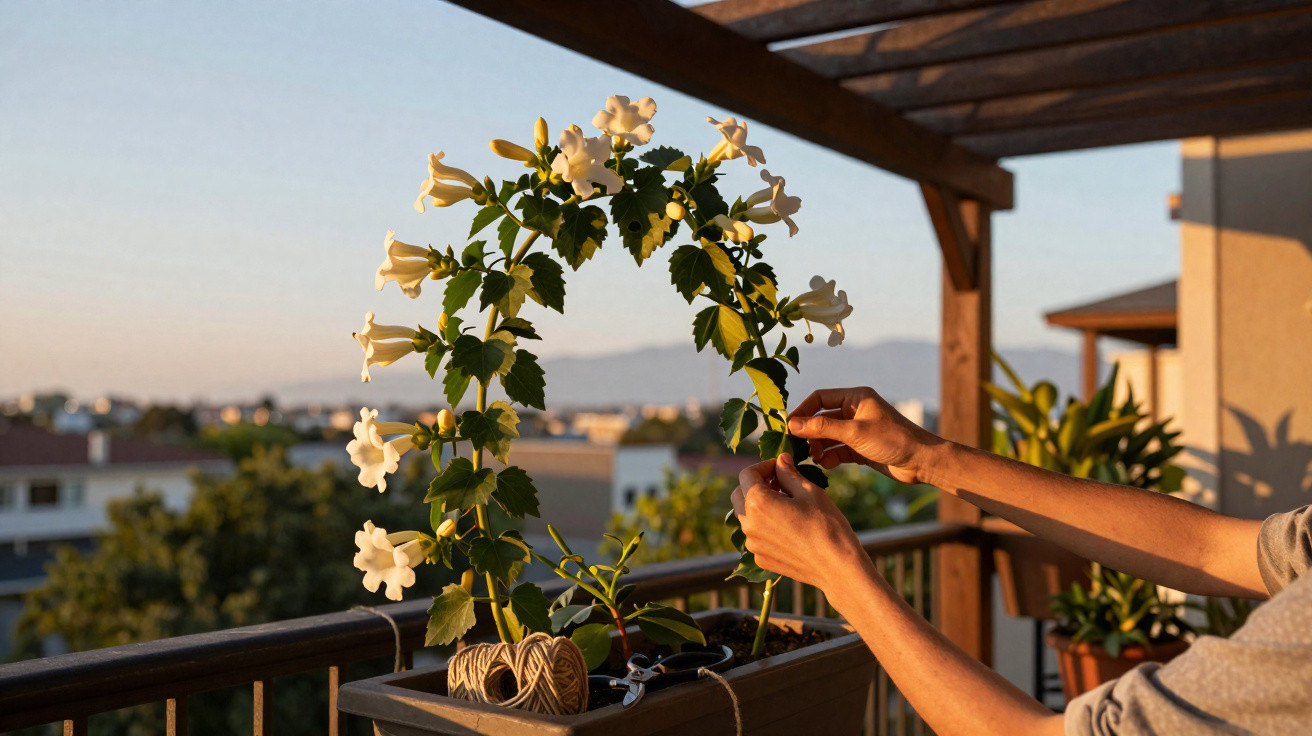
Night-blooming jasmine can fill balconies and spaces around a pergola with a powerful scent, including sites in partial shade. Although it is often described as a climber, this species is a vigorous shrub that can be trained onto a support in a deep planter.
Is night-blooming jasmine really a climbing plant?
Cestrum nocturnum is not a true climber because its stems do not twine around a structure by themselves. It develops as a woody, arching shrub, but can be gently tied to a trellis to follow it and produce a covering effect beside a pergola.
This distinction is important: rather than simply needing somewhere to climb, the plant requires training, pruning and a robust support. Once properly shaped, its canopy can fill vertical areas and bring its flowers closer to an evening socialising space.
Its key characteristics include:
- Growth habit: it grows as a vigorous shrub rather than a true climber.
- Fragrance: the scent becomes stronger after nightfall.
- Planter: this should be deep, sturdy and free-draining.
- Support: soft ties help guide the stems.
- Pruning: this stops the plant from taking up too much space.
Why does the fragrance become stronger after nightfall?
Cestrum nocturnum is a shrub in the nightshade family, recognised for its small flowers and intense fragrance. Its scent intensifies after dark because the flowers release volatile compounds that attract nocturnal pollinators.
On warm nights with little wind, the fragrance can travel across much of the garden and remain noticeable for hours. This makes it suitable for night-time gardens, although it should be kept away from bedrooms and enclosed spaces used by sensitive people.
How to grow night-blooming jasmine in a deep planter
For container growing, select a large, deep and durable planter with several drainage holes. Fill it with fertile growing medium that is rich in organic matter and retains some moisture without leaving the roots permanently waterlogged.
Bright partial shade, rather than deep shade
Light levels affect the number of flowers. The plant tolerates partial shade, but may flower less if it remains in a dark location all day. Choose a spot with strong brightness or several hours of gentle sunshine.
Night-blooming jasmine copes with bright partial shade, but generally flowers more freely with a few hours of direct sun or intense light. During hot weather, check the growing medium regularly and water thoroughly whenever the surface layer begins to feel dry.
Basic care includes:
- using a deep planter with unobstructed drainage holes;
- filling it with fertile soil rich in organic matter;
- placing it in bright partial shade or moderate sun;
- watering more often in hot periods;
- preventing standing water from collecting in a saucer or at the base of the container.
How should growth be controlled and the best position chosen?
Pruning keeps its size manageable, refreshes the stems and prevents the plant from obstructing walkways or becoming too heavy for its support. After flowering, remove dry and overly long sections with clean tools, while retaining the shrub's main structure.
Young stems can be attached to a trellis with broad, flexible ties that do not constrict the stem. As it grows quickly in warm conditions, inspect the training regularly and remove shoots that extend towards roofs, gutters or neighbouring plants.
When positioning and training the plant:
- place it near a balcony or evening socialising area;
- keep it away from bedroom doors and windows;
- secure stems without tightening or damaging them;
- prune to manage both height and width;
- avoid enclosed locations or places with limited air circulation.
What precautions are needed because of its toxicity and fragrance?
Anyone seeking a fragrant plant to cover walls and structures should distinguish between species before planting. Night-blooming jasmine is toxic if eaten, especially its berries, and must be kept beyond the reach of children and animals.
Its highly concentrated fragrance may also cause discomfort, headaches or irritation in sensitive people, particularly near open windows. With a well-ventilated position, controlled growth and measures to prevent ingestion, growing it can enhance outdoor spaces without overlooking safety.
Comments
No comments yet. Be the first to comment!
Leave a Comment