
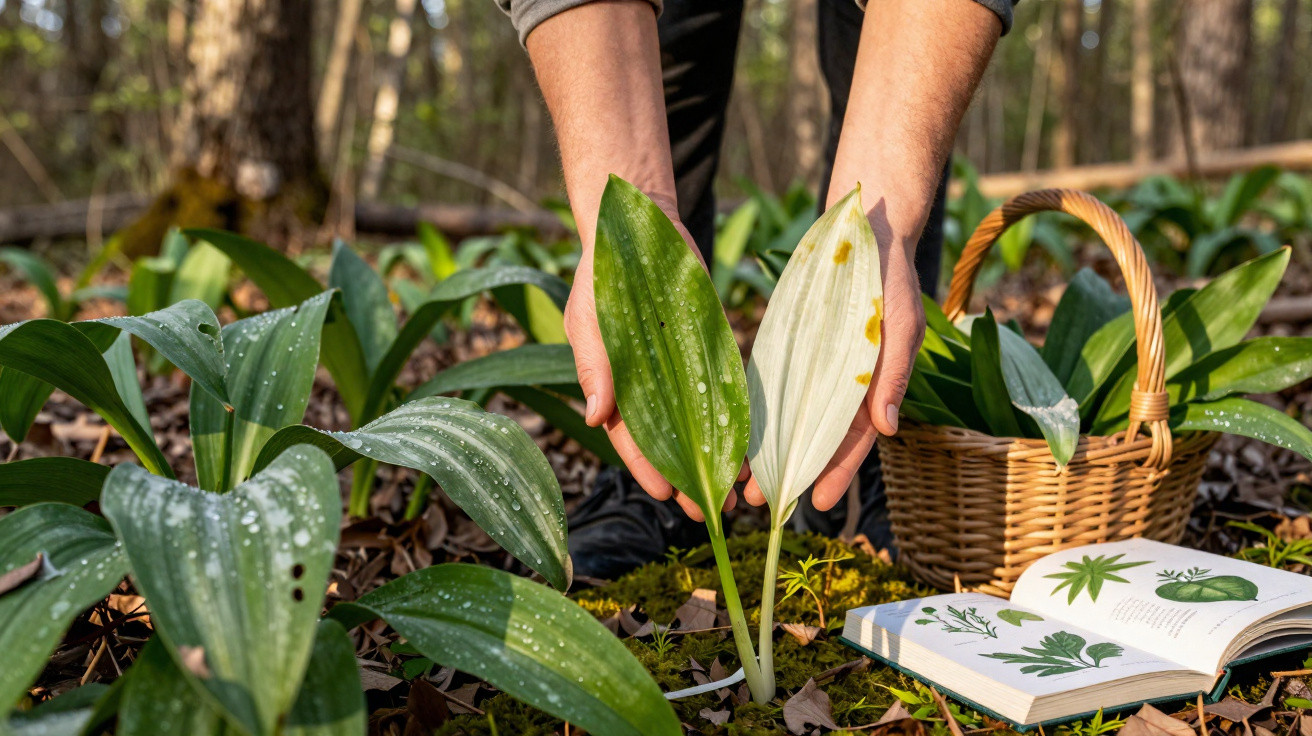
Among the lush green leaves, plants with white stripes, pale patches or yellowish sections can suddenly appear. Many people immediately assume disease or toxins are to blame and prefer to leave the leaves untouched. Yet in many instances, there is no problem at all: it is a completely natural effect that you may only consciously notice once in a lifetime.
Why some wild garlic leaves look so unusual in March
In early spring, wild garlic rarely looks as flawless as it does in food photography or garden catalogues. The plants are only just beginning their growth and must cope with changeable conditions, frost, limited light and sometimes nutrient-poor soil. All of this can affect leaf colour.
“In March, pale or yellowish wild garlic leaves usually reflect the site, weather or genetics – and are not automatically a sign of danger.”
The most important rule is this: edibility or toxicity is never determined by one feature alone, and certainly not by colour alone. Anyone gathering wild garlic needs to assess several characteristics at the same time.
Variegation: when wild garlic naturally develops white stripes
Leaves bearing a sharply defined white or cream stripe, often running directly along the centre, are especially striking. This phenomenon is known as variegation. In certain parts of the leaf, chlorophyll – the green pigment – is absent.
As a result, the foliage displays pale, almost decorative markings, much like some ornamental plants, except here they appear in the middle of a carpet of wild garlic in the woods. It may initially look “diseased”, but it is actually a genetic variation.
- not an indication of mould or fungal disease
- no known toxic effect caused by variegation
- rarely seen in large stands
- these plants often return in the same spot for years
Anyone who finds striped wild garlic like this has effectively come across a small botanical rarity. It remains edible, provided the plant has been identified beyond doubt as wild garlic.
Limited light and nutrients: why wild garlic can appear pale
Alongside these genetic quirks of nature, there are much more ordinary explanations for lighter foliage. In dense, dark woodland, wild garlic may simply receive too little light in places. The plant then produces less chlorophyll, causing the leaf to become generally paler or slightly yellowish.
The following locations are commonly affected:
- deeply shaded dips in woodland
- areas beneath dense shrubs or old tree canopies
- sites with nutrient-poor, depleted soil
March adds another factor: many leaves have only just emerged. Young wild garlic leaves often look far lighter at first than they do later in April. Over the following weeks, the plant produces more chlorophyll and the colour becomes a rich green.
“Pale young leaves are not an alarm signal but a normal spring condition – comparable to delicate seedlings in a garden.”
Paler stands are also more common at woodland edges or disturbed ground, such as beside forestry tracks or paths. Soil in these places is often less nutrient-rich, for example after forestry work or as a result of erosion. Despite their lighter shade, the wild garlic remains edible if all identification features match.
Frost damage: the typical translucent look and yellowish patches
March and April often still bring nights with distinctly sub-zero temperatures. Wild garlic usually copes surprisingly well, but individual leaves can show changes afterwards: translucent, almost water-soaked areas or irregular yellowish patches.
These are frost injuries, similar to those seen on lettuce in a garden. The tissue has been affected in isolated areas and some cells have burst. As temperatures rise, the plant as a whole normally recovers quickly. New leaves then look normal again.
Many foragers simply cut away heavily damaged sections generously, or pick only uninjured leaves. Wild garlic that has been badly frozen can taste somewhat watery or less aromatic.
How to identify genuine wild garlic safely
Whether it is pale, dark, striped or slightly yellowish, colour is always only a secondary factor when identifying the plant. What matters is the combination of several features. Anyone collecting wild garlic should learn these characteristics well:
| Feature | Wild garlic |
|---|---|
| Leaf arrangement | Each leaf grows individually from the ground on its own stalk; there are no leaf pairs |
| Leaf surface | The upper side is slightly glossy, the underside matt, and the leaf is soft and thin |
| Smell | A distinct garlic scent is released when a fresh leaf is crushed |
| Growth habit | Carpet-like stands, usually in damp deciduous woodland, often beneath beech trees |
“Never rely on a single criterion – reliable identification comes from the overall combination of features.”
Important: always test the smell on a fresh leaf that has not yet been handled. If you have already crushed other leaves, the garlic scent will be on your fingers and can easily mislead you.
Dangerous lookalikes: plants that resemble wild garlic
The greatest risk when gathering wild garlic does not come from slightly paler leaves, but from confusing it with poisonous lookalikes. Three species repeatedly cause problems:
- Lily of the valley: Usually has two thicker leaves on a shared stem. The leaves feel firmer and more leathery. There is no garlic smell.
- Lords-and-ladies: Its leaves are often arrow-shaped or irregularly marked, again without a garlic scent. It frequently grows among wild garlic.
- Meadow saffron: Dangerous because it is highly poisonous. Its leaves can emerge early in the year, but grow in different clusters and lack the characteristic scent.
If there is even the slightest uncertainty, leave the plant where it is. Poisonous mix-ups can be life-threatening in serious cases. Beginners in particular are best advised to forage initially with experienced wild-herb experts, or to use courses and illustrated identification guides.
How to gather wild garlic safely and sustainably in March
The picking season often begins in March, and sometimes as early as late February, depending on the region and weather. At this early stage, the leaves are especially tender and aromatic, but their appearance can still vary greatly.
- Pick only plants that have been identified without doubt as wild garlic.
- Check several leaves, the growth habit and the surroundings, rather than judging a single leaf.
- Never pull up entire clumps; cut individual leaves instead.
- Leave at least one third to one half of the stand so that the plant can recover.
- Do not pick close to roads, popular dog-walking routes or contaminated areas.
Following these practices protects both the forager and the plant population. Wild garlic spreads slowly through bulbs and seeds, and needs years to form dense carpets.
What leaf colour reveals about flavour and uses
Slightly pale or striped leaves generally taste just as aromatic as deep-green ones. Some foragers even find especially young, lighter leaves milder and more delicate. Leaves severely affected by frost, by contrast, tend to be limp and watery, making them more suitable for cooked dishes than for pesto.
Typical culinary uses include:
- freshly chopped into herb butter, dips or cream cheese
- as a pesto base, on its own or mixed with other herbs
- briefly cooked into soups, risotto or pasta dishes
- finely sliced and scattered over potatoes, scrambled eggs or roasted vegetables
Anyone with a sensitive stomach should begin with small amounts. The garlic character is pronounced, particularly when raw, and some people react to it much as they do to ordinary garlic.
Why wild garlic in nature can sometimes look “untidy”
Many people are accustomed to visually perfect supermarket produce: evenly sized, unblemished, deep-green leaves. Woodland works differently. It responds to frost, shade, competition, soil compaction and grazing by wild animals, and the plants reveal those effects.
Wild garlic is a good example of how adaptable a wild plant can be. Pale stripes, light young leaves, frost-damaged sections and varying shades of green are all part of the picture. Those who regularly kneel down and inspect the plants closely gradually learn to interpret these nuances.
“Anyone who truly wants to understand wild garlic looks beyond the green leaves and considers the whole site – from the woodland floor to the tree canopy.”
March is an especially worthwhile time for this closer observation. You do not merely take home a tasty wild herb; you also gain a better sense of woodland dynamics, seeing how light, temperature and soil visibly alter plants from day to day.
The question “What is wrong with these leaves?” soon becomes a different one: “What is this carpet of wild garlic telling me about the place where I am standing?” That is precisely what makes spring foraging so fascinating.



Comments
No comments yet. Be the first to comment!
Leave a Comment