
What is really causing it?
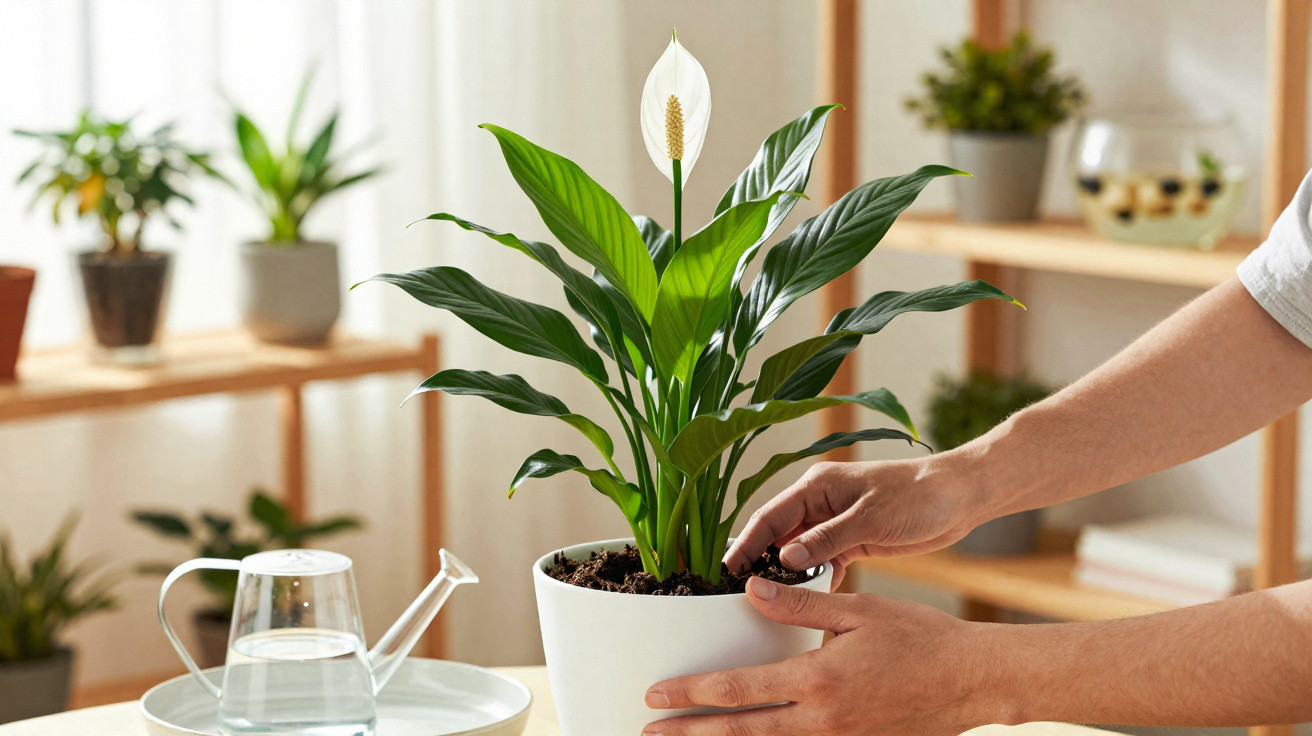
Anyone who owns a peace lily (botanically Spathiphyllum, and also commonly called the “peace lily”) will recognise the situation: the plant looks healthy and its leaves are glossy, yet fresh blooms fail to appear. You change the fertiliser and repot it too, but very little changes. In many cases, the overlooked deciding factor is neither the compost nor the position, but an apparently ordinary routine: watering.
Why your peace lily does not flower despite good care
Peace lilies originate in shady tropical forests. They grow beneath the canopy there, sheltered from direct sunshine, in soil that remains consistently fresh without becoming waterlogged. This precise balance is often missing when they are grown in a pot.
Too little water causes stress. The plant then conserves its energy: it may survive, but it economises on flowering. Too much water, on the other hand, literally deprives it of air. Roots sitting in saturated compost no longer receive oxygen, begin to rot, and the plant stops producing flowers.
A peace lily flowers reliably only when the compost stays lightly moist throughout, never soaking wet, while its surface is allowed to dry out between waterings.
Many owners water to a timetable: every Wednesday and Sunday, using the same amount each time. For a tropical houseplant, this habit can often be harmful. Its water requirements vary greatly according to the season, room temperature, pot size and available light.
The finger test: the most important watering rule
The simplest way to judge the right time to water is the old-fashioned but highly effective finger test. It removes the need for watering apps and fixed schedules.
Using the finger test day to day
- Push your index finger around two to three centimetres into the compost.
- If the upper layer feels dry but the compost beneath is still slightly fresh, it is the ideal time to water.
- Wait before watering if it is clearly damp even at a depth of two to three centimetres.
- If everything feels completely dry and dusty, the peace lily urgently needs water.
Use this test regularly and you will soon notice just how much the pace changes. In a warm, bright living room during summer, the plant may need water one to three times a week; in a cool corner in winter, a modest watering every two to three weeks can sometimes be enough.
There is also a useful practical clue: peace lilies communicate clearly. Leaves drooping limply are almost always a sign of insufficient water. Water the plant promptly and its leaves will stand up again within a few hours. This response helps you develop a sense of the perfect moment to water.
Watering like a professional: from below rather than above
Many experts recommend watering peace lilies mainly from below. This allows the roots to take up only the amount of water they genuinely require, making waterlogging far less likely.
Watering from below – step by step
- Fill a bucket, bowl or sink with water to a depth of a few centimetres.
- Remove the decorative outer pot and place the plant pot directly into the water.
- Leave it for 10 to 15 minutes, until the compost has absorbed water.
- Lift out the pot, allow it to drain thoroughly and pour away any surplus water.
- Return the pot to its outer pot only once no more drops are draining from it.
Anyone who waters frequently will notice the difference clearly. When watering from above, water often runs down the edges of the pot or collects in the outer pot. With bottom watering, moisture is drawn more evenly through the entire root zone.
Watering from below lowers the risk of root rot and ensures that the peace lily takes up precisely the amount of water it can actually use.
There is just one important point: after its soak, the plant must not remain in water for hours. Any water that has not been absorbed after 20 minutes should be poured away.
Light, humidity and temperature: the quiet supporting team
Even an excellent watering routine has its limits if the surrounding conditions are unsuitable. Peace lilies prefer bright, indirect light. A position one to two metres from a window is ideal, provided direct midday sun does not hit the leaves.
In dark corners, a peace lily may grow but will rarely produce flowers. On a windowsill in strong direct sunlight, its leaves can scorch in places and develop yellow or brown marks; flowering often fails in this situation too.
| Factor | Ideal for the peace lily |
|---|---|
| Light | Bright, but without direct midday sun |
| Temperature | 18–24 °C, with no cold draughts |
| Humidity | Slightly higher, without extremely dry central-heating air |
| Watering frequency | Based on the finger test, not a calendar |
Humidity is another factor that many people underestimate. It is high in tropical forests, but can be very low in a German living room during winter. When a peace lily stands directly beside a radiator, both its leaves and compost dry out quickly, causing the plant stress.
How to raise humidity with little effort
- Put the pot on a saucer filled with damp expanded clay pebbles.
- Group several plants closely together, as they create a more humid microclimate for one another.
- At temperatures above 20 °C, occasionally mist the leaves lightly with low-limescale water.
Avoid spraying the flowers directly. Otherwise, the white bracts may become marked or age more quickly.
How to spot stress and care mistakes in a peace lily
A peace lily gives fairly obvious signs when something is wrong. Reading these signals correctly means you can respond quickly and restore its willingness to flower.
- Yellow leaves, mushy roots: usually an indication of waterlogging and watering too often.
- Limp, dry leaves, with compost pulling away from the pot edge: the plant is significantly too dry.
- Brown leaf tips: frequently the result of air that is too dry or very hard water.
- Hardly any flowers despite healthy leaves: a location that is too dark, or overly nutrient-rich compost that remains constantly wet.
Room-temperature tap water is suitable for watering as long as it is not extremely hard. In a hard-water area, you can use water that has been left to stand or rainwater instead. Cold water straight from the tap slows growth and may damage the roots.
When fertiliser really makes sense – and when it does not
Watering your peace lily correctly creates the foundation for abundant flowering. A suitable fertiliser can enhance the result, but it can never replace the correct amount of water. During the growing period from spring to late summer, a weak liquid fertiliser for foliage plants every two to four weeks is entirely sufficient.
During autumn and winter, reduce feeding substantially or pause it briefly. Growth is slower at this time, the plant needs fewer nutrients, and it reacts more sensitively to excessive doses. Too much fertiliser can burn the roots and weaken the plant despite a perfect watering routine.
Why the effort is worthwhile: the peace lily as a green air filter
Good peace lily care delivers more than attractive white flowers. These plants are considered robust improvers of indoor air. They trap dust, raise humidity slightly and can absorb certain pollutants from the air.
Especially in small flats, a home office or a bedroom, a strong peace lily adds visual calm, absorbs a little noise and quietly creates a more pleasant sense of space. With the finger test, bottom watering and a suitable bright position, the effort remains manageable.
So there is no need to give up on a plant that has so far been reluctant to flower. Often, it is enough to use the watering can more thoughtfully, check the compost regularly and give the plant a little more light and humidity. In many cases, the peace lily responds within a few weeks with fresh, bright white bracts, showing that the new routine has taken effect.

Comments
No comments yet. Be the first to comment!
Leave a Comment