
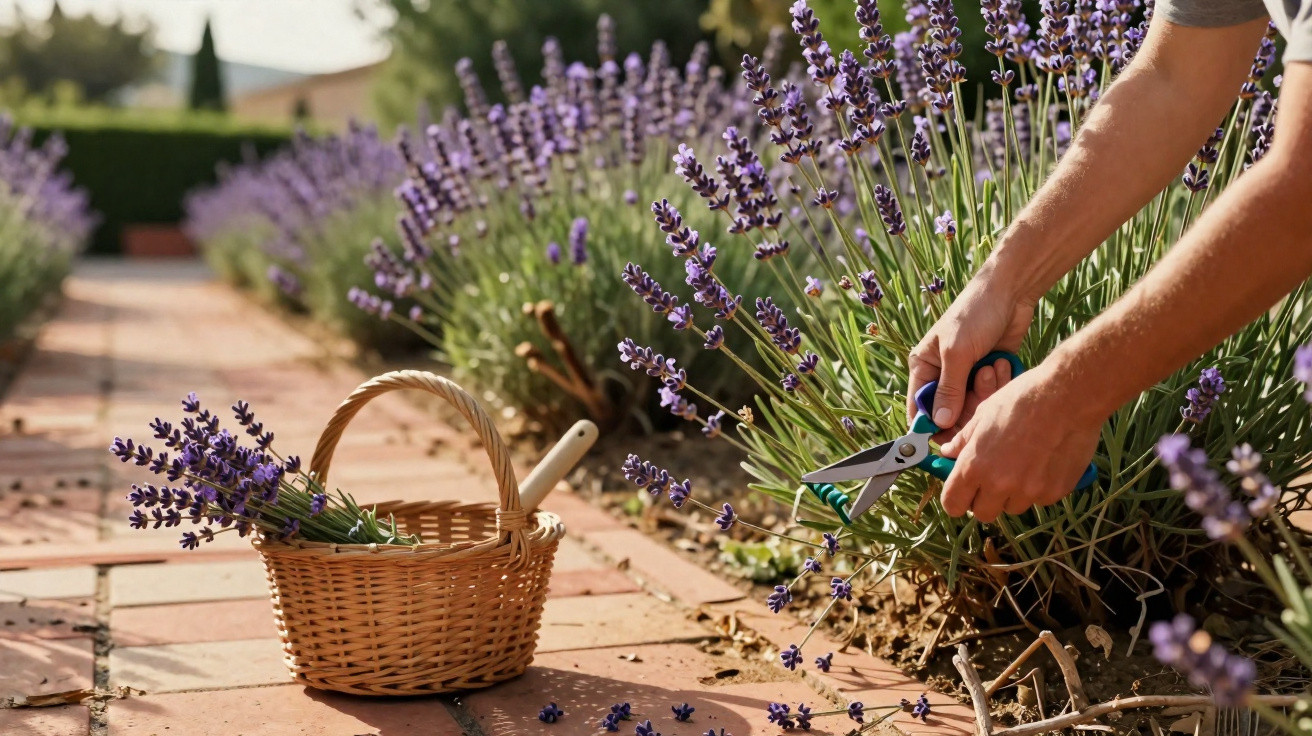
Many people blame climate change, the soil or the age of the plants. Yet in reality, whether lavender dies after a few years or flowers reliably for two decades often comes down to one very simple pruning step that has been missed.
Why lavender becomes woody so quickly without pruning
Lavender is not a typical herbaceous perennial; it is a subshrub. This means its lower growth turns woody, while the upper parts remain soft and green. That is exactly where the difficulty lies. The old brown wood produces new growth only unreliably. Leave the bush to grow unchecked and, after a few years, the same picture emerges:
- the centre becomes increasingly bare
- shoots flop outwards
- the plant resembles a dried-up twiggy broom
If you then reach for the secateurs and boldly cut into the brown wood, it is usually already too late. Many of those branches simply remain dead. As a result, the plant gradually declines, often well before reaching its true potential.
“Regular pruning within the green growth can increase lavender’s lifespan from under ten years to as much as twenty years.”
Lavender that is pruned correctly every year stays dense and rounded, continually producing fresh, flower-rich shoots. It remains visually youthful as well as biologically active.
The two best times to prune lavender
There is plenty of uncertainty around this: many amateur gardeners hesitate to prune lavender because they are worried about choosing the wrong moment. However, two pruning periods have proved particularly effective, with adjustments for local climate and region.
Main prune after flowering
The most important pruning window comes immediately after the main flowering period, usually from late August to late September. By then, the plants have invested their energy in flowering, are beginning to recover, and respond well to a more substantial cut within the green growth.
Shaping prune at the end of winter
The second pruning period falls at the end of winter, between February and March. Before sap flow becomes too active, this is the time to refine the shape, remove dead shoots and encourage the plant to branch again.
The timing can shift slightly depending on your region:
- Milder regions: Carry out the main prune after flowering; a light shaping prune is often possible from late February, provided the buds are still tightly closed.
- Cooler areas (northern regions, higher uplands and the fringes of the Alps): In autumn, mainly remove spent flower stems. Leave the actual shaping and maintenance prune until March, choosing frost-free days.
The calendar provides only a broad guide. If in doubt, inspect the plant: when the flowers have faded, the foliage is still green and there is no strong flush of new growth, the timing is usually right.
The most important rule: prune only green wood
The key technique is surprisingly straightforward, yet many people still overlook it: lavender tolerates pruning, but only in the green, leafy section.
“Never cut below a point just above the final layer of green leaves – this invisible ‘safety line’ saves many lavender plants.”
In practical terms, proceed as follows:
- Look at the plant from the outside and identify the area where green leaves are still present.
- Imagine a line just above the final pairs of leaves.
- Make every cut so that several centimetres of green shoots always remain.
Cutting further down into brown, bare wood risks leaving those shoots unable to regrow at all. Older lavender bushes in particular react very sensitively to this.
Step-by-step guide: how to prune lavender correctly
Following the right sequence makes pruning feel less daunting and helps even beginners achieve good results. Before making the first cut, check your tools: clean, sharp, disinfected secateurs significantly reduce the risk of disease.
1. Remove faded flower stems
Start by taking off the spent flowers. Cut each flower spike just above the first pair of leaves. This “cosmetic prune” immediately gives the plant a neater appearance and prevents it from putting too much energy into producing seed.
2. Shorten the green growth
Next, reduce the entire green section by roughly one third. At this stage, the exact shape is less important. The aim is to return the plant to a compact cushion.
- Young plants can be cut back by as much as half of their green shoots.
- With older specimens, proceed more carefully and remove no more than one third.
3. Round off the shape
Finally, give the lavender its familiar cushion-like form. Bring all shoots to a similar length, removing harsh corners and any isolated, overlong stems. Air and light should be able to reach the centre of the plant without creating gaps.
“The more even the ‘lavender ball’ looks, the more stable it remains – and the less likely shoots are to flop under snow or heavy rain.”
Young, mature and old lavender bushes – what changes?
Not every lavender plant in the garden needs the same approach. Age and variety both matter.
| Age / type | Pruning strategy |
|---|---|
| Young plants (1–3 years) | Prune fairly firmly, removing up to half of the green shoots; this encourages strong branching and a dense base. |
| Mature plants (lavender, lavandin, butterfly lavender) | Prune only in the green section, always leaving 3–5 cm of leafy shoots, and maintain the shape carefully. |
| Very old shrubs | Rejuvenate gradually by removing only some of the oldest shoots each year; replace plants with entirely bare bases with new ones. |
Many gardeners have an emotional attachment to old lavender bushes. When no green shoots appear from the base any longer, radical rejuvenation is rarely worthwhile. Instead, take cuttings from the most attractive plants that are still vigorous in good time, then establish young replacements elsewhere.
Common mistakes that shorten lavender’s life
A number of pruning errors occur repeatedly and drastically reduce lifespan:
- Cutting brutally into old wood: Shoots are cut back severely, but then remain dry and fail to regrow.
- Pruning during a strong flush of growth: Heavy cutting while spring sap flow is at its peak weakens the plant considerably.
- Not pruning at all: The plant may look wonderful at first, but it reaches the “bare broom” stage much sooner.
- Pruning in wet, cold weather: This encourages fungal disease and rot at cut surfaces.
Avoid these pitfalls and stick to the green safety line, and you have already dealt with the most important part.
Why this lavender pruning technique works so well
The principle behind this method is horticulturally simple: the green area contains active buds which, after pruning, immediately form fresh side shoots. This creates denser, finer branching. Each year, a compact framework of young, productive shoots develops.
“Lavender stays young for longer when it is deliberately encouraged to grow, rather than being allowed to become woody unchecked.”
Rather than concentrating its energy on long, woody stems, the plant produces numerous short shoots with strong flowering potential. More light reaches every leaf, moisture dries away faster and the risk of fungal infection is reduced.
Useful extra tips for long-lived lavender
Correct pruning is half the battle, but several additional factors can extend its lifespan even further:
- Position: Choose full sun, an airy spot and relatively dry conditions – waterlogging is more deadly than drought.
- Soil: It should be lean, ideally sandy or gravelly, and free-draining; if needed, improve it with horticultural grit or sand.
- Feeding: Feed very sparingly, or preferably not at all. Too many nutrients make shoots soft and prone to snapping.
- Choosing varieties: In colder areas, more robust lavandin varieties are often more dependable than sensitive butterfly lavender.
When planting new lavender, establish this routine from the outset: during the first few years after planting, cut it back regularly and firmly within the green growth so that it develops a dense framework. Later, the annual two-part prune after flowering and at the end of winter is sufficient.
This keeps lavender alive for longer while also producing more fragrant flowers for bouquets, scented sachets or bee forage. With sharp pruning tools, a clear eye for the green safety line and a little confidence to make the cut, the lifespan of these blue garden mounds can almost be doubled.
Comments
No comments yet. Be the first to comment!
Leave a Comment