
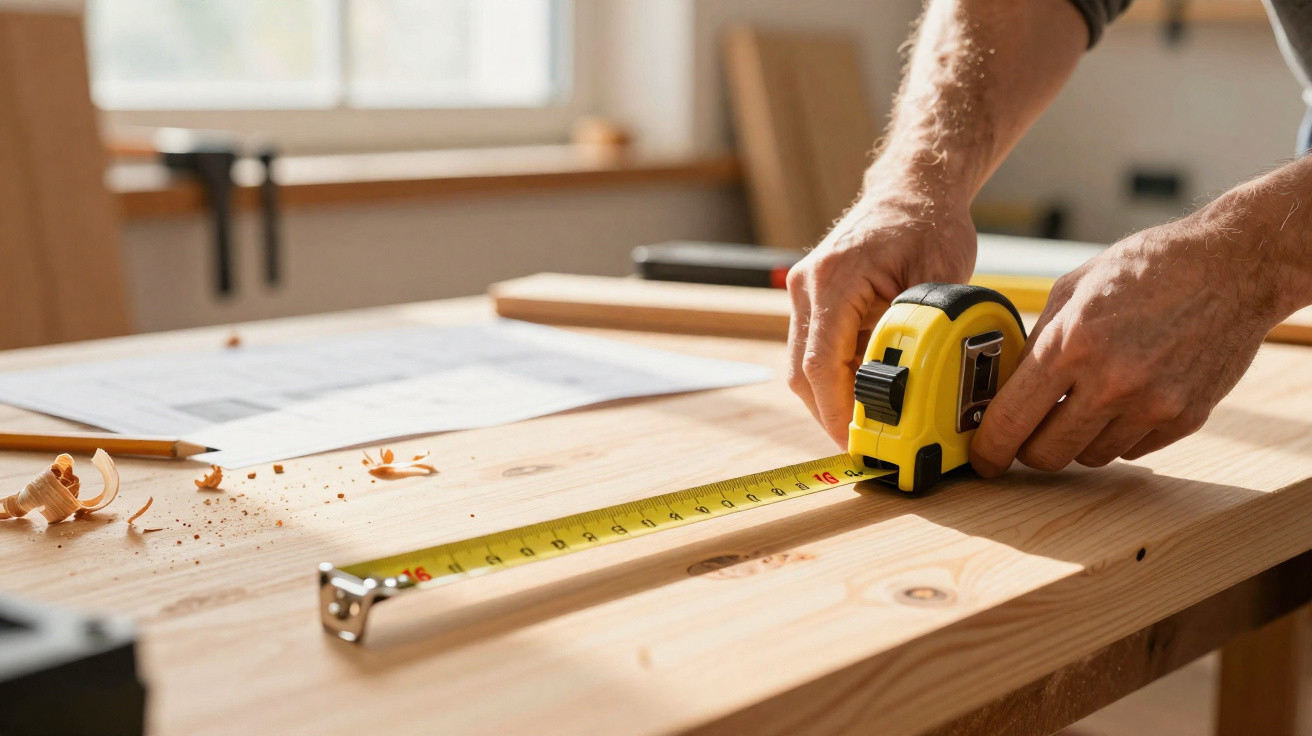
The red numbers on a tape measure are not simply decorative. On many models, they indicate measurements that are useful for repeated carpentry tasks, frame assembly and construction work based on standard intervals.
What are the red numbers on a tape measure for?
The red numbers on a tape measure generally identify particular inch measurements, especially the 16-inch interval. This distance is roughly 40.6 centimetres and is widely used as a guide for wall framing.
In day-to-day work, these indicators make it quicker to find fixing points, studs and divisions without having to recalculate each measurement. For people working with timber, plasterboard or panels, they speed up reading the tape and reduce the risk of mistakes.
Why is the 16-inch mark highlighted?
The 16-inch measurement is shown in red because many construction systems use this spacing between vertical studs. Rather than measuring every position from scratch, tradespeople can follow the highlighted marks along the tape measure.
- Makes it easier to locate studs behind walls.
- Helps mark repeated framework at consistent intervals.
- Lowers the likelihood of mistakes in successive cuts and drilled holes.
- Speeds up work involving panels, boards and timber.
Why are these marks less common in Brazil?
In Brazil, most work is measured in centimetres and metres rather than inches. As a result, many people see the red numbers on a tape measure without realising that they were designed for a different building standard.
Even so, many tape measures sold there include references for both systems. A tape measure may display centimetres along one edge, inches on the other, and special marks inherited from markets that use the imperial system.
Other hidden features can improve measurements
In addition to the red numbers, a tape measure includes features that can go unnoticed during straightforward household jobs. The metal hook at the end, for instance, has a small intentional amount of movement to account for its own thickness.
- The sliding hook accommodates internal and external measurements.
- The case may state its own length for measuring openings.
- Some tapes include centre markings for splitting dimensions.
- The lock keeps the blade steady when taking longer readings.
How can you use these marks without mixing up measurements?
Before relying on the red numbers, check whether the job is being measured in centimetres or inches. When making furniture, working on walls or carrying out small household repairs, mixing the two systems can lead to incorrect cuts and misaligned parts.
If the required dimension is given in centimetres, use the metric scale as your main reference. The red numbers on a tape measure are most useful when a project specifies inches, 16-inch spacing or framing standardised around that system.






Comments
No comments yet. Be the first to comment!
Leave a Comment