
After frying or deep-frying, many people routinely pour leftover oil straight into the sink. It disappears down the drain, the pan is quickly clean and the matter seems settled. In reality, this everyday habit can cause serious long-term damage inside the pipes. A straightforward method using kitchen starch can prevent blocked drains while also protecting the environment and your wallet.
Why cooking oil in the drain becomes a ticking time bomb
Fresh or still-warm frying oil initially appears entirely harmless. It is liquid, drains away rapidly and may still smell faintly of chips. The issue only starts further down the pipework.
When the oil meets cooler water, its properties change: it thickens, separates into flakes and coats the inside of the pipes like a film. Every rinse adds another layer.
Over time, thin oil turns into hard plugs of fat that gradually squeeze the pipe shut.
Food particles, hair, soap residue and limescale collect between these fatty deposits. Together, they clump into a dense blockage. At first, you may only notice water draining a little more slowly. Later, the sink suddenly fills up – and an emergency plumber has to be called out.
Plumbing firms have reported for years that these accumulations of fat account for a large proportion of call-outs to private kitchens and bathrooms. Public sewer systems are affected too: proper “fat mountains” can form there, which councils must remove at considerable cost.
Rather than drain cleaner: how starch solves the problem
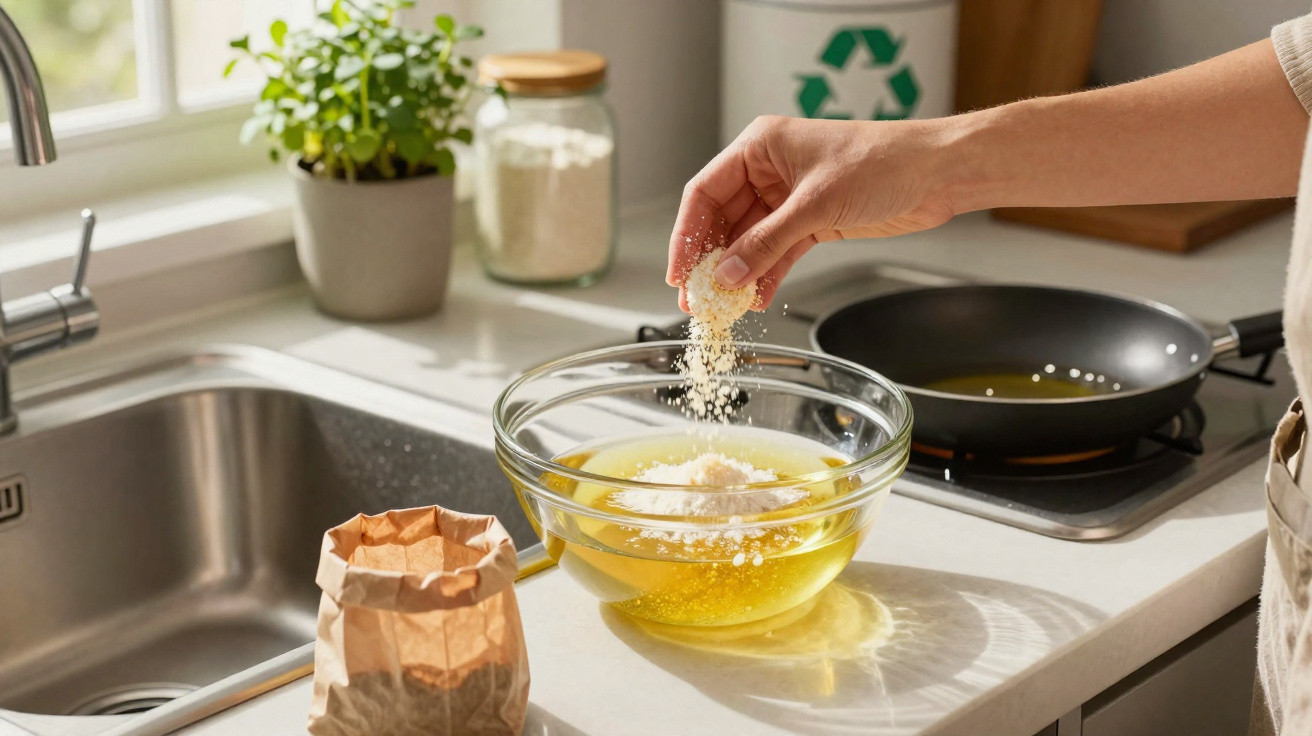
A simple yet remarkably effective answer is already stored in many kitchen cupboards: food starch, such as cornflour. This fine powder absorbs the fat and binds it into a solid mass that can be put into general waste without difficulty.
The principle is straightforward. Starch is made up of countless tiny particles with a large surface area. When it comes into contact with oil, the fat adheres to those particles. Given a little time, this forms a compact, dough-like mixture that hardens in the container.
Liquid problem waste becomes a solid lump that can go in the bin without risk.
Unlike hot water or harsh drain cleaners, starch does not merely push the problem further down the pipe; it stops it at the source. There are no chemical fumes, no danger to skin or airways, and no damage to seals or pipes.
How to use the method step by step
All you need
- used cooking oil, for example from frying or deep-frying (approx. 0.5 litres)
- 1–2 tablespoons of food starch, such as cornflour
- a jar or another sealable container
- a spoon for stirring
Prepare the oil correctly
Most importantly, the oil must no longer be boiling hot. Leaving it for a few minutes after cooking allows it to reach a comfortably warm, hand-safe temperature. This reduces the risk of burns and also protects the container.
Pour the oil into the container afterwards. Anyone who deep-fries often can keep an old screw-top jar permanently as an “oil catcher”, filling it gradually over time.
Turning oil into a solid lump
- Sprinkle the food starch over the oil in a fine stream.
- Stir thoroughly with the spoon until no dry lumps remain.
- Depending on the consistency, add a little more starch until the mixture thickens noticeably.
- Seal the container and leave it at room temperature for at least one day.
After around 24 hours, the liquid leftover oil will have become a solid beige-grey mass. It can be loosened easily with a spoon or knife and disposed of directly with general waste. If you use a jar with a secure lid, simply place the entire jar in the general waste bin once it is full.
No food starch available? These powders work too
The approach is not limited to conventional starch. What matters is that the powder is fine and absorbs liquid effectively.
Many kitchens already contain suitable alternatives:
- Wheat flour: binds fat somewhat more slowly, but works reliably.
- Baking powder: absorbs oil and can also help with mild odours.
- Leftover dried yeast: rather sticky to handle, but useful when nothing else is available.
- Plant-based starches such as arrowroot: similar to cornflour and sometimes even finer.
- Fine coffee grounds (dry) or sawdust: for DIY-minded people who deliberately want to make use of waste materials.
The brand matters less than the properties: fine, dry and absorbent.
If your household regularly produces larger amounts of oil, perhaps from a deep fryer or frequent pan cooking, you can create your own “oil block” from kitchen leftovers without buying anything extra, then dispose of it with household waste.
Benefits for the environment, household and budget
The immediate benefit is in your own sink: no gradual narrowing of pipes, fewer drain odours and a significantly lower chance of costly pipe-cleaning work. Simple changes to how fat is handled are among the most effective ways to prevent blocked drains.
There is an environmental benefit as well. Every litre of cooking oil kept out of the sewer reduces the burden on wastewater treatment plants. Fat has to be separated there through labour-intensive processes so that it does not pollute rivers and lakes. Oils and fats disrupt biological treatment processes and require additional energy during processing.
Binding oil at home and disposing of it in general waste avoids this extra work. The solid material is simply incinerated at a waste-to-energy plant, where it even provides energy, much like other combustible household waste.
Other options for old cooking oil
For small quantities from a frying pan, the powder method is ideal. Larger volumes, however, can quickly result in a sizeable amount of starch and flour. In this case, other routes are more suitable.
Many local authorities and recycling centres collect cooking oil separately. In some places, collection machines or dedicated bins are available. The collected fat is then used as a raw material, for instance for biodiesel or industrial applications. Those who fry frequently, whether using a home deep fryer or for hobby catering, should ask their local council about regional services.
Common mistakes – and how to avoid them
A few basic rules will ensure the method works properly:
- Never bind oil while it is boiling hot: there is a risk of fire and scalding, and the glass may crack.
- Use enough powder: if the mixture is still very runny after several hours, sprinkle in more and stir again.
- Do not overfill the container: the mixture needs room for stirring.
- Do not pour organic waste into the toilet: bound fat belongs in general waste too, not down the WC.
Following these points quickly establishes a safe kitchen routine. Let the used pan cool briefly, pour the oil into a jar, add powder – and pipe problems stay away.
Why one small kitchen habit has a big effect
The way a household deals with fat often reflects how consciously it uses resources. Pouring it down the drain may seem convenient, but it can lead to costly repairs years later. The powder method takes only a few minutes and a little cupboard space, yet prevents a whole range of follow-on problems.
For parents, the process can also be a useful way to teach children about environmental issues and household knowledge through play: Where do blockages come from? Why must certain substances not enter the sewer system? How can risks from the kitchen and everyday life be removed without giving up convenience?
What seems like an insignificant action can ultimately become a firm part of the everyday kitchen routine, offering clear benefits for pipes, your wallet and the environment. Liquid trouble becomes a manageable lump that can no longer harm anyone.



Comments
No comments yet. Be the first to comment!
Leave a Comment