
“But this is exactly where the rescue begins.
A lemon tree that looks dried out and has not a single leaf left can appear alarming. Yet this sight usually does not mean the plant is beyond saving; instead, it has entered a clear survival mode. A straightforward method that costs virtually nothing can revive the weakened tree surprisingly quickly – without specialist equipment or expensive fertiliser, using only water, secateurs and a little patience.
Is a bare lemon tree actually dead?
It is a familiar scenario after a holiday, a period of central heating or a hot summer weekend: the lemon tree resembles a skeleton. There are no leaves, the branches feel rigid and the pot seems unusually light. Many people then take the plant to the bin far too soon.
In most cases, the tree is suffering from severe lack of water. It sheds its leaves to survive and switches into an energy-saving state. The key question is therefore whether the wood is still alive.
- Carefully scratch a thin branch tip with your fingernail
- If a greenish layer is visible underneath, that branch is still alive
- If it is brown and dry throughout, that section has died
As long as green layers can still be found beneath the bark, the lemon tree has a realistic chance of making a comeback.
Before fertilising prematurely or watering frantically every day, the tree needs a clear recovery plan – otherwise the problem may become worse.
Why lemon trees “suddenly” lose all their leaves
The bare appearance is nearly always caused by the same process: acute water shortage and a completely dried-out root ball. Once compost in a pot becomes too dry, it shrinks and pulls away from the sides of the container. Water subsequently poured onto the surface then simply runs down the pot wall and out again, without soaking into the root ball.
The plant therefore remains dry even when it is watered regularly. Its roots receive very little moisture, the leaves wilt and then drop. Adding fertiliser to dry compost at this point can damage the roots, as the nutrients come into contact with roots that are already weakened.
Typical warning signs
- A light pot despite regular watering
- Water immediately drains out through the bottom
- Sudden heavy leaf drop without a pest infestation
- The compost surface lifts away from the pot edge like a “lid”
At this stage, merely “watering more from above” will not help. The entire root ball must be properly rehydrated – and that is where the classic zero-cost method begins.
Day 1: The rescue plan for dried-out lemon trees
Step 1: A radical but targeted prune
First, assess the tree’s vitality. Scratching the bark in several places reveals how far the dead wood extends. Any part that is completely brown inside can be removed. Using clean, disinfected secateurs, cut away dead material until only healthy, green wood remains.
A useful rule of thumb is to reduce the crown by around one third, directing the remaining strength into the shoots that are left.
Although this pruning can seem harsh, it relieves the tree considerably. A smaller crown means less moisture loss and more energy for fresh buds. Larger cut surfaces can be treated with wound sealant; this is not essential, but it may help.
Step 2: A full soak instead of a watering can
After pruning comes the most important stage: giving the dried-out root ball a complete supply of water. Leave the plant in its pot and place it in a bucket or tub of lukewarm water. The ideal temperature is roughly 20 degrees.
- Place the pot in water up to just below its rim
- Wait for at least 15 to 20 minutes
- Leave extremely dry compost in the water for up to two hours
- Wait until air bubbles stop rising
When no more air bubbles rise, the root ball has been fully saturated. Then remove the pot and place it somewhere shaded so that it can drain thoroughly. Important: do not use saucers where water can remain standing.
The tree should now be kept in a bright but non-sunny room at moderate temperatures of around 15 to 18 degrees. Water sparingly during this period.
The “mini greenhouse” trick using a plastic bag
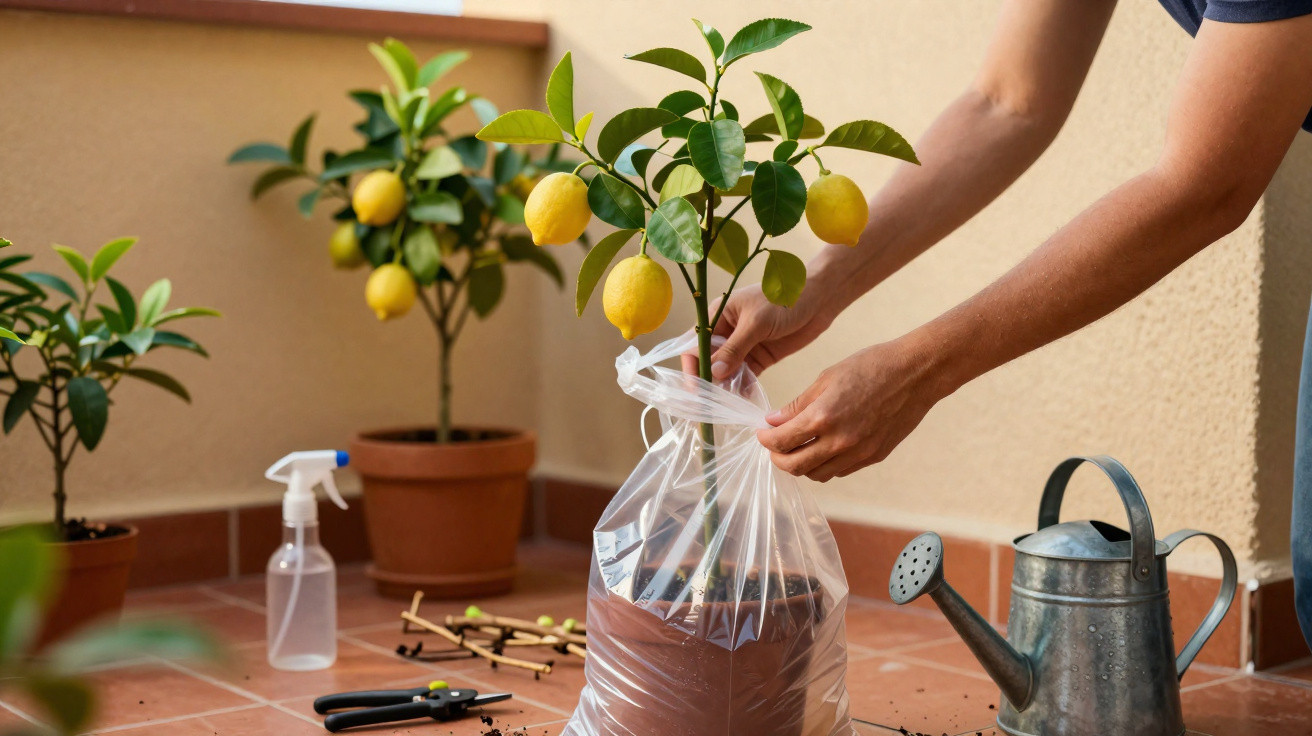
The second key part of this method is creating a humid microclimate around the weakened tree. This reduces moisture loss and encourages new growth.
Use an ordinary transparent plastic bag or thin plastic film, such as the type used by dry cleaners. Loosely place it over the crown and secure it around the pot beneath the branches, for example with an elastic band.
The plastic creates a climate with very high humidity, helping stressed citrus plants produce new shoots noticeably faster.
The plant is now effectively sitting in a temporary greenhouse. However, it still needs fresh air: open the bag for around ten minutes every two days to prevent mould from forming. In many cases, the first fresh buds appear after roughly two weeks.
The critical 15 days: What the tree really needs now
Days 2 to 7: Rest, light and very little water
For the first week after the soak, keep the plastic covering on the tree continuously. The compost should dry slightly, but must not become completely dry. Checking with a finger at a depth of around three centimetres once a day is sufficient.
- Water only when the compost is clearly dry at this depth
- Do not apply fertiliser while no new buds are visible
- Do not move the plant outdoors
- Avoid draughts and direct warm air from radiators
The tree’s energy is now directed towards root recovery and activating dormant buds. Additional stress from wind, temperature changes or direct sunlight serves no purpose at this stage.
Days 8 to 15: Gradually returning to normal plant life
Once buds begin to swell or tiny leaves emerge, the conditions can be adjusted carefully. Keep the plastic bag in place initially, but open it a little further each day. This allows the tree to acclimatise gradually to normal indoor air.
After several days, the bag can be removed completely. The lemon tree can now tolerate more light; its position may be brighter, though it should not yet be in intense direct sunshine. Temperatures can now settle more in the range of 18 to 22 degrees.
Only after proper, strong new leaves have developed should a specialist liquid fertiliser for citrus plants be used – initially at half strength, about every three weeks. Applying too many nutrients at once can place the roots under stress again.
When repotting is worthwhile – and when it is not
Many people instinctively reach for a larger pot when problems arise. For a lemon tree that has just been stressed, however, this is usually the wrong moment. The plant is putting all its energy into recovery, and changing pots adds further stress.
| Situation | Is repotting advisable? |
|---|---|
| Roots circle tightly around the edge of the pot, with hardly any compost visible | Yes, after recovery, into a loose, free-draining growing medium |
| Compost appears old, compacted and poorly draining | Yes, likewise after new growth has started |
| The plant has only just been rescued from drought stress | No, stabilise it in the existing pot first |
A suitable growing medium is a mix of specialist citrus compost and some coarse material, such as expanded clay or coarse sand, so that water can drain away well.
Common mistakes when caring for lemon trees
Container-grown lemon trees are considered demanding, but many issues recur time and again. Knowing these pitfalls helps prevent the next alarming moment of bare branches.
- Saucers that are too small and retain standing water – roots suffocate
- Inconsistent watering: soaking wet at first, then dry for weeks
- Direct midday sun through glass without gradual acclimatisation
- No protection from cold in winter quarters during major temperature changes
- Applying fertiliser to bone-dry compost
A simple routine is helpful: water less often but thoroughly, then wait until the top layer has noticeably dried again. A finger in the growing medium remains the most reliable checking tool.
Why citrus plants are so sensitive to water
Lemon trees originate in regions with abundant light and relatively free-draining soils. Their roots tolerate neither constant waterlogging nor drought lasting several days. In addition, plants in containers dry out far more quickly in summer than garden plants growing in the ground.
If the root ball is repeatedly moistened only at the surface, roots grow shallow and remain weak. Strong roots that extend deeply develop when the whole root ball is soaked thoroughly at wider intervals. The bucket water-bath rescue method described here replicates exactly these conditions and can revive even severely weakened plants.
Anyone who takes a slightly more systematic approach to care after the initial shock can enjoy their lemon tree for a long time – and the supposedly “dead” plant may ideally prove to be a persistent survivor that received the right treatment just in time.



Comments
No comments yet. Be the first to comment!
Leave a Comment