
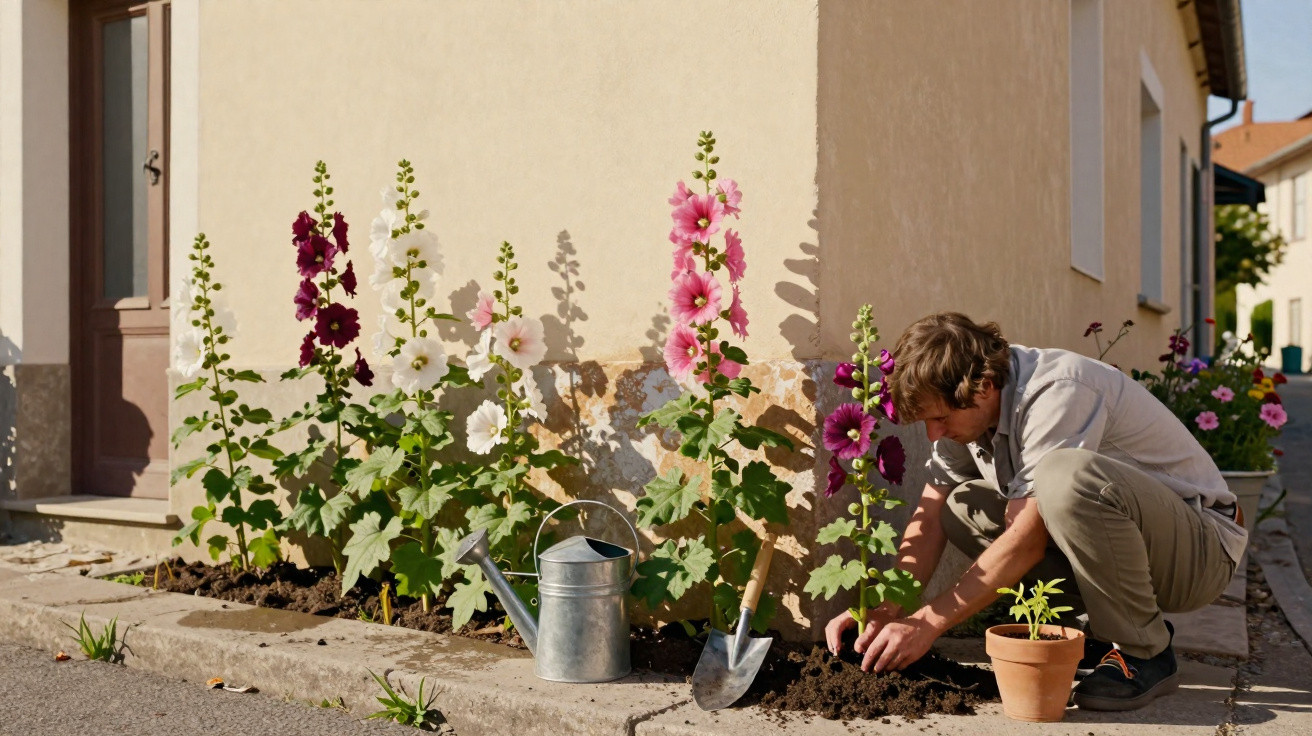
The hollyhock, scientifically known as Alcea rosea, can be seen growing against façades, walls and old houses in many European villages. Although its tall, colourful blooms may seem purely decorative, the plant was also used to help manage damp at the base of walls, particularly in older buildings without modern waterproofing.
Which flower is commonly seen on town façades?
The hollyhock is an upright plant with tall stems and flowers that may be pink, white, red, purple or yellow. Because it grows close to walls and façades, it has become a familiar feature of old streets, country homes and stone-fronted buildings.
Its appearance is striking, as the blooms are arranged along the stem to form a colourful vertical display beside the building. As a result, many people view it simply as an ornamental plant, unaware that it once served a practical purpose.
Why was the hollyhock planted beside walls?
In old houses, damp could rise through the lower sections of walls, especially after rainy spells. Since many buildings lacked modern barriers against water ingress, placing deep-rooted species near walls offered a simple way to absorb some of the water collecting in the ground.
- Deep roots: draw water from lower layers of soil.
- Dense foliage: increases transpiration and the amount of water used by the plant.
- Vertical growth: takes up little room alongside a wall.
- Its flowers also added beauty to plain façades.
- The plant could conceal flaws, drains and old marks on walls.
How does the hollyhock help manage damp?
Hollyhocks need water to grow well, particularly during warm periods. When planted at the foot of a wall, they can take up some of the moisture in that area, helping to make the surrounding ground less waterlogged.
- It performs best in well-drained soil.
- A wall provides protection from strong winds.
- Heat retained by the wall supports growth on colder days.
- Its roots generally grow downwards rather than spreading sideways.
- It therefore does not usually lift paving in the way that species with aggressive roots can.
Is the hollyhock still useful around modern homes?
In modern buildings, hollyhocks are not a replacement for waterproofing, proper drainage or repairs for water ingress. If there is mould, flaking plaster or persistent damp, the issue must be assessed by a professional.
Nevertheless, the plant remains useful as a landscaping feature. It enhances walls, adds height to gardens, attracts pollinators and softens overly harsh façades, especially around rustic homes or in sunny outdoor spaces.
How should hollyhocks be grown near façades?
Choose a sunny position with free-draining soil and enough space for the stems to develop without obstructing doors or windows. The plant benefits from regular watering but does not tolerate constant waterlogging, so the soil must allow excess water to drain away effectively.
The hollyhock shows how many gardening traditions developed through practical observation. It decorated and scented the setting, helped disguise imperfections, and could also contribute to managing moisture around walls, combining beauty and function in one plant.


Comments
No comments yet. Be the first to comment!
Leave a Comment