
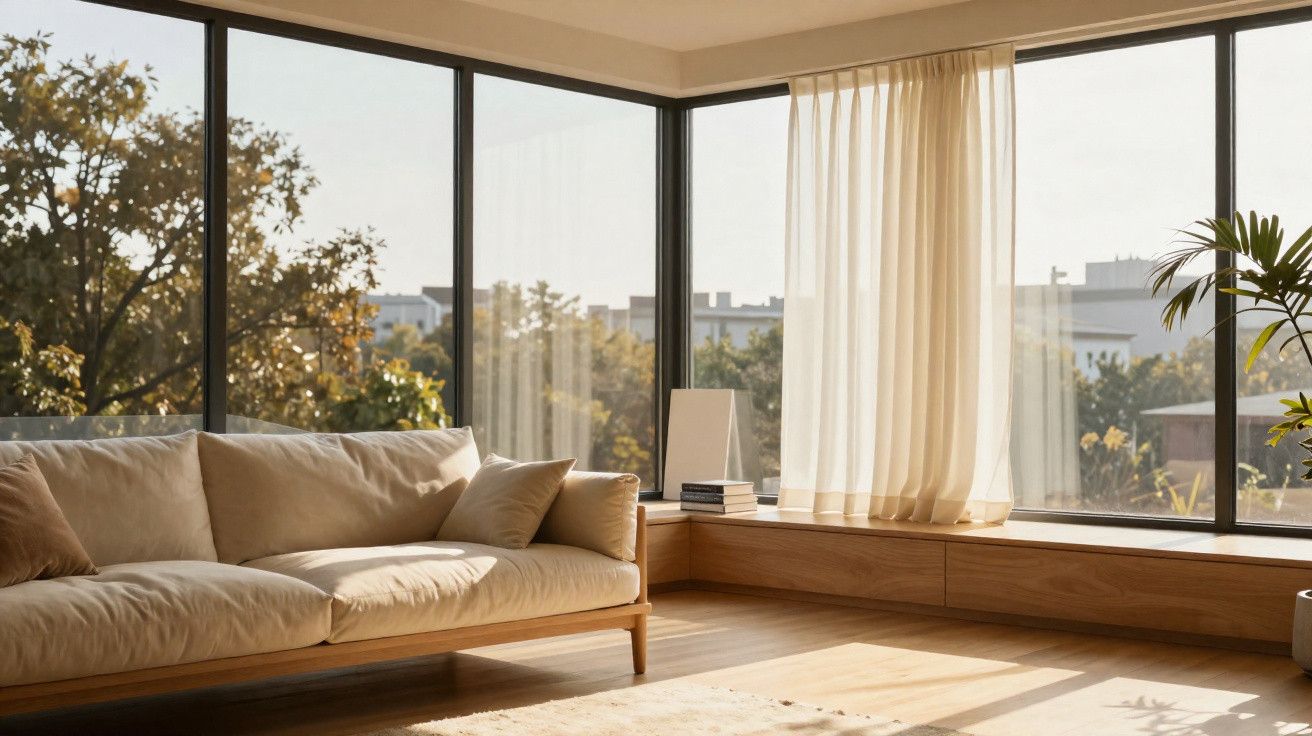
On a Saturday morning, daylight streams confidently into the living room. There are no sheer curtains to draw, no fabric collecting dust: only a broad glazed window, a few plants and the faint reflection of the sky across the wooden floor. The room immediately feels larger, almost as though its walls had shifted back overnight. Yet some visitors frown when faced with this bare window: “But the neighbours can see everything, can’t they?” It is a recurring question, carrying the blend of curiosity and unease prompted by this trend. Curtain-free windows leave no one unmoved. They offer light, while challenging our deeply personal desire to hide away. What if the real luxury were simply letting daylight in?
Why bare windows transform a room’s atmosphere
In period flats and newly built homes alike, taking down curtains creates a small visual jolt. The eye travels more freely, window frames return to their role as architectural features, and daylight brings out details that had faded into the background: the texture of a wall, the outline of a vase or the grain of a wooden table. The window becomes a living picture, changing with the time of day, the weather and the seasons. We all know how a room can seem calmer after a thorough tidy; here, the result is much the same, except that it is created by light.
In a one-bedroom flat in Paris’s 11th arrondissement, a young owner removed her beige lined curtains after repainting her sitting room in off-white. She expected to gain a few apparent centimetres. Instead, she found that her sitting room received almost two additional hours of direct winter sunshine, a noticeable difference in everyday life. Professionals often refer to a perceived gain: difficult to measure with a tape measure, yet obvious to the eye. An unobstructed window can make a room seem 10 to 20% bigger. In 25 m², that matters enormously.
This look also appeals because it responds to a very contemporary weariness with overloaded interiors. After layers of cushions, heavy drapes and bold colours, many people are looking for breathing space. A bare window need not feel cold; it can highlight a period radiator, a brass handle or mouldings concealed by fabric for years. The decoration does not vanish; it simply gives more room to what is already there. The debate begins when the view faces the building opposite.
Designers’ advice for curtain-free windows without losing privacy
Before taking down the curtain rail, spend a full day observing your home. See what happens at 8 am, at 2 pm and after nightfall, when a lit interior becomes highly visible from the street. A curtain-free window works particularly well when it overlooks a garden, an open courtyard, a roofscape or trees. If neighbouring properties are close by, consider a partial solution: frosted film on the lower section of the glass, tall plants, a discreet blind or a sliding panel used only in the evening.
A common mistake is copying a magazine photograph without considering the orientation. A large south-facing glazed window with no protection can turn the sitting room into a greenhouse as soon as warmer weather arrives, while fading a sofa positioned too close to it. Let us be honest: hardly anyone really checks sun exposure before buying every piece of furniture. It is therefore better to plan ahead with hard-wearing materials, a plant that can cope with intense light or an almost invisible technical blind. The aim is not to live behind glass, but to create comfort that lasts.
Designers often suggest treating the window as a feature in its own right, paying attention to its finishes, glazing and the view outside.
“Removing curtains does not mean giving up privacy; it means thinking about it differently, based on real uses rather than decorative habits,” observes interior designer Camille Moreau.
A few useful guidelines can help you decide without regrets:
- Keep the light with transparent UV-protection film or a retractable sheer curtain.
- Position plants, a low bench or a lightweight bookcase to screen overlooking views.
- Give the frame proper attention: paint, handles, seals and the sill all become visible.
- Plan a night-time solution if neighbours are less than fifteen metres away.
A minimalist trend, though not necessarily for everyone
Curtain-free windows also suggest a more exposed way of living, one that is more open to the outside world. For some people, the idea brings an almost instant sense of freedom: watching trees move, following rain across the panes or glimpsing city lights without having to pull fabric aside each morning. For others, no curtains remove something reassuring, as though the sitting room were unfinished. There is nothing snobbish about preferring sheer curtains. A home is not a shop window, and comfort cannot be measured by the amount of light that enters it.
The trend is most common in bright homes, contemporary renovations and interiors influenced by Japanese or Scandinavian style. It can also give a second life to an old window whose proportions had been forgotten beneath heavy drapery. Perhaps the real question is not “curtains or no curtains”, but how you want to feel when you come home. A very bright room may energise you in the morning, while a more cocooning atmosphere can soothe you after a noisy day. Between those two options lie countless variations, from fine blinds to linen panels.
Ultimately, this decorating trend owes its appeal to its apparent simplicity. Removing curtains seems free, quick and reversible, which explains its attraction at a time when many people want to change their interior without major building work. Yet the gesture reveals everything: the quality of the view, the condition of the windows, the aspect, the relationship with neighbours and even our need to feel at home. Sharing a photograph of a bare window may inspire people, of course. Explaining what it genuinely changes in a day is even more interesting.
| Key point | Detail | Added value for the reader |
|---|---|---|
| Natural light becomes a decorative feature | With no fabric in front of the glazing, daylight moves more freely and emphasises the volumes, materials and colours already present in the room. The window frame, often overlooked, also regains a genuine visual presence. | This option can create a sense of space without repainting or buying furniture. It helps people understand what already works in their sitting room, sometimes through a simple trial lasting a few days. |
| Privacy should not be taken lightly | The result varies greatly according to the height of the home, the distance from neighbours, night-time lighting and the nature of the view. A window looking onto trees raises different issues from a ground-floor window facing the street. | Readers can avoid an impulsive decision by observing their interior at several points during the day. Frosted films, lightweight blinds and plants provide less drastic alternatives to immediately reinstating lined curtains. |
| Minimalism works when it remains comfortable | A bare window may require protection from sunshine, overlooking views or cold. The trend is not about removing every window dressing, but about selecting a subtler solution that fits real life. | This approach helps create a personal home rather than a setting copied from social media. The best window is one that lets in light while still allowing you to feel at ease in your own home. |




Comments
No comments yet. Be the first to comment!
Leave a Comment