
The reason is often only apparent at second glance.
Many owners notice a problem only when the spider plant’s normally elegant “leaf fountain” begins to collapse. The plant may look lopsided, with some leaves sharply bent, others unusually soft or even turning yellow. There is enough light and it is watered regularly – yet this houseplant suddenly looks miserable. The key point is that not every bend has the same cause, and those differences determine whether the spider plant recovers quickly or gradually declines.
What a truly healthy spider plant looks like
A vigorous spider plant produces long, narrow, bright-green leaves, often marked with a white stripe through the centre or along the edge. They emerge in clumps from the middle of the pot before arching gently outwards. At its best, the plant resembles a small ornamental fountain of foliage: dense, flexible and free from sharp bends.
If you move a healthy leaf gently between two fingers, it should offer resistance without making a cracking sound or having a single distinct bend point. Its central rib follows the leaf’s curve, with no sign of breakage or compression. The surface feels smooth, without sunken patches, papery dryness or soft, mushy areas.
A damaged leaf looks very different. It has a clear angle, rather like a bent drinking straw. Run a finger over it and you will feel a noticeable ridge. If the area around the break is yellowish, soft or crumbly and dry, the inside of the leaf has been injured. Water can then travel less effectively, photosynthesis is disrupted and the leaf provides hardly any energy.
Healthy spider plant leaves are long, flexible and evenly curved – without hard edges, broken sections or mushy patches.
Common causes of bent or broken leaves
A simple accident: mechanical damage
Before assuming there is a care issue, check whether an accident may be responsible. Common situations include:
- A leaf being trapped while cleaning, vacuuming or walking past
- A cat or dog jumping onto the windowsill and landing in the plant
- The pot briefly toppling over or being moved roughly
- Leaves becoming caught between the pot rim and the saucer
In these cases, only individual leaves are usually affected, while the rest of the plant grows normally. New growth remains upright and strong. There is no need to change your entire care routine; simply remove the affected leaves.
Too much water: when the pot becomes a bathtub
Several bent or soft leaves in different areas, combined with a heavy, sodden root ball, often indicate overly frequent watering. The roots remain in water for too long, receive too little oxygen and start to rot.
Typical signs of overwatering include:
- The compost feels permanently damp and cold, sometimes with a musty smell
- The surface remains dark even days after watering
- Leaves become soft, flop sideways and bend easily
- Yellowish or glassy-looking areas develop along the central rib
In this condition, the roots can no longer transport water and nutrients properly. Leaf tissue loses its firmness, breaks more readily and looks unhealthy, even though you appear to be “taking good care” of the plant.
Overwatering is more common in houseplants than genuine drought – especially in heavy, compact composts without good drainage.
Too little water: dry, brittle foliage
The opposite problem is insufficient water. The root ball pulls away from the sides of the pot, the compost looks pale and almost dusty, and the plant appears slightly shrivelled. Put simply, it lacks moisture.
Typical warning signs are:
- Leaves turn brown and brittle from the tips inwards
- Entire leaves snap when touched, like dry paper
- The pot feels exceptionally light when lifted
- The compost visibly shrinks away from the pot walls
When this happens, the plant’s transport channels narrow as it protects essential parts. The leaves lose their elasticity and bend at the slightest knock.
Root rot, insufficient light and dry air
Looking at the surface is not always enough. If leaves remain soft despite adjusted watering, root rot may already have developed. It is then worth carefully checking the root ball: gently tip the pot, ease out the root ball and inspect it.
| Symptom | Possible cause | Immediate action |
|---|---|---|
| Brown, slimy roots with an unpleasant smell | Root rot caused by too much water | Remove rotten tissue, repot, allow to dry out |
| Plant leans heavily towards the window | Insufficient light weakens leaf tissue | Choose a brighter position, directly by a window |
| Leaf tips are brown while the rest of the leaf remains green | Dry heated air, uneven watering | Increase humidity, water more consistently |
Dry air is particularly troublesome during winter. The leaf tips die back gradually, making the tissue at the transition point unstable. Bends often then occur directly behind a brown tip.
What to do with damaged spider plant leaves
There is little point hoping bent spider plant leaves will “heal themselves”. Once a leaf has properly snapped, that point remains weak. The leaf will not regain continuous strength there.
The best approach is:
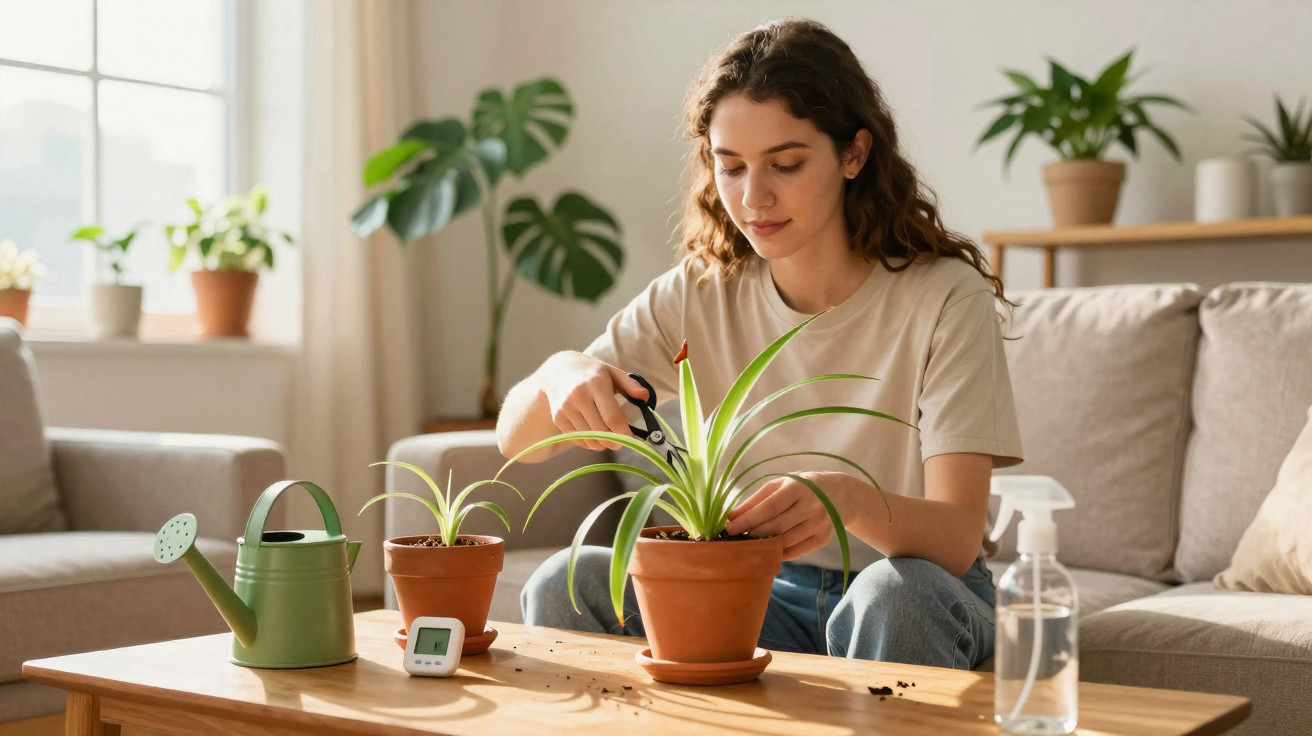
- Cut affected leaves close to the base with clean, sharp scissors.
- Clean the cutting tool beforehand with alcohol or hot water.
- Remove only severely misshapen or mushy leaves; the rest can stay.
A generally healthy spider plant will quickly produce new leaves and visually fill the gaps. Rather than putting energy into partly functional foliage, it can direct its strength towards fresh, sturdy growth.
Watering correctly: finding the balance
The most important factor is probably a watering routine suited to the conditions around the plant. Fixed rules such as “once a week” can easily go wrong. Use these points as your guide instead:
- Check the top 3–5 centimetres of compost with your finger: water only when it feels dry.
- If in doubt, wait one more day rather than watering too early “just in case”.
- Empty any standing water from the saucer after 15–20 minutes.
- Water considerably less in winter and in darker positions than in summer.
Anyone unsure can use a simple soil-moisture meter. It does not need to be an expensive model; what matters is being able to judge moisture around the roots more accurately than by sight alone.
Preventing new bends and break points
The right pot and suitable compost
A pot with a drainage hole is essential. Without an outlet, water collects at the bottom even when the surface appears dry. An airy compost is ideal, such as quality potting compost mixed with a little coarse sand or expanded clay. This allows water to drain away while giving roots access to oxygen.
Overly large pots can also be problematic. The compost in the centre stays wet for longer, while the surface already feels dry. Spider plants prefer pots that are slightly snug, provided they are not completely root-bound.
Position, humidity and everyday practical tips
A bright spot without direct midday sun encourages firm leaves. In deep shade, the plant stretches towards the light, its leaves become softer and they break more easily.
Straightforward measures can help against dry heated air:
- Place a tray of water and stones beneath or beside the pot
- Keep the spider plant with other plants to raise local humidity
- Avoid placing it directly above a radiator
For households with pets or small children, a hanging pot is a good option. The plant is kept safely out of the way, and its leaves are less likely to be knocked or treated as a toy.
Why leaf damage is more than a cosmetic issue
Bent leaves do not merely make a plant look neglected; over time, they weaken it. Every leaf surface produces energy. If a large proportion becomes non-functional, the spider plant must draw on reserves in its roots and remaining leaves. In the long run, this makes it more susceptible to pests, fungi and further care mistakes.
Those who spot the warning signs early – soft leaves, unusual bends or changing colour – can correct the problem with only a few steps. In most cases, adjusted watering, a more free-draining compost and a stable location are enough for the characteristic green “fountain” to rebuild within a few weeks.
One further factor is often underestimated: nutrients. Heavily faded, thin leaves that bend easily may indicate unbalanced feeding or no fertiliser at all. A moderate green-plant fertiliser in spring and summer – always at a low dose – helps the plant form strong, resilient leaves that cope better with knocks and pulling.

Comments
No comments yet. Be the first to comment!
Leave a Comment