
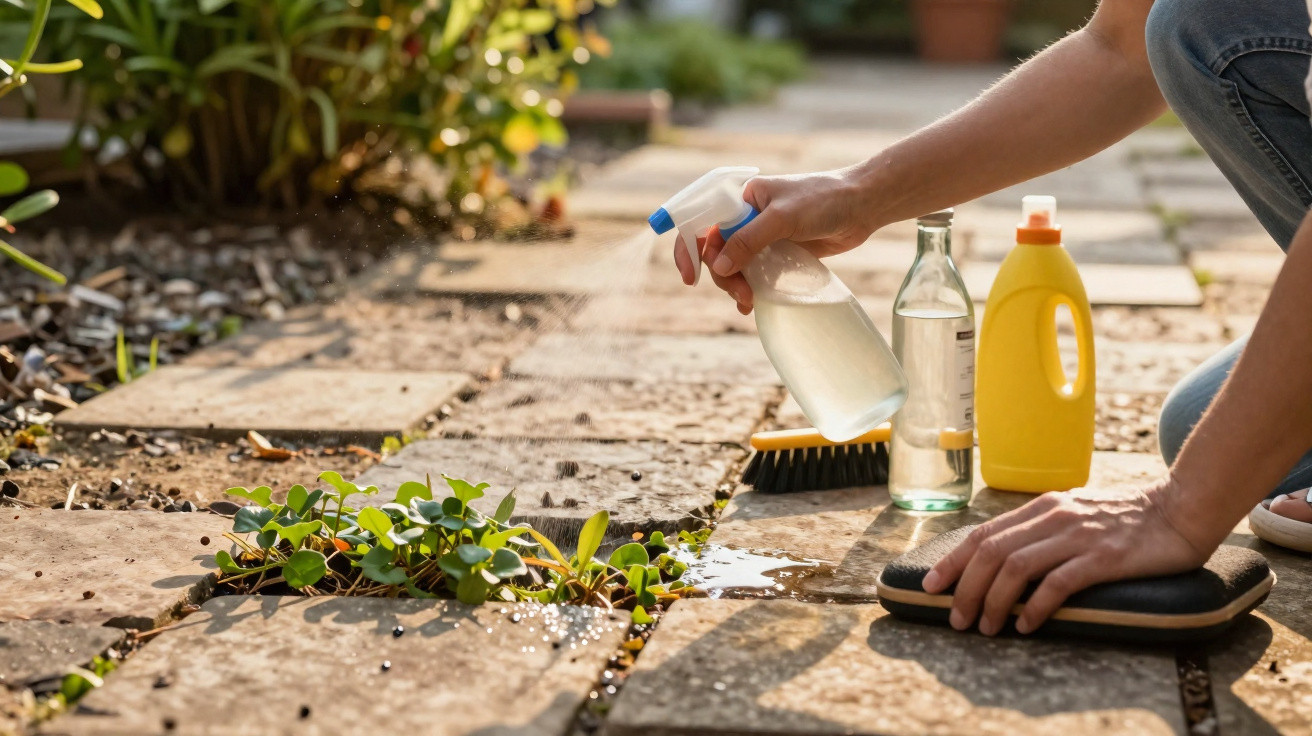
Anyone with a block-paved driveway, a slabbed patio or a gravel path will know the issue: no sooner have the weeds been removed than they start growing back. Household vinegar was long regarded as the natural remedy of choice. Yet before long, the problem returns. Now, another kitchen product appears to work far more effectively behind the scenes – and is rapidly gaining attention among gardeners.
Why ordinary household vinegar barely solves the weed problem
Vinegar acts only on the plant's surface. Its acid attacks leaves and stems, causing them to discolour, lose moisture and quickly droop. Visually, this can look like complete success, as though the plant has died.
In reality, very little happens below ground. With many species, the roots remain largely undamaged because they sit too deep for the acid to reach them. As a result, fresh shoots can emerge from the still-living root system after a few days or weeks.
“Vinegar can scorch visible greenery, but it often leaves untouched the very part of the plant that allows the weed to keep returning: the root.”
Vinegar may be sufficient for isolated, very young weeds. However, anyone wanting permanently clear joints in a driveway or patio would need to keep spraying repeatedly. That takes time, becomes frustrating and can also place a long-term burden on the soil. Many amateur gardeners therefore look for a stronger solution that does not rely on harsh shop-bought chemicals.
Washing-up liquid: an overlooked aid against weeds in joints
The surprising answer may be in the kitchen cupboard: ordinary washing-up liquid. This everyday product contains substances known as surfactants. They break down grease and dirt, but they also attack plants' natural protective coating.
Leaves have an extremely thin, waxy outer layer that makes water bead up rather than penetrate. This is exactly where washing-up liquid comes in: its surfactants disrupt that waxy layer. Liquids adhere more effectively to the plant and can enter its tissue more easily.
Used on its own, washing-up liquid can dry leaves out so severely that the plant can no longer regulate its water supply. The above-ground growth then gradually dries up. Its effect is considerably increased when it is combined with vinegar. The vinegar scorches the plant, while the washing-up liquid helps the acid cling for longer and penetrate more effectively.
“Washing-up liquid works like a door opener: it clears the way for acetic acid to enter the plant tissue and makes the weed cocktail much more powerful.”
A simple base mixture for paths, joints and gravel areas
Many gardeners use a straightforward base mixture for small areas and young weeds in joints:
- 1 tablespoon of washing-up liquid
- 1 litre of water
- optional: 1 cup of household vinegar
Stir everything thoroughly, pour it into a spray bottle and apply it directly to the unwanted plants. A warm, dry day with as much sunshine as possible is ideal, as the mixture then works particularly quickly.
For heavily overgrown joints or gravel paths, some people use a stronger version. This liquid consists of vinegar, washing-up liquid and, in some cases, salt. However, every additional ingredient also increases the risk of damaging the soil. The simple base mixture is generally more suitable for areas where plants are intended to grow again later.
Stronger recipes – and their limitations
In practice, experienced amateur gardeners often distinguish between three levels:
- Gentle mixture: 1 litre of water + 1 tablespoon of washing-up liquid – suitable for young weeds in patio joints.
- Medium strength: 1 litre of vinegar + 2 teaspoons of washing-up liquid – for more densely vegetated areas on paved surfaces.
- Radical version: 1 litre of vinegar + 40 g of salt + 10 ml of washing-up liquid – only for pure stone or gravel areas where nothing is meant to grow permanently.
The latter two versions should only ever be used in targeted spots. Vinegar and washing-up liquid can alter the soil structure. Salt makes the issue worse: it remains underground, salinises the soil and makes it uninhabitable for many plants and soil organisms.
“Where salt is involved, the soil often does not recover for years – these mixtures belong exclusively on pure stone surfaces.”
Suitable places include driveways, edges alongside walls or transitions to pavements where no greenery is genuinely wanted on a permanent basis. Such mixtures have no place in vegetable gardens, lawns or perennial borders.
How gardeners use the washing-up liquid trick correctly
Choose the right time
The mixture's effectiveness depends heavily on the weather. It works most reliably on sunny, dry days. During the early afternoon, when temperatures are at their highest, treated plants dry out fastest. Do not spray on rainy days, as rain rapidly washes off the solution and spreads it uncontrollably.
Spray precisely rather than over a wide area
The liquid should be applied only to the weeds, not to ornamental plants or lawns. A fine spray is advisable so that individual plants and joints can be targeted accurately. Those wishing to treat larger areas can use a backpack sprayer, but should take particular care when doing so.
In practical terms, it takes just one or two days to see which plants have died. The dried remains can then be removed easily with a joint scraper or broom. This reduces the amount of seed present and stops the plants from growing back.
Keep soil and environmental risks in mind
Although washing-up liquid may help in the fight against weeds, the method is not entirely free of side effects. Surfactants can affect soil organisms when larger amounts seep into the ground. Anyone treating whole areas regularly risks gradually damaging soil fauna.
The risk rises substantially with recipes containing salt. Salt disrupts the balance of the soil, binds water and can even attack paving blocks and joint mortar. Many local authorities have strict rules governing the outdoor use of products containing salt. Gardeners should therefore always use sparing amounts and opt for salt-free alternatives wherever possible.
When manual work and equipment are the better option
Not every area needs to be treated with household remedies. On small surfaces, traditional weeding with a joint scraper or weed puller is often enough. For large driveways and long paths, joint brushes with metal bristles or gas-powered weed burners can be useful. They generally put less strain on the soil, even if they require more physical effort.
Over the long term, the best results usually come from combining mechanical methods with targeted use of the washing-up liquid trick. Acting consistently as soon as the first shoots appear prevents plants from becoming established and spreading seeds.
Practical tips for keeping joints clear in the long term
Anyone wanting fewer weeds in joints and gravel areas over the long term can influence the outcome while creating the surface. Narrow joints, a stable sub-base and high-quality jointing sand make it harder for seeds to establish themselves. Special jointing sand with mineral additives provides further inhibition of growth.
Regular sweeping also helps. Instead of remaining in the joints, seeds are collected by the broom. Combined with occasional applications of the gentle washing-up liquid mixture, this creates a system that keeps weeds small from the outset – without harsh chemicals from the shelf.
Comments
No comments yet. Be the first to comment!
Leave a Comment