
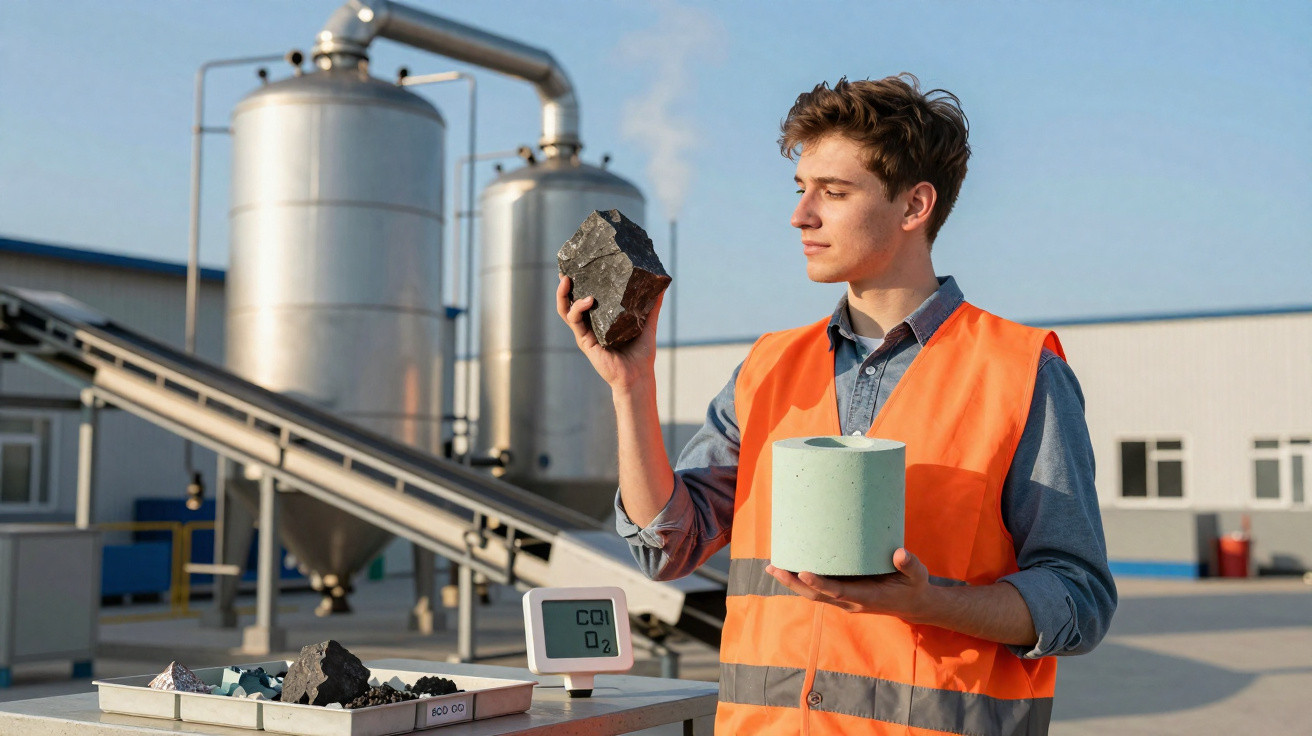
Traditional cement manufacturing causes serious environmental damage because of the high levels of pollutants released into the atmosphere. A new technology developed in the United States offers a revolutionary alternative for the construction industry, using volcanic rocks to establish a clean and sustainable foundation.
How does limestone affect the global climate?
Conventional Portland cement production relies directly on firing limestone in industrial kilns. This mineral compound contains substantial amounts of carbon, which becomes residual carbon dioxide during the essential chemical reactions that take place under industrial heating.
This process is thought to account for a significant share of worldwide heavy-pollutant emissions. To address this serious ecological issue, researchers assessed different data sets revealing the main sources of environmental impact created directly by the cement production chain:
- Raw material: Replacing conventional limestone with rocks such as basalt.
- Energy: Lowering the energy consumption required for the thermal processing of rock.
- Emissions: Dramatically reducing the chemical release of pollutants into the atmosphere.
- By-products: Recovering valuable minerals, including iron and aluminium, during manufacturing.
- Compatibility: Producing a final material identical to the traditional hydraulic binder.
Why can basalt replace limestone?
Silicate rocks such as basalt contain the calcium required to manufacture this structural material. The principal advantage of these formations is that their basic structure contains no carbon, preventing harmful reactions to the environment during industrial thermal processing.
The abundance of these minerals across the Earth's surface can meet demand for exceptionally long periods of human history. However, specialists point out that not every reserve is situated in an area that is accessible for the sustainable mineral extraction of this high-performance ecological input.
What are the genuine energy benefits?
Reduced energy consumption is among the most appealing economic advantages of this recently developed industrial method. The theoretical limit delivers promising data on the efficiency that can be achieved, indicating a profound change in the global ecological footprint while optimising thermal resources in a highly revolutionary way.
Theoretical efficiency
Reduction potential
Processing silicates may require less than sixty per cent of the energy needed to calcine conventional limestone.
Associated gas emissions fall by more than eighty per cent in the ideal scenarios assessed by the American researchers.
Even under real-world conditions using standard technologies, the practical results remain significant for the electricity grid. Monitoring these indicators reveals important advantages that deserve particular attention, including specific factors that improve factory performance and reduce manufacturing costs:
- An immediate reduction of more than twenty-five per cent in the initial total carbon footprint.
- A substantial drop in emissions per tonne of binder when combined with the use of natural gas.
- The immediate practical use of existing methods in today's manufacturing base, without major structural alterations.
Does the final product change technical standards?
The greatest obstacle facing new construction materials is the considerable rigidity of current technical standards. Fortunately, this innovation does not aim to introduce an unfamiliar compound to contractors; instead, it precisely replicates the conventional hydraulic binder consumed by the market on a large scale.
As a result, builders do not need to redesign complex structural projects or alter established mixes. This functional similarity supports acceptance in major developments, delivering clear operational benefits that can be set out in terms that are easy for sector professionals to understand:
- Mechanical behaviour that is entirely identical to the ordinary Portland cement used for decades.
- Full retention of the standard safety protocols established by civil engineering worldwide.
- Removal of the technical uncertainties commonly associated with developing unusual alternative binders.
Which additional minerals can be recovered?
Alongside the supply of purified calcium, processing basalt formations offers further benefits for other basic industries. The original rock contains important concentrations of metals that can be efficiently separated throughout the refinement stages of this high-technology ecological material.
These by-products include iron, aluminium and silica, all of which have immediate commercial uses in parallel supply chains. Although the transition to heavy-industry production still faces considerable economic implementation challenges, this holistic approach strengthens the viability of a highly promising circular economy.
References: Silicate-derived calcium as a pathway to low-carbon Portland cement | Communications Sustainability






Comments
No comments yet. Be the first to comment!
Leave a Comment