
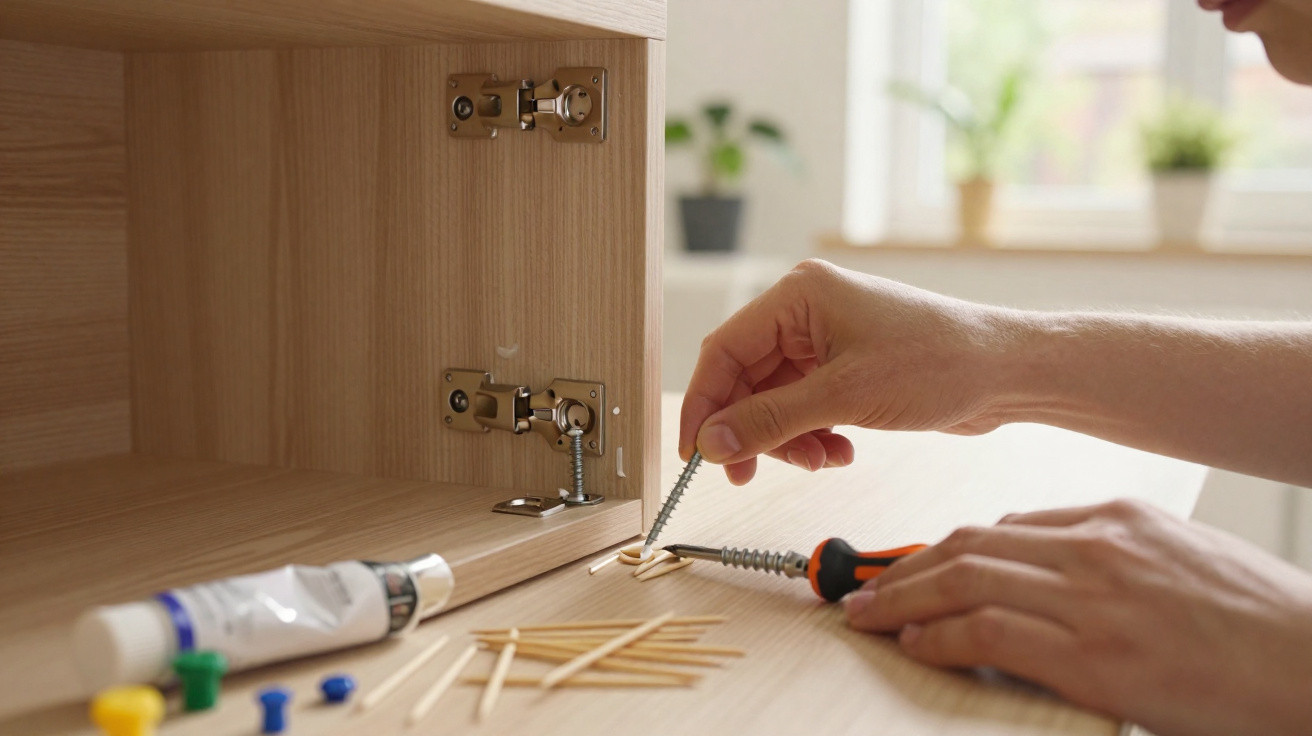
When a screw spins without gripping, the issue is usually the enlarged hole rather than the whole item. Using pieces of toothpick, suitable filler and enough drying time, you can restore the fixing and make the fitting secure again.
Why does a screw spin freely when the hole is too large?
A screw relies on contact between its thread and the surrounding material to hold in place. If the hole crumbles, widens or loses friction, the thread can no longer bite into the base and the tightness gradually disappears as well.
This can occur in aged wood, weak walls, dried-out wall plugs or holes drilled with a bit that was larger than required. Before trying again, remove the screw, clear out the hole and check for dust, play or visible cracking.
Several signs indicate that the hole has lost its support:
- Spinning: the screw turns but neither moves forward nor tightens.
- Play: the hole appears wider than the screw diameter.
- Wood: the internal fibres may be worn or brittle.
- Wall: weak plaster releases dust and affects the wall plug.
- Weight: heavy loads require a safer reinforcement than a makeshift repair.
How does a screw fasten one surface to another?
A screw used as a fixing element has spiral grooves and uses rotation and pressure to join surfaces together. This depends on a proper fit, durable material and enough friction around the secure internal thread.
Once the hole becomes larger, this mechanical relationship fails because there is empty space where resistance should be. The household trick works by filling some of that play, forming fresh contact so the screw can once again apply pressure steadily.
How can you use a toothpick to repair the hole?
The traditional method involves snapping up pieces of wooden toothpick or matchstick, fitting them into the cleaned hole and slowly putting the screw back in. The wood fills the play, increases friction and gives the thread something to grip.
A toothpick increases friction
Use small pieces fitted tightly into place. The filling must be firm without preventing the screw from entering straight. If the item will carry weight, allow any glue or filler to dry completely before using it.
In wood, this adjustment is often quick, especially for light hinges, handles and small brackets. In a wall, however, it may only be temporary, as weak plaster or a distorted wall plug needs a more suitable, durable repair first.
Make the adjustment in this order:
- remove the screw and clear dust from the hole;
- insert toothpick pieces until the play is reduced;
- refit the screw in alignment, without forcing it in at an angle;
- stop tightening once the item is secure.
When should you use filler, glue mixed with plaster or a larger wall plug?
If the hole is crumbling, ready-mixed filler, white glue combined with plaster powder or a purpose-made fixing product may fill the cavity more effectively. The crucial point is to allow for drying before putting weight back on the item.
For heavier loads, such as shelves, cupboards and heavy brackets, it is best to stop relying on an improvised fix and use a wall plug of the right diameter. If needed, drill the hole again with the correct bit to provide a firm base and greater safety.
Choose the reinforcement according to the situation:
- toothpicks for minor repairs in wood;
- ready-mixed filler to correct slight play in internal walls;
- glue with plaster powder to fill small cavities;
- a chemical anchor or larger wall plug where there is a constant load.
How can you make the repair last longer?
Anyone familiar with surprising uses for toothpicks can use this idea for straightforward repairs, but should not overlook the weight of the item. The key is to pair a household trick with sound judgement for safe everyday fixing.
After the repair, test the item with gentle pressure before hanging anything from it. If the screw starts spinning again, the wall cracks or the bracket gives way, stop and replace it with the correct wall plug solution and professional installation.





Comments
No comments yet. Be the first to comment!
Leave a Comment