
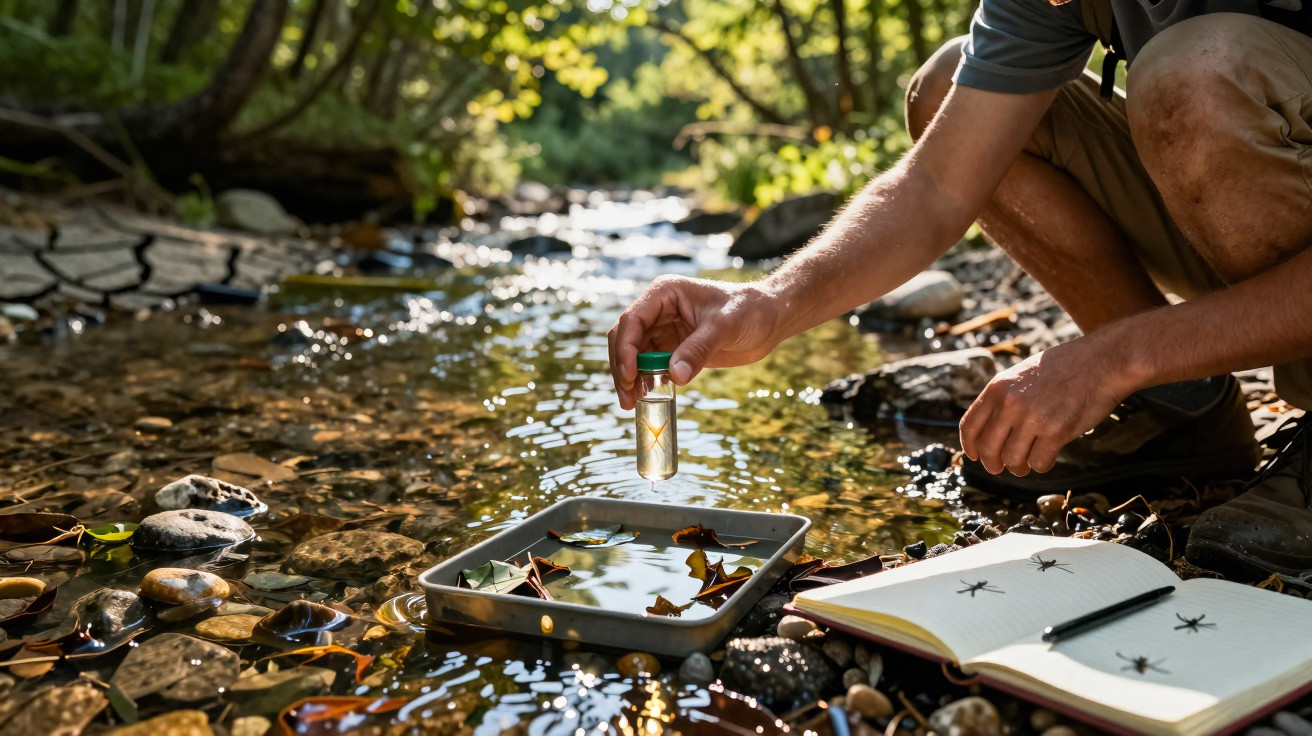
Scientists have recorded a previously unknown insect species, Tinodes lumbardhi, which is limited to one diminishing pocket of freshwater.
Its future relies on a small habitat fragment that now marks the edge of what is still undisturbed within the region’s freshwater networks.
Tinodes lumbardhi was discovered in a narrow tributary stream of a mountain river in Kosovo, a small landlocked nation in south-east Europe. The insect was found in an area where cold, swiftly flowing water survives despite extensive environmental degradation.
In this setting, Professor Halil Ibrahimi of the University of Prishtina identified the insect as a separate caddisfly species after establishing that it occurred in this isolated section of stream.
The population seems confined to this sanctuary, with no indication that it survives in the modified main river channel or in neighbouring tributaries.
Such severe restriction leaves the discovery highly vulnerable, underlining the need to understand how these refuges operate and why they have become the final strongholds for uncommon species.
Tinodes lumbardhi description
In a peer-reviewed study, the team described the caddisfly’s form in sufficient detail to formally name it.
They compared males with related species and identified important distinctions in the structures that connect during mating.
The adult wings were less than 5 millimetres long, helping the insect to escape notice during broader surveys.
The scientists called the species Tinodes lumbardhi, directly connecting it with Lumbardhi, the Albanian name of the river in which it was discovered. The name ties the finding to a particular location rather than simply adding to a classification count.
Caddisflies reveal river health
Caddisflies are insects whose young develop underwater and can live only where streambeds remain cool, stable and rich in oxygen.
As the species requires these conditions, its ongoing presence indicates that sections of the river still operate as healthy freshwater habitat.
Their aquatic young use gills to breathe, meaning that silt, reduced flow or higher water temperatures can rapidly force them away.
This makes caddisflies valuable bioindicators: living signs of water quality used by managers monitoring stream condition.
When rivers lose their flow
Hydropower schemes alter watercourses by diverting water through pipes, making long river sections shallower and more likely to warm up.
Reduced flows also carry less oxygen, allowing algae and fine sediment to accumulate and cover insect habitat.
A 2021 review cautioned that numerous small hydropower plants can severely affect mountain wildlife by interrupting river flows.
This is especially significant in this mountainous part of Kosovo, where streams are short and wildlife has few refuges left.
Insects vanish, food webs crack
The researchers found sections of the Lumbardhi i Deçanit River with no fish whatsoever.
Much of this harm resulted from hydropower construction and operation, while insect communities in the main channel became markedly less diverse.
Fish need oxygen as well as prey, and many rely on river insects for food at crucial stages of growth.
After fish disappear, their return can take years because the river must restore its oxygen levels, food supply and habitat structure.
Small refuges carry rare life
When human activity damages a river’s main flow, side-stream refuges become the last secure places because they remain cooler and shaded.
Thick shade maintains low water temperatures, while leaf litter and stones provide surfaces on which larvae can feed and shelter.
Across the same watershed, the land that drains into a single river, the team reported that rare insects now endure solely in side channels.
Road building has already displaced Rhyacophila siparantum – another endemic caddisfly species – by obstructing flow and converting a stream section into still water.
Kosovo’s insect biodiversity
Bjeshkët e Nemuna has developed into a hotspot for stream insects, with researchers continuing to identify species found nowhere else.
Its steep valleys divide water into separate runs, and this separation creates endemic populations that occur nowhere else on Earth.
In previous surveys, Ibrahimi and his colleagues also documented Potamophylax coronavirus, another caddisfly associated with these mountain streams.
Every discovery increases the urgency, as a dam, road or dry season could eliminate an entire local lineage.
Protecting Tinodes lumbardhi
Media coverage brought the discovery beyond academic circles, and such attention can be important when conservation protections come under pressure.
Directorate park staff can develop protection plans and halt illegal activities, although their work still relies on public backing.
“The discovery of Tinodes lumbardhi is both a celebration of Kosovo’s unique natural heritage and a wake-up call for conservation,” said Ibrahimi.
Focused measures can curb further water diversions and lower pollution, ensuring that these side-stream habitats stay cool enough for sensitive insects.
Lessons from Tinodes lumbardhi
Formally naming a species transforms an unseen insect into one that governments and scientists can record and safeguard.
This procedure, taxonomy, is the science of classifying living things and connects field observations with checklists and legislation.
Once a species has official recognition, monitoring schemes can assess whether its range contracts following construction or pollution.
Without this documented record, a rare insect may disappear unnoticed and later surveys cannot demonstrate what has been lost.
This new insect brings Kosovo’s river condition, energy decisions and conservation capability together in a tangible test within a protected park.
Should agencies safeguard side-stream refuges and maintain clean water, findings such as this can inform more effective river management for years to come.





Comments
No comments yet. Be the first to comment!
Leave a Comment