
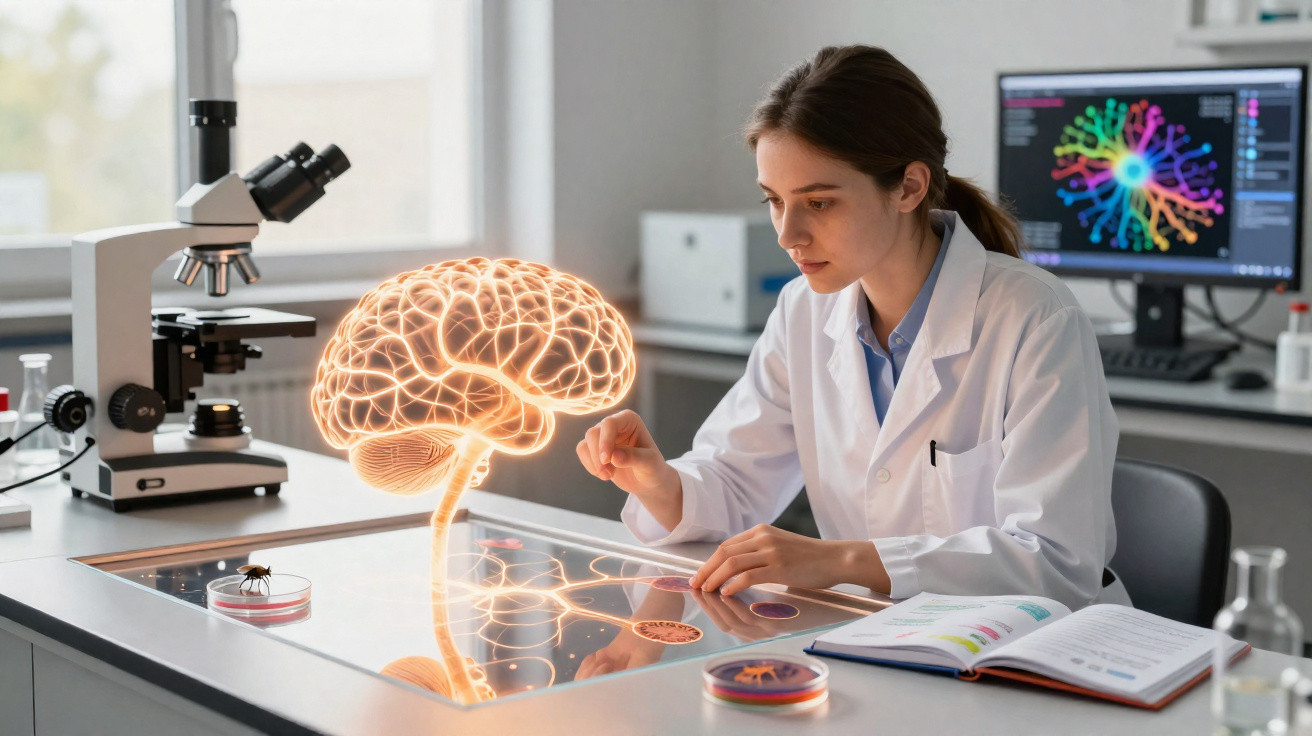
For more than half a century, scientists have aspired to achieve this. Now, a vast international research collaboration has produced a remarkably detailed map of every neuron in the brain of an adult animal that has both eyes and legs.
Available for anyone to examine freely, this remarkable brain is smaller than a poppy seed. Even so, it holds 139,255 neurons linked by 50 million connections.
It came from an adult female fruit fly (Drosophila melanogaster).
Adult fruit fly brain map reaches a major milestone
Set against the human brain, with its 80 billion neurons and 100 trillion connections, this may appear a modest achievement. Yet it represents an enormous advance from the position neuroscience occupied in the 1960s.
If past precedent offers any guide, the work may eventually be considered for a Nobel prize.
"This is a major achievement," says neuroscientist Mala Murthy from Princeton University, who helped lead the team.
"There is no other full brain connectome for an adult animal of this complexity."
The nearest comparable resource is a 3D map of the adult fly ‘hemibrain’, although it contains only about 20,000 neurons.
Writing in an accompanying Nature commentary, Emory University biologist Anita Devineni, who did not take part in the research, says the new map will "transform Drosophila neuroscience".
From Caenorhabditis elegans to an adult Drosophila connectome
Scientists began charting the wiring of animal brains around 50 years ago. Those early efforts centred on a far simpler organism: the blind, legless worm, Caenorhabditis elegans.
In 2002, the researchers responsible for that partial map of only 302 neurons received a Nobel Prize.
What previously required more than 12 years of work can now be accomplished in under a month.
Researchers finished a substantially larger brain map in 2023, covering all 3,016 neurons in a fruit fly larva. But that creature, too, was unable to walk or see.
Mapping an adult fruit fly therefore marks the next major advance. The neural networks responsible for vision and the complex motions involved in walking resemble those found in humans, and can now be investigated with unprecedented detail.
"Flies can do all kinds of complicated things like walk, fly, navigate, and the males sing to the females," explains molecular biologist Gregory Jefferis from the University of Cambridge, who helped lead the research.
"Brain wiring diagrams are a first step towards understanding everything we're interested in – how we control our movement, answer the telephone, or recognize a friend."
Building and annotating the fruit fly brain atlas
Researchers from 122 institutions contributed to the team behind the diagram, with Princeton University, the University of Cambridge and the University of Vermont providing major input.
Creating the map involved more than 7,000 slices of a female fruit fly brain and 21 million images. The resulting data could have filled 100 standard laptops.
An artificial intelligence programme developed at Princeton University proved essential for sorting through this material.
The findings have been assembled into no fewer than 9 associated papers, whose author lists overlap.
One of these papers labels the complete map. Researchers created a crowdsourcing project so that scientists and volunteers worldwide could check the names and functions assigned to neurons and correct computer mistakes. Completing all roughly 3 million manual changes would have required one person working full time for 33 years.
Among the 8,453 known and named cell types shown in the diagram, which account for 96 percent of all neurons, more than 4,500 are newly identified by science.
"Just like you wouldn't want to drive to a new place without Google Maps, you don't want to explore the brain without a map," explains neuroscientist Sven Dorkenwald, a 2023 graduate of Princeton.
"What we have done is build an atlas of the brain, and added annotations for all the businesses, the buildings, the street names. With this, researchers are now equipped to thoughtfully navigate the brain, as we try to understand it."
In one related study, scientists used the annotated map to activate neurons in a fruit fly’s computer brain. This made it extend its proboscis for sugar, mirroring what real flies do when those neurons are activated.
Researchers studying the common fruit fly have so far received 6 different Nobel Prizes. A 7th may yet follow.
The principal findings appear in Nature.



Comments
No comments yet. Be the first to comment!
Leave a Comment