
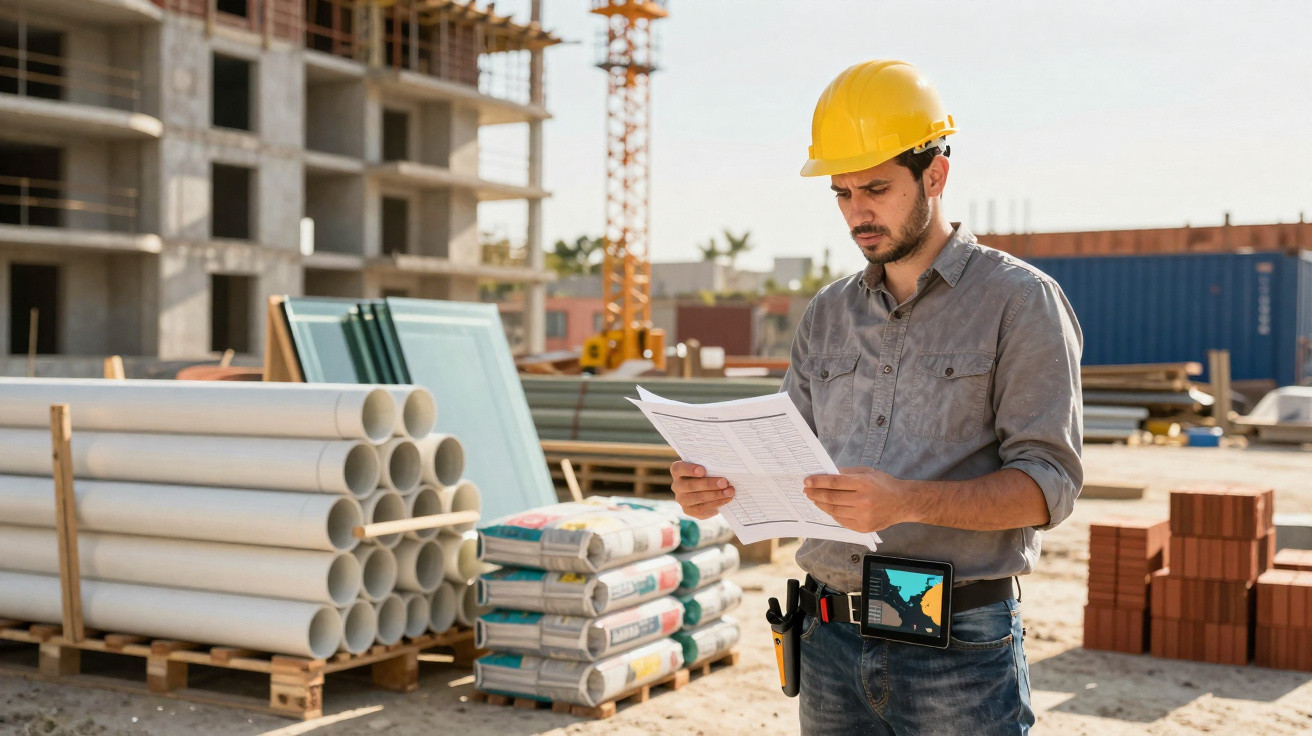
The construction materials sector is already feeling the impact of the Middle East conflict, with product suppliers - particularly those most reliant on oil - announcing price rises this May.
According to José de Matos, consultant to the Construction Materials Association (APCMC), suppliers had limited themselves to minor price adjustments in recent weeks, hoping the situation in the Strait of Hormuz would be resolved. From May, however, “price revisions are being implemented with increases that may reach 5% for some materials”, he notes.
Rising costs are being felt most acutely in materials for which higher oil prices have the greatest effect, namely plastics. This includes PVC (polyvinyl chloride) products such as pipes and plumbing systems.
José de Matos says these were the first products to come under pressure from rising prices, followed by other materials including glass and ceramics.
The increases are also evident in other materials whose manufacture, as well as transportation, requires intensive energy use, such as cement and bricks.
The slowdown in construction activity is a concern for the residential segment
Construction materials price pressure affects development
João Bugalho, executive director of Arrow Global - a group with several development assets in Portugal, including Norfin and Nexor, its affordable housing partnership with the Ferreira group - said suppliers’ pressure to raise prices is now a reality and is affecting the construction and property sectors.
At the “What are we building in Portugal” conference, held as part of the Portugal Real Estate Exhibition (SIL) in Lisbon last week, João Bugalho warned that “there are already some signs from contractors that they will not be able to maintain the prices in their works contract budgets”.
In his view, this is another factor that will make conditions more difficult for the property sector and further increase the final cost of construction.
A representative of Ferreira Build Power, who attended the event, said there is “visible greater pressure from suppliers to increase the prices of materials such as cement, glass, ceramics and aluminium”. In their opinion, this has been happening for the past three or four weeks.
For Manuel Maria Gonçalves, chief executive of the Portuguese Association of Property Developers and Investors (APPII), the main consequence of the crisis caused by the Middle East conflict is growing uncertainty, particularly through movements in energy prices, inflation and expectations surrounding interest rates.
Higher energy costs tend to be passed on through materials prices
Energy costs and uncertainty in the construction sector
He therefore points to greater caution in decision-making, which is natural in the current geopolitical environment. Moreover, because this is a sector with a medium- to long-term investment horizon, “the effects tend to be more gradual than immediate”.
Manuel Reis Campos, president of AICCOPN, the body representing the construction industry, believes companies “are already starting to feel the indirect effects of the current geopolitical context, chiefly through changes in energy costs”.
He warns that the sector is especially vulnerable to shocks of this kind because of its heavy use of machinery and the transport of materials. At the same time, many construction materials are energy-intensive to produce, meaning higher energy costs also tend to be reflected in their prices.
In addition, he warns, “the existing price revision mechanisms are neither sufficient nor broad enough to accommodate fluctuations of this magnitude”.
Residential construction activity slows
José de Matos considers the slowdown in building construction activity, already apparent at the end of 2025, to be worrying for the residential segment. According to APCMC’s construction sector outlook for the fourth quarter, growth “is largely due to increased activity in the public works segment”, while “building construction rose by only 0.15%”.
The report attributes this, on the one hand, to permits for refurbishment works having “recorded a very sharp fall, following the declines seen in the previous two quarters”. It also points to the permitted construction area, which “fell slightly during this quarter”.






Comments
No comments yet. Be the first to comment!
Leave a Comment