
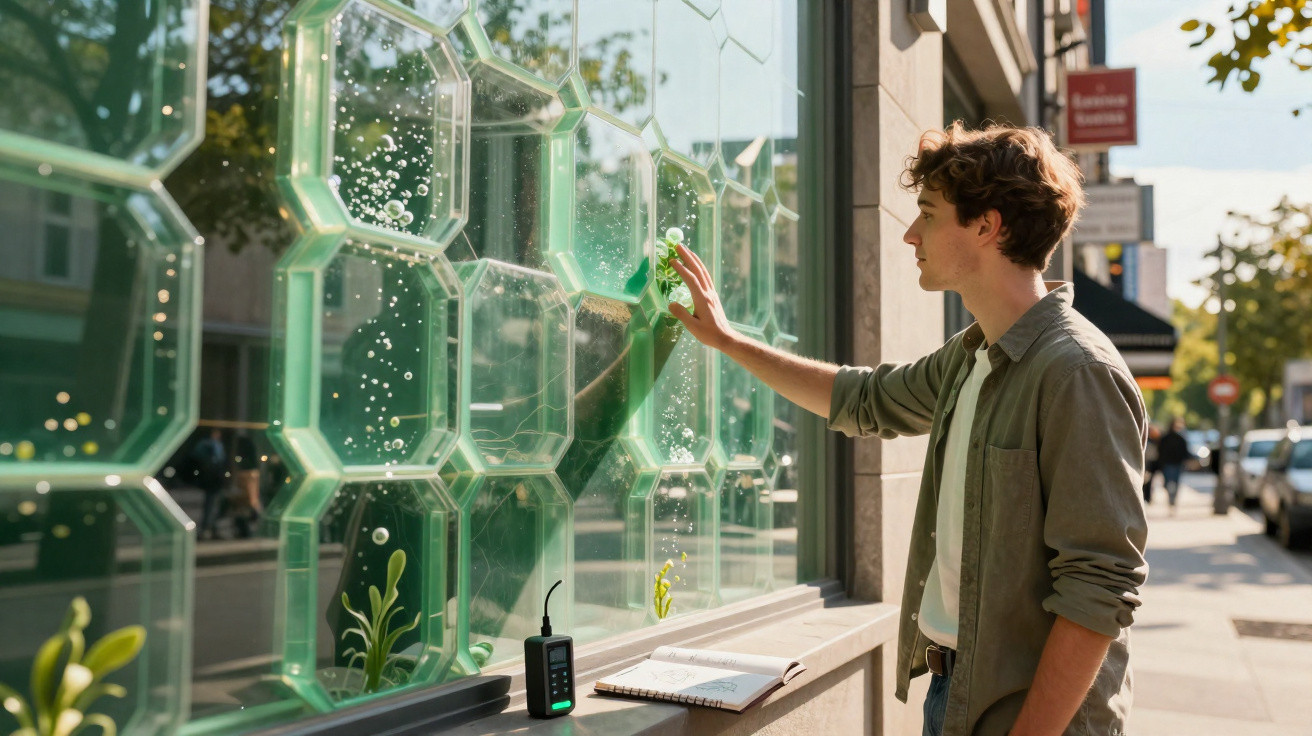
While debates rage over heat pumps, insulation and bans, Swiss researchers are pursuing a radically different approach: turning building façades themselves into active climate protectors. At the heart of the concept is an innovative construction material that lives, breathes, captures CO₂ and continues growing from within.
How a living construction material can be made from algae
The project centres on cyanobacteria, often referred to as blue-green algae. These microorganisms have existed for more than three billion years and are masters of photosynthesis: using sunlight, they convert water and CO₂ into oxygen and energy-rich compounds.
Researchers at ETH Zurich are harnessing precisely this capability. They embed the cyanobacteria in a specially designed hydrogel – a porous, water-saturated gel structure. Within it, the microorganisms receive enough moisture, light and carbon dioxide to remain active over the long term.
The key point is that the blue-green algae do not merely store the captured carbon in their own biomass. They also create solid minerals similar to limestone. Over time, this forms an internal framework that makes the construction material more stable and locks away carbon in a solid form that is difficult to dissolve.
The construction material grows from the inside during use: more CO₂ means more minerals, more stability and more green “life” within the material.
Why mineralisation is crucial
Biomass alone soon reaches its limits when storing CO₂. Cyanobacteria grow only for a limited period before their growth slows markedly. In conventional cultures, there is usually no significant increase after around 30 days.
Converting carbon into minerals avoids this limitation. Rather than producing only soft biomass, the microorganisms generate microscopic crystals that reinforce the gel internally. A rigid framework therefore develops over time, remaining stable in laboratory tests for more than a year.
3D-printed hydrogel as a mini habitat for algae
For this to work, the environment must be tailored with precision. This is where 3D printing comes in. The team created a hydrogel that can be printed accurately into any chosen shape. Its structure resembles a finely porous sponge: plenty of water, numerous cavities and a large surface area.
- sufficient light transmission to keep photosynthesis running
- enough water to prevent the microorganisms from drying out
- open pores allowing CO₂ from the air to enter
- room for newly formed minerals without causing the material to burst
In trials, the system operated with impressive stability: the cyanobacteria remained continuously active for more than 400 days. Per gram of material, they captured around 26 milligrams of CO₂ in mineral form – considerably more than comparable biological carbon-capture approaches.
From laboratory gel to a façade that contributes
The researchers do not intend to stop at laboratory testing. Their objective is clear: façades and building elements that do more than look attractive, actively removing CO₂ from the surrounding air. Potential applications include panels, cladding layers and decorative elements made from this living material.
The team has already shown initial prototypes at an architecture exhibition in Venice. The components resembled organically shaped tree trunks. Each of these “trunks” can capture up to 18 kilograms of CO₂ per year – roughly as much as a 20-year-old pine tree.
A building clad with such elements would behave like a small urban forest – only without roots and leaves, directly within the façade.
As mineralisation progresses, the prototypes visibly change as well: they become firmer, harder and take on a more intense green shade. The material therefore reveals its “state of health” and level of activity much like a houseplant, but in the form of a building component.
How the construction material can repair itself
The term “living construction material” is more than marketing. Because the cyanobacteria remain active, they can recolonise and reinforce damaged areas, provided water, nutrients and light are available.
If small cracks emerge, the microorganisms’ metabolism supplies fresh minerals. These can settle in fine gaps and partly compensate for the damage. It is not a miracle material that makes every crack disappear, but it differs clearly from inert, rigid building materials such as concrete.
Its use is particularly conceivable in thin-walled elements or façade modules exposed to weather and temperature fluctuations. Rather than needing immediate replacement, they could stabilise themselves to a certain extent.
How sustainable is it really?
The living construction material relies on a process that already takes place everywhere on Earth: photosynthesis. The sun supplies the energy, meaning that, ideally, no additional electricity costs arise during operation.
Unlike many industrial CO₂-capture processes, this system requires neither high temperatures nor aggressive solvents or complex pressure technology. The microorganisms work at ambient temperature and normal pressure, with water as their main medium. From an energy perspective, this is substantially more favourable than large technical installations.
The researchers stress that the new construction material is not intended to replace established climate-protection measures, but to complement them. Buildings would become small, decentralised CO₂ sinks that work continuously, quietly and in the background.
Biotechnology as a turbocharger for the living concrete alternative
The current prototype uses natural strains of cyanobacteria. However, the team is already looking ahead: genetic adaptation could increase photosynthetic performance, allowing more CO₂ to be captured per unit of area and time.
Possible adjustments include:
- improved use of light, enabling efficient operation even in diffuse or weak light
- faster mineral formation to harden the material more quickly
- adaptation to the large temperature variations found on façades
- built-in safety mechanisms to ensure that the organisms cannot survive outside the material
At the same time, the construction material needs more than light and CO₂. Cyanobacteria require salts and trace elements, which have so far been supplied through an artificial seawater solution. One unresolved issue is therefore how these nutrients can be incorporated into real building components without continually adding liquid.
Where the risks and limitations lie
As fascinating as the approach sounds, it does not come without unanswered questions. Façades are exposed to weather, dirt, animals and pollutants. Whether the microorganisms can remain stable there for many years has yet to be demonstrated.
Construction practice also presents challenges: fire safety, structural requirements and building regulations. No clear regulatory frameworks currently exist for a living construction material. In many countries, the approval of new materials takes years in any case. Realistically, pilot projects on research buildings or pavilions are likely to come first, before residential buildings follow.
Nor would the image of a permanently green façade suit every location. In deeply shaded street canyons, the microorganisms may receive too little light. In extremely dry regions, irrigation becomes a concern. Hybrid solutions will be needed here, for example combinations with conventional construction materials or shading structures.
What terms such as hydrogel and cyanobacteria mean
Many people already know hydrogels indirectly through contact lenses, wound dressings or hygiene products. They are cross-linked polymers able to absorb and retain very large quantities of water without flowing apart. In this construction material, the hydrogel serves both as a sponge and as a supporting framework.
Cyanobacteria are not actually “algae”, but bacteria that behave similarly to plants because they carry out photosynthesis. In bodies of water, mass growth can become a nuisance, but in a controlled technical application they can be managed deliberately.
For use on buildings, the researchers work with strains accustomed to salty environments. This reduces the risk of them spreading uncontrollably into freshwater systems while also increasing their resilience to evaporation and fluctuating moisture levels.
What daily life with breathing houses could look like
Imagine a residential neighbourhood in 20 or 30 years: some buildings are fitted with modular pieces of living material, like tiles or suspended panels. In sunny areas they are deep green, while in partially shaded zones they appear paler.
Sensors report how much CO₂ the façade captured during the previous month. Every few years, a maintenance team checks moisture levels and nutrient status. Instead of replacing entire components, technicians stimulate new growth in specific areas, perhaps using fine sprays or nutrient gels.
Such building components could be particularly suitable for urban areas with high air pollution: alongside major roads, on multi-storey car parks, logistics warehouses or school buildings. Wherever ample surface area is available and a deliberately futuristic appearance is acceptable, the living construction material could come into its own.
The principle could also be applied on a smaller scale: as living solar-shading panels on balconies, free-standing “CO₂ totems” in parks, or modules attached to bus shelters. The more standardised the system becomes, the more easily new applications could be developed.




Comments
No comments yet. Be the first to comment!
Leave a Comment