
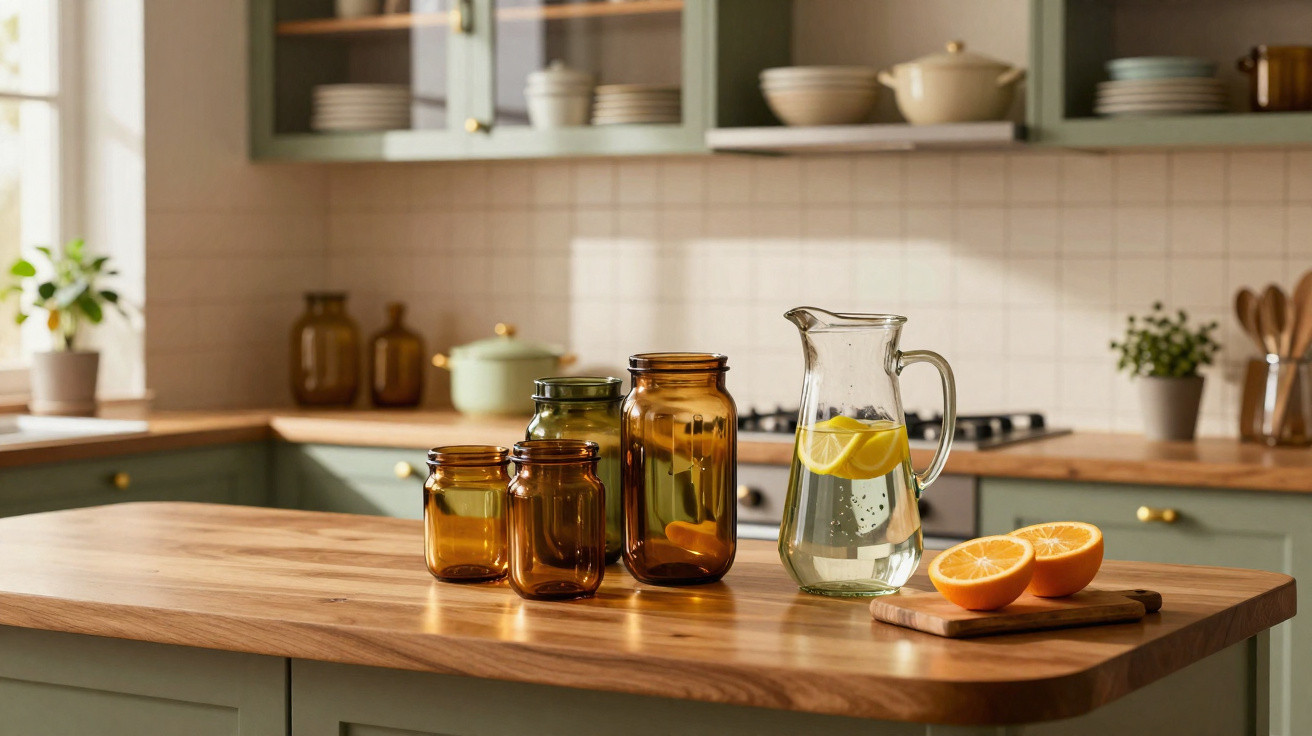
White metro tiles, clinical stainless-steel surfaces and plain walls devoid of personality: anyone renovating a kitchen has often had quite enough of them. By early 2026, planners and tradespeople are already reporting a clear shift. The splashback is meant to become the focal point – without a full refurbishment and without a five-figure bill. Quietly, a returning favourite from the 1970s is moving into first place.
Smoky glass instead of metro tiles: what is driving the new trend
The leading new choice for kitchen walls is smoky glass, also commonly called tinted glass. For decades, it was considered a leftover from dated living rooms and dimly lit bars. Today’s interpretation is considerably more refined, however: new collections feature understated shades ranging from pale anthracite and warm bronze to semi-transparent black.
The result is striking. A kitchen with country-style cabinet fronts suddenly looks more contemporary without losing its character. An entirely white, highly minimalist kitchen gains warmth and depth instead of feeling clinical. This blend of timeless appeal with a subtle retro note resonates with people who do not want to chase a fresh craze every three years.
“Smoky glass as a kitchen splashback strikes a balance: a hint of vintage, yet an unmistakably contemporary look.”
Many people are simply tired of stark white walls and expansive stainless-steel surfaces. Interior designers are therefore increasingly treating the splashback like a picture: a coloured, reflective surface that catches light without causing glare. Compared with conventional tiles, the look can be changed more quickly, while the room also appears more spacious.
How smoky glass changes the appearance of a kitchen
Smoky glass acts like a gentle filter between the light source and the wall. It reflects without the harshness of a mirror and absorbs some light without genuinely making the room darker. Particularly in narrow kitchens, this creates a surprisingly deep visual effect.
Anyone cooking in a typical single-run fitted kitchen will know the feeling of standing virtually “against the wall”. A continuous glass surface makes that wall seem set farther back. Reflections from under-cabinet lights or windows bring life to the surface without becoming distracting.
- In compact kitchens, the wall appears to move further away.
- In exceptionally bright kitchens, smoky glass softens harshness and glare.
- In dark kitchens, it creates an intimate, almost lounge-like atmosphere.
This is especially beneficial for anyone using their kitchen as a living space, such as in an open-plan layout. In the evening, when lit indirectly, the splashback resembles a stylish bar more than a purely functional area.
Everyday test: easy-care, hard-wearing and remarkably flexible
Looks alone are not enough in a working kitchen. Here, smoky glass performs well for practical reasons: its surface is smooth, sealed and grout-free. Oil, tomato sauce and splashing water simply remain on the surface rather than soaking in.
In most cases, cleaning requires only:
- a microfibre cloth;
- a little glass cleaner or mild washing-up liquid;
- a quick wipe afterwards, and the job is done.
Fingerprints are visible on dark shades, of course, but nowhere near as prominently as on high-gloss stainless steel. Limescale splashes are less noticeable than on clear glass because the tint visually softens them.
For safety, it is important to note that almost all suppliers use toughened safety glass or tempered glass. The material easily withstands the heat behind a ceramic or induction hob and is far more impact-resistant than many people expect. For gas hobs, the manufacturer’s specifications should be followed, as a little more clearance is often required.
“Smoky safety glass combines design ambition with everyday practicality – without specialist cleaning products and without concerns about heat.”
Another advantage is the vastly expanded choice of colours. Some glaziers offer hundreds of graduated shades. This makes it possible to match the splashback precisely to cabinet fronts, worktops or flooring – from cool grey and warm taupe to near-black glass with a slight transparency.
How to incorporate a smoky glass splashback into your kitchen
Contrast is key. The sleek, cool surface of glass needs companions with texture and tactile appeal. These combinations work particularly well:
- Rustic wooden kitchen: Smoky glass in pale grey or bronze reduces the visual weight of the wood and introduces a modern edge.
- Strictly white kitchen: A bronze glass splashback with brass or gold handles adds warmth and a more homely feel.
- Dark, small kitchen: Dark smoky glass can work if the worktop and wall units remain light, with powerful LED strips fitted beneath the wall cabinets.
Important rules of thumb for a harmonious scheme:
- Pair very dark glass colours only with strong under-cabinet lighting.
- Include at least one larger light-coloured surface, whether the worktop or the cabinet fronts.
- Bring in wood or warm finishes so that the kitchen does not feel overly cool.
- Plan sockets within the glass surface precisely in advance, as cut-outs are difficult to alter later.
Mini renovation: major impact without a full refurbishment
Anyone wanting to refresh the appearance of an existing kitchen does not need to rip everything out. Smoky glass is ideal for targeted updates:
- as a strip behind the hob only;
- as a vertical panel beside a window;
- as a continuous surface between wall and base cabinets above the sink area.
Many manufacturers supply pre-cut panels that can be screwed into place or installed on rails. In a rented home, this means the original condition could theoretically be restored. Those unsure whether they will like the look long term can begin with inexpensive glass-effect panels before ordering made-to-measure safety glass.
Costs, risks and kitchen splashback planning considerations
Compared with extensive natural-stone cladding, glass is often more affordable, although it generally costs more than basic tiles. The final price depends on the thickness, type of glass, bespoke cuts and installation.
Typical cost factors include:
| Factor | Effect on price |
|---|---|
| Glass thickness and safety glass | Greater safety, with a slightly higher price per square metre |
| Colour and coating | Specialist shades or metallic finishes make the panel more expensive |
| Socket cut-outs | Every cut-out creates additional labour |
| Installation method | Adhesive fixing looks more seamless; screw fixing is usually cheaper and reversible |
Poor planning carries a certain risk: if a socket cut-out is just a few millimetres out of position, the socket will no longer fit exactly. Ideally, installation should therefore be carried out by a specialist company, or measurements should at least be taken together with a glazier.
Colour is another consideration. Shades often appear noticeably lighter on small samples. Across a large surface and under different lighting, the glass can quickly seem darker. Anyone uncertain should order several sample panels and hold them against the wall in their own kitchen.
Why the smoky glass trend is likely to outlast other kitchen crazes
Many kitchen fashions of recent years – from vivid coloured cabinet fronts to extreme concrete looks – have proved highly divisive. Smoky glass occupies a different space. It is sophisticated rather than loud; it works with both country style and minimalism; and, if necessary, it can be replaced without altering the layout.
There is also a growing preference for enduring design. Anyone investing several thousand pounds in a kitchen often wants solutions that will last ten or fifteen years. A tinted glass surface ages visually far more slowly than a bold pattern or a trend-led colour on cabinet fronts.
The psychological effect is also noteworthy. Gentle reflections in the glass make the kitchen feel livelier as light, plants and decorative objects are mirrored in it. At the same time, the room remains clearly organised because the surface is uninterrupted and calm. That appeals to many people who quickly tire of open shelving and overcrowded worktops.
Practical examples and combination ideas for 2026
Anyone considering updating their kitchen in 2026 can use several proven scenarios as a guide:
- City flat with period charm: White framed cabinet fronts, an oak worktop, bronze smoky glass and a black tap create a blend of classic and contemporary.
- Loft with a concrete floor: Matt-black base cabinets, a light quartz worktop, a deep-anthracite glass splashback and wooden shelves above for warmth.
- Small kitchen run in a new-build home: Handleless, very simple light-grey fronts, pale taupe smoky glass and a powerful LED strip make it feel larger and more premium than the footprint suggests.
The same principle applies to every option: the glass splashback should never be the only special accent, but nor should it compete with too many other statement features. One, or at most two, strong elements are enough – for instance, glass with distinctive handles, or glass with eye-catching pendant lights.
Those who plan carefully and take lighting seriously will find that smoky glass offers a way to elevate kitchens far beyond the ordinary in 2026. It is not loud or flashy, but creates a crisp, calm overall impression – precisely what many people are seeking after years of extreme kitchen experiments.




Comments
No comments yet. Be the first to comment!
Leave a Comment