
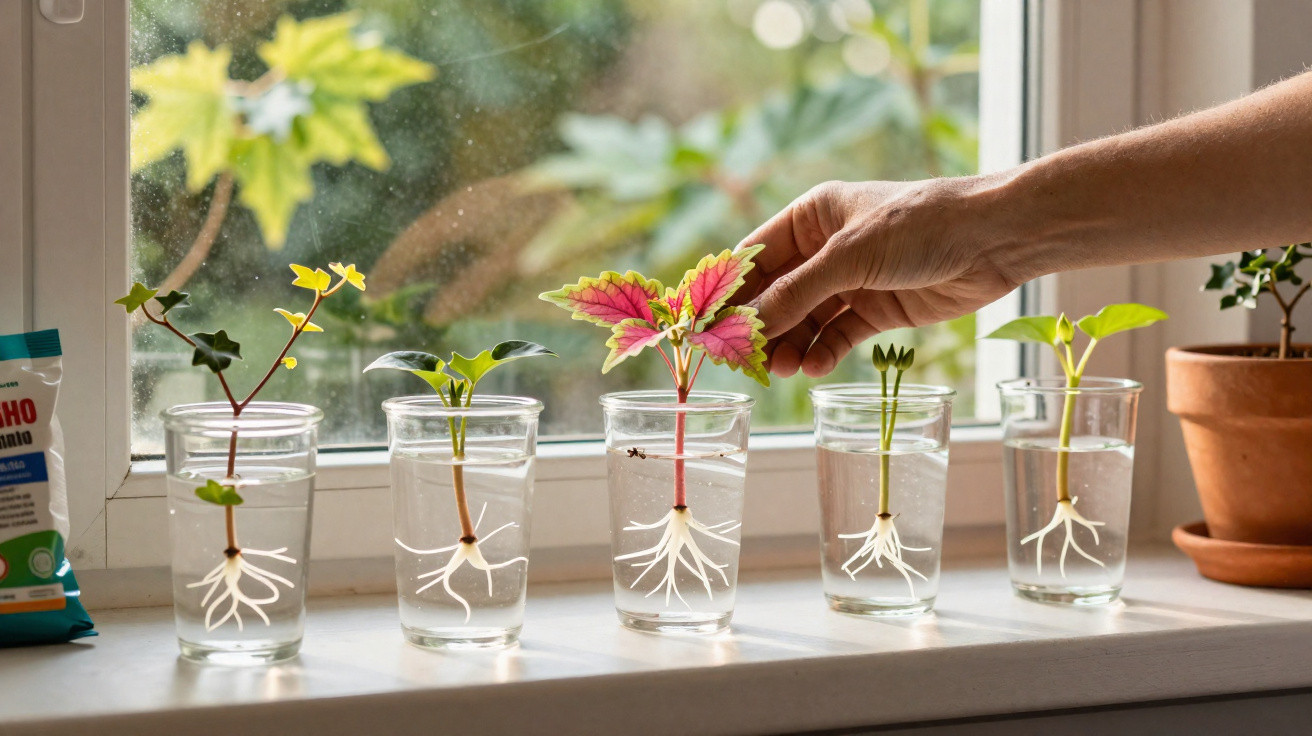
Rather than buying new plants, you can raise entire groups of young plants from just a few cut shoots. The key is to root cuttings in a glass of water. Three especially reliable choices – ivy, coleus and Busy Lizzie – produce roots remarkably quickly in water, turning balconies, patios and gardens into a lush, colourful backdrop within only a few weeks.
Why June is the ideal month for water cuttings
Cuttings can generally be propagated successfully from April to September, but June offers almost perfect conditions. Plants are growing vigorously, while their shoots are young, pliable and continuing to develop strongly. Temperatures also often remain steady at 20 to 25°C, a range in which cut surfaces seal quickly and fresh roots form particularly fast.
“If you put cuttings in water now, you will often have well-rooted young plants after just one to four weeks – without buying anything from a garden centre.”
The result is clearly visible in the garden. Ivy soon covers dreary fences or trails attractively from hanging baskets; coleus adds colour to pots and containers with its contrasting foliage; and Busy Lizzie creates a carpet of flowers in shady spots. A small number of parent plants can therefore provide numerous new plants to position strategically around the garden.
What you actually need for water cuttings
No specialist equipment is required for this method. Many amateur gardeners underestimate just how straightforward it is. Essentially, you need only a few everyday items:
- clean, sharp secateurs or a knife
- one or more glasses, small vases or transparent cups
- tap water that has been left to stand for a few hours
- a bright position away from intense midday sun, such as a windowsill or well-lit hallway
Rooting hormones are usually unnecessary for ivy, coleus and Busy Lizzie. You may use them if you already have some at home, although they make little difference with these undemanding plants.
Basic method: how to take water cuttings step by step
The underlying technique is the same for all three plants. Once you have learned it, you can apply it almost automatically throughout summer. The main steps are:
- Choose a healthy, vigorous shoot, between 7 and 15 cm long depending on the species.
- Make an angled cut immediately below a leaf node.
- Remove all leaves from the lower section so that none can rot in the water.
- Submerge one or two nodes, while keeping the leaves above the water surface.
- Replace the water every two to five days, depending on the plant.
- Plant into compost once the roots measure around 2.5 to 5 cm.
Cutting below a node is vital because this is where most root buds are located. Leaves left hanging in the water can rot easily, cloud the water and slow the start of rooting. Keeping everything clean and changing the water regularly noticeably improves the success rate.
Ivy in a glass of water: a free filler plant for climbers
Ivy is considered tough and can sometimes grow almost too enthusiastically. That is an advantage when taking water cuttings, as this woody climber reliably sends out new roots. Proceed as follows.
Making the right cut on ivy
Choose a strong trailing stem with several nodes. A length of approximately 10 to 15 cm works well. Cut just below a node, then remove the leaves from the lower half of the shoot. The leaves remaining at the top continue to supply the cutting with energy without causing it to lose too much water.
Place the shoot in a clear glass with one or two nodes beneath the water. The shape of the glass matters very little; what counts is a clean container and fresh water. At temperatures of around 20°C, strong white roots usually develop after two to four weeks.
When to move ivy into compost
Once the roots are about 5 cm long, the cutting can be transferred to a pot filled with loose growing medium. A blend of multipurpose compost with a little sand or perlite helps prevent waterlogging. Growing ivy in a pot also makes it easier to control – ideal if you do not want it spreading unchecked through a border.
“Ivy propagated in a pot grows quickly, yet remains far easier to keep under control than ivy planted directly in a border.”
After a short period to establish, use the young plants to cover privacy screens, wall tops or hanging baskets.
Propagating coleus in water: a burst of colour for balconies and patios
Coleus is among the most popular foliage plants for containers and window boxes. Its range of varieties extends from vivid pink shades to almost black leaves edged with bright colours. Many amateur gardeners purchase new specimens every year, even though this plant is exceptionally easy to propagate from cuttings.
How to take the perfect coleus cutting
Select a shoot around 8 to 12 cm long, making sure not to use a flowering tip. Flowers use energy that is better directed towards forming new roots. Remove any flowers, then leave only two or three leaves at the top.
After cutting, place the lower part in water up to a node. At roughly room temperature, fine roots often appear in as little as one to two weeks. Change the water every three to five days to prevent bacteria and algae from building up.
From glass to pot: transplanting coleus correctly
When a clear cluster of roots measuring 2.5 to 5 cm has formed, the coleus cutting can be planted in fresh compost. Use low-nutrient, loose potting compost so the roots can branch out quickly. For the first few days after planting, a semi-shaded spot works well, as it prevents the young roots from drying out too severely.
Later, you can move the plants to a sunnier place if the variety tolerates it. Many coleus varieties develop especially intense leaf colours in brighter positions, but will then need sufficient watering.
Busy Lizzie in a glass of water: a flower carpet for shade
Busy Lizzie flowers tirelessly all summer, particularly in semi-shaded and shady areas. It is almost always a good choice for brightening darker corners of the garden. Here, too, a few original plants can rapidly produce dozens of young plants.
Cutting and preparing Busy Lizzie cuttings
Choose a healthy, non-woody shoot tip approximately 7 to 10 cm long. Again, cut just below a node and remove all lower leaves as well as any buds. This allows the cutting to focus entirely on producing roots.
Busy Lizzie is sensitive to decaying plant material in the water, so it is worth changing the water more often – every two to three days is ideal. Fine roots measuring 2.5 to 3 cm usually appear after only one to two weeks. That is enough length to plant the young plants in small pots or directly into window boxes.
Planting out and care tips
Use loose, humus-rich compost and keep it evenly moist during the first few days, without soaking it. Busy Lizzies are sensitive to waterlogging, yet they must never be allowed to dry out. Especially on warm days, it is worth doing a quick finger test in the compost before reaching for the watering can.
“Anyone who keeps taking cuttings and placing new ones in water can gradually fill window boxes, containers and borders with home-grown young plants throughout June.”
Common mistakes with water cuttings and how to avoid them
Although the method seems easy, small details can cause some attempts to fail. Three issues are particularly likely to lead to frustration:
- A position that is too dark: Root formation stalls without enough light. Bright places away from direct midday sun work best.
- Changing the water too infrequently: Cloudy water encourages rot and restricts growth. It is better to replace it more often than risk root damage.
- Planting out too late: Very long water roots snap easily when transplanted. Pot up cuttings once the roots are a few centimetres long and well branched.
If you place several cuttings in one glass, make sure the stems do not overlap excessively. Leaving a little space improves oxygen availability in the water and reduces the chance of rot. A transparent container makes it easier to spot changes early.
Using your free young plants cleverly in the garden
Having plenty of new young plants opens up interesting design possibilities. Ivy is excellent for disguising unattractive areas: old posts, weathered wooden sheds and bare wire fences can disappear behind green foliage in a short time. Coleus creates a striking display when several varieties are combined in one container – use darker foliage at the back and brighter varieties towards the front.
Busy Lizzies are at their best in semi-shaded areas. They are ideal beneath trees, along north-facing house walls or on balconies that receive little direct sunshine. Plant them in groups and they will provide a colourful carpet for months, with hardly any gaps.
Practical extras: keeping an eye on light, water and nutrients
Once planted into compost, young plants have different needs. In a glass of water, they did not have to search for nutrients, whereas they must do so in growing medium. Two to three weeks after potting on, you can begin applying a light feed, such as half-strength liquid fertiliser for balcony plants added to the watering water. This supports compact, healthy growth.
Another consideration is the change from indoor to outdoor conditions. If the cuttings rooted on a windowsill, they should not be exposed suddenly to the full demands of being outdoors. A few days in a sheltered, semi-shaded position eases the stress and reduces the risk of leaf scorch or drooping stems.
Making consistent use of June for water cuttings gives you a small reserve of plants with very little effort. You can fill gaps at short notice, put spontaneous border ideas into practice or give home-grown young plants to gardening friends – all without additional cost from the garden centre.



Comments
No comments yet. Be the first to comment!
Leave a Comment