
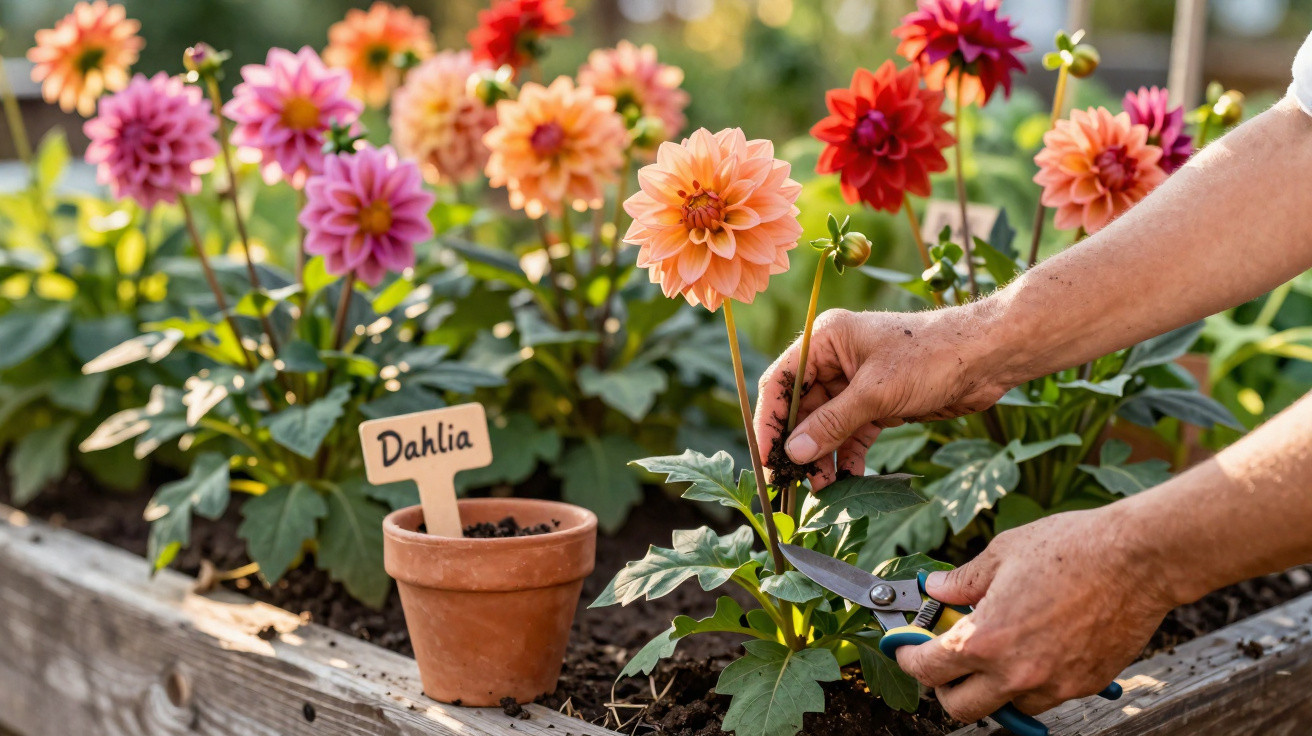
A confident early-season cut can transform the result entirely. Removing a small section from young dahlia plants creates sturdier stems, greater stability and, above all, significantly more flowers in summer. It may seem drastic, but this technique has been a standard method among professional gardeners for decades.
Why an early cut completely transforms dahlias
Most dahlias naturally grow rather like small trees: they form one dominant leading tip, with plenty of foliage below it but relatively few flower buds. The plant directs most of its energy towards that uppermost tip. Leave it untouched and you may get a tall, impressive plant – though often one with sparse flowering and stems that are vulnerable to wind.
This is exactly where an early cut makes a difference. Once a young dahlia is around 20 to 30 centimetres tall and has four to five pairs of true, well-developed leaves, its main tip is removed. This deliberate intervention disrupts the leading shoot’s internal “position of power”.
“The small cut at the tip forces the dahlia to produce several side shoots – a single flowering stem becomes a compact, flower-filled bush.”
The plant responds by producing a burst of fresh growth. One solitary stem becomes four to six flowering shoots, sometimes even more. Its entire habit changes from an “asparagus spear” into a robust, bushy perennial.
One effect is immediately noticeable: the plant stays shorter and fuller, is less likely to topple over in the first summer thunderstorm, and is much better suited to producing colourful cut flowers. Although flowering starts roughly ten to fifteen days later than on uncut plants, practical experience shows that the number of flowers across the season rises considerably, often to two or three times as many.
How to spot the perfect time to make the cut
Getting the timing right determines whether the method succeeds or fails. Use these three straightforward indicators:
- The dahlia has been planted in a border or container for around three to four weeks.
- The plant measures approximately 20 to 30 centimetres in height.
- There are four to five pairs of proper, strong leaves along the stem.
At this stage, the main stem is still fairly thin, solid throughout and not hollow. Cutting it will not harm the tuber, and the wound will normally dry quickly. A dry day without rain is ideal, so the cut surface does not remain damp unnecessarily.
Step by step: how to cut a young dahlia correctly
Once you have seen the process done, any hesitation soon disappears. The technique itself is simple – accurate placement and cleanliness are what matter.
Prepare your tools
You need very little:
- clean, sharp small secateurs or a small sharp knife
- alternatively, just your fingernails for particularly soft shoots
- alcohol or disinfectant for wiping the blade
Disinfecting the tool reduces the chance of introducing fungi or bacteria into young plants. For valuable varieties in particular, this minute of preparation is worthwhile.
Where to make the cut
Now turn to the plant itself:
- Find the main shoot: this is the central stem growing straight upwards.
- Count the leaf pairs: look from the bottom upwards at the properly developed leaf pairs.
- Choose the cutting point: position the cut directly above the second or third level of leaf pairs.
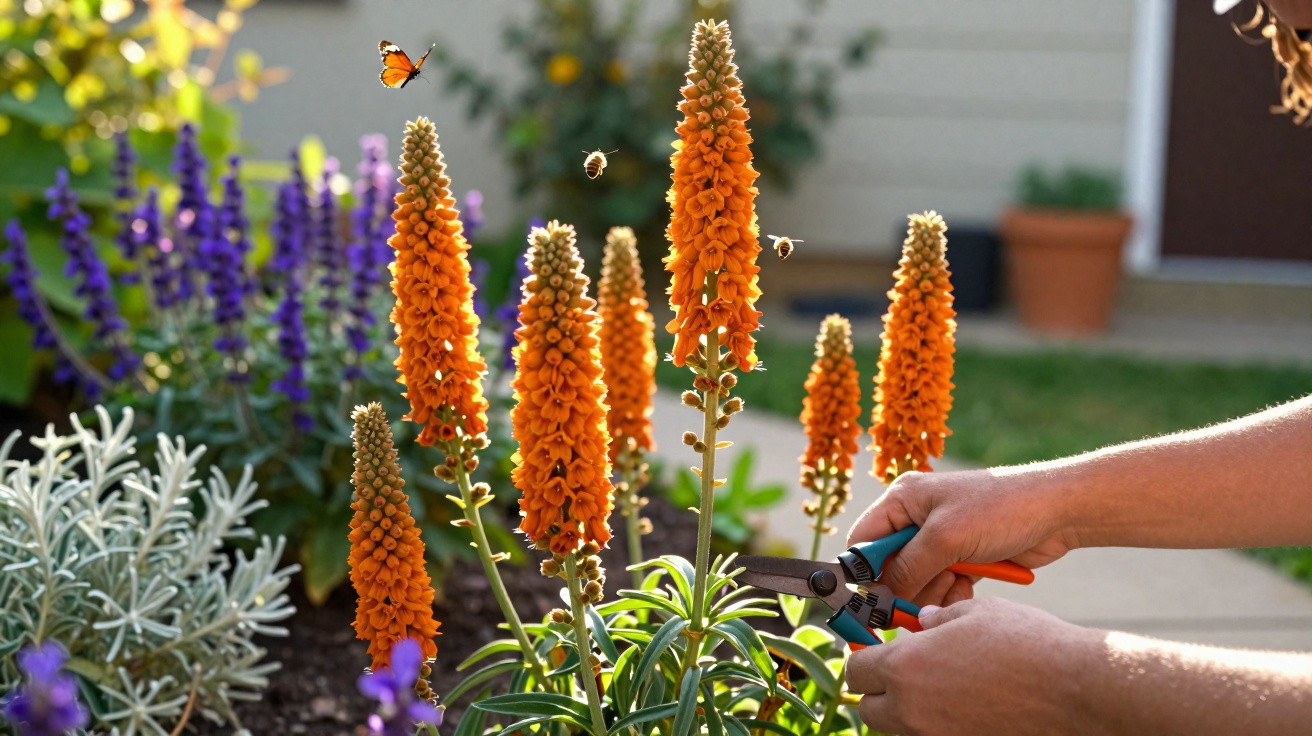
- Remove the tip: cleanly cut off the upper section or pinch it out with your fingers.
“Only the shoot tip is removed – the lower part, with at least two strong pairs of leaves, remains completely intact.”
This modest loss of height triggers a marked hormonal shift inside the plant. Growth hormones that had previously suppressed the development of side buds are no longer produced in the same quantity. The formerly “dormant” side buds along the stem wake up and grow vigorously.
The effects in the border: compact growth, less breakage, more flowers
The difference becomes visible just a few weeks after cutting. What was previously a rather thin cluster of stems develops into a dense, much more stable plant. The new side shoots cope better with wind, so the whole clump sways rather than bending over sideways in the first storm.
Flower production is also spread more widely. Instead of buds appearing only at the original tip, they now form along several shoots. This brings several advantages:
- a longer flowering period, because the buds do not all open at once
- more cut flowers for a vase, without stripping the plant bare
- a more balanced appearance in the border, as flowers are not simply “stuck” at the very top
Anyone who enjoys lush perennial borders or colourful cottage gardens benefits particularly from this effect. The plants fill gaps more effectively and, with their many flower heads, create a livelier display.
These dahlia-cutting mistakes can cause real damage
As useful as this early intervention is, it becomes problematic if the right moment has already passed. If a dahlia is cut back too late, its main shoot will usually have thickened and become hollow inside. Cutting into such a tube creates an ideal entry point for water and pathogens.
“Once the main stem is clearly more than one centimetre thick and feels hollow, the opportunity for cutting has passed.”
If rainwater enters through this opening, it can run into the stem and further down the plant. Eventually, the moisture reaches the area close to the tuber. The tissue there can begin to rot easily and, in the worst case, the entire plant may collapse within just a few days.
If that point has been reached, it is better to use supports than reach for the secateurs late. Tall, unbranched dahlias can be guided well with bamboo canes or sturdy metal stakes. Several soft ties placed along the stem prevent breakage without constricting the plant.
Who is this dahlia technique suitable for – and which varieties is it less suited to?
Early cutting is particularly suitable for varieties where plenty of medium-sized flowers are desired, including:
- single and semi-double varieties for naturalistic borders
- decorative dahlias with striking colour variation
- Café-au-Lait-like types, when many stems are wanted rather than only individual blooms for photographs
- smaller pompon and ball dahlias for cut flowers
Anyone aiming to grow individual, exceptionally large flowers for exhibitions or special bouquets will often take the opposite approach and avoid this intervention. In these cases, all the plant’s energy is focused on a few carefully selected buds, which can then become unusually large.
Additional care steps for stable, free-flowering dahlias
Cutting alone is not enough. For the plant to cope with the newly stimulated growth, it needs favourable conditions. Free-draining, loose soil prevents waterlogging around the tuber. Organic fertiliser supplies nutrients to the young shoots without forcing them into excessive growth.
During dry spells, a consistent watering routine is worthwhile. Dramatically fluctuating moisture levels – bone-dry soil followed by a heavy soaking from the watering can – quickly cause stress. A mulch layer of grass clippings or shredded material keeps the soil cooler and moister, providing further support for the plant.
What new gardeners should also know
Many beginners hesitate to remove a shoot tip that appears perfectly healthy. That reaction is understandable. However, those who take the step usually notice the difference in their very first season. One tip is to test the method on only some of your plants initially. This lets you compare directly how differently their growth habits and flower numbers develop.
For children, this technique is a useful introduction to plant science. Observing growth before and after cutting clearly demonstrates how strongly plants respond to small interventions, and how a whole flowering bush can emerge from one single stem.
Once you have understood early dahlia cutting, you will often apply the principle to other ornamental plants. Fuchsias, geraniums and some summer-flowering plants also branch more strongly and flower more densely when their tips are boldly cut back. Looking at a young dahlia therefore teaches a basic gardening principle almost incidentally: sometimes a small cut at the right time brings more abundance than waiting ever could.


Comments
No comments yet. Be the first to comment!
Leave a Comment