
When people think of construction materials, concrete, steel and brick usually come to mind. An international research team now argues that an everyday natural product could partly displace these established materials. Studies point to major benefits for the climate, costs and structural stability – along with a radical shift in the construction industry.
What lies behind the ‘construction material of tomorrow’
Researchers are focusing on a raw material that is already familiar from the dinner table: wood-based and plant-derived materials, such as those associated with bread, porridge oats and breakfast cereal, provide the basis for reimagined construction materials. Cellulose and lignin – key components of plant fibres – are at the heart of this work.
Cellulose can be obtained from timber, straw, residues from grain processing and other plant waste. This is precisely where the research begins: materials that have often been burned or discarded could in future become load-bearing structures, insulation products or building surfaces.
“Construction materials made from plant residues can replace steel and concrete in certain applications while also locking CO₂ into the material.”
The underlying principle is straightforward: fibres combined with binders can form boards, modules or even entire structural systems, used in much the same way as today’s industrial products. Modern techniques, including 3D printing and CNC milling, can shape these natural materials with precision.
Why researchers are so enthusiastic about plant-based construction materials
Concrete and steel are widely regarded as major climate polluters. Cement production accounts for roughly seven to eight per cent of global CO₂ emissions. Steel requires vast quantities of energy and coke. Plant-based construction materials partly reverse this equation: as they grow, plants absorb CO₂ from the atmosphere, then retain it in a building for decades.
- Less CO₂: Plant-based construction materials store carbon rather than releasing it.
- Less waste: Agricultural and timber residues are given a second use.
- Less weight: Lightweight components make transport and installation easier.
- Greater comfort: Strong insulation performance creates a pleasant indoor climate.
Researchers describe this as a “double lever”: highly energy-intensive materials are replaced on the one hand, while waste is converted into valuable resources on the other. At a time of rising energy prices and increasingly strict carbon-balance requirements in construction, many designers see this as a major breakthrough.
From the breakfast table to the building site: practical examples
Some uses have already progressed well beyond theory. Pilot schemes in several countries are turning plant residues into robust building components. Their applications range from highly compressed boards to complete modules.
Lightweight boards made from grain residues
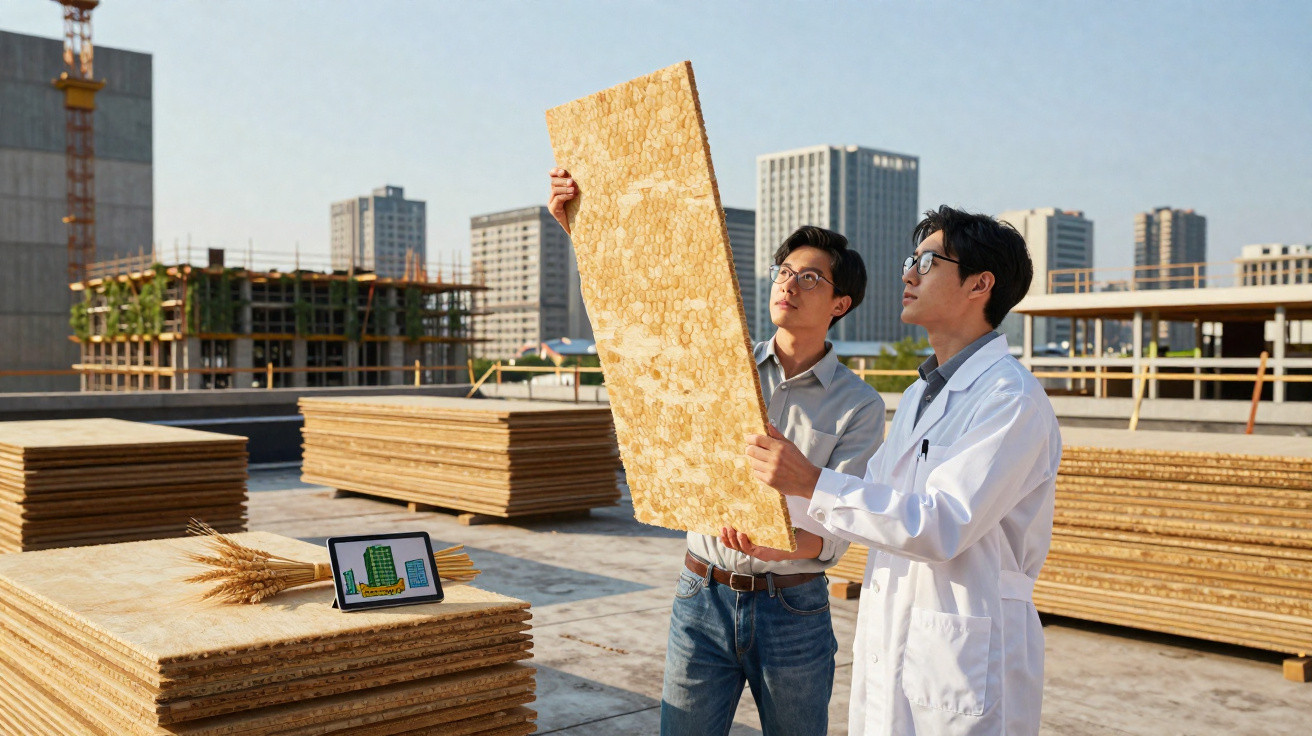
Industry laboratories are trialling insulation and lightweight boards produced from husks, shells and straw – the parts of cereal crops left behind by food production. Special resins or bio-based binders compress these residues into dimensionally stable boards.
Such boards can be used:
- as internal partitions in dry-lining construction;
- in suspended ceilings;
- as a backing for plaster or wallpaper.
The appeal is clear: instead of plasterboard, walls can use a material made from a by-product of the food chain – and one that is considerably easier to recycle at the end of its life cycle.
Timber and cellulose in high-rise construction
The boom in timber construction is already more familiar. Multi-storey timber buildings now stand in many cities. New studies show how this trend can be pushed further with highly processed cellulose fibres. These fibres can be made into high-strength boards and composite elements assembled using interlocking systems.
These systems can shorten construction programmes, keep sites cleaner and deliver a markedly better CO₂ balance. Engineers are currently testing how far load-bearing capacity and fire protection can be improved, so that bridges, halls and buildings taller than 20 storeys also become realistic options.
Comparison with concrete and steel
| Property | Plant-based construction materials | Concrete / steel |
|---|---|---|
| CO₂ balance | locks in CO₂, with low manufacturing emissions | very high emissions during production |
| Weight | substantially lighter | heavy, with high transport loads |
| Thermal insulation | very good | poor, requiring additional insulation |
| Fire behaviour | controllable through coatings and design | fundamentally non-combustible |
| Durability | dependent on protection against moisture and pests | very long-lasting with appropriate corrosion protection |
The new construction material cannot replace concrete and steel entirely. Traditional materials will remain important for foundations, particularly long spans and heavily loaded bridges. However, researchers expect that in many standard buildings, more than half of the load-bearing and bracing elements could be replaced by plant-based products and timber.
The biggest obstacles to everyday use
Despite the opportunities, the route to mass-market adoption remains difficult. Standards, building regulations and insurance requirements are lagging behind the research. Many approval processes were designed around mineral construction materials. New materials must prove their durability, fire behaviour and load-bearing capability through extensive testing.
Preconceptions are another barrier. Some clients instinctively associate plant fibres with damp, mould or pests. Studies do show that modern boards with properly designed layers are highly robust. Yet changing this perception will take time and reference projects.
“Researchers see the biggest task no longer in the technology, but in standards, approvals and the mindsets of decision-makers.”
Supply chains must expand as well. Farms, the food industry and construction-material manufacturers currently seldom work closely together. Turning residues into construction materials systematically requires new logistics, storage capacity and adapted machinery.
What this means for tenants, owners and cities
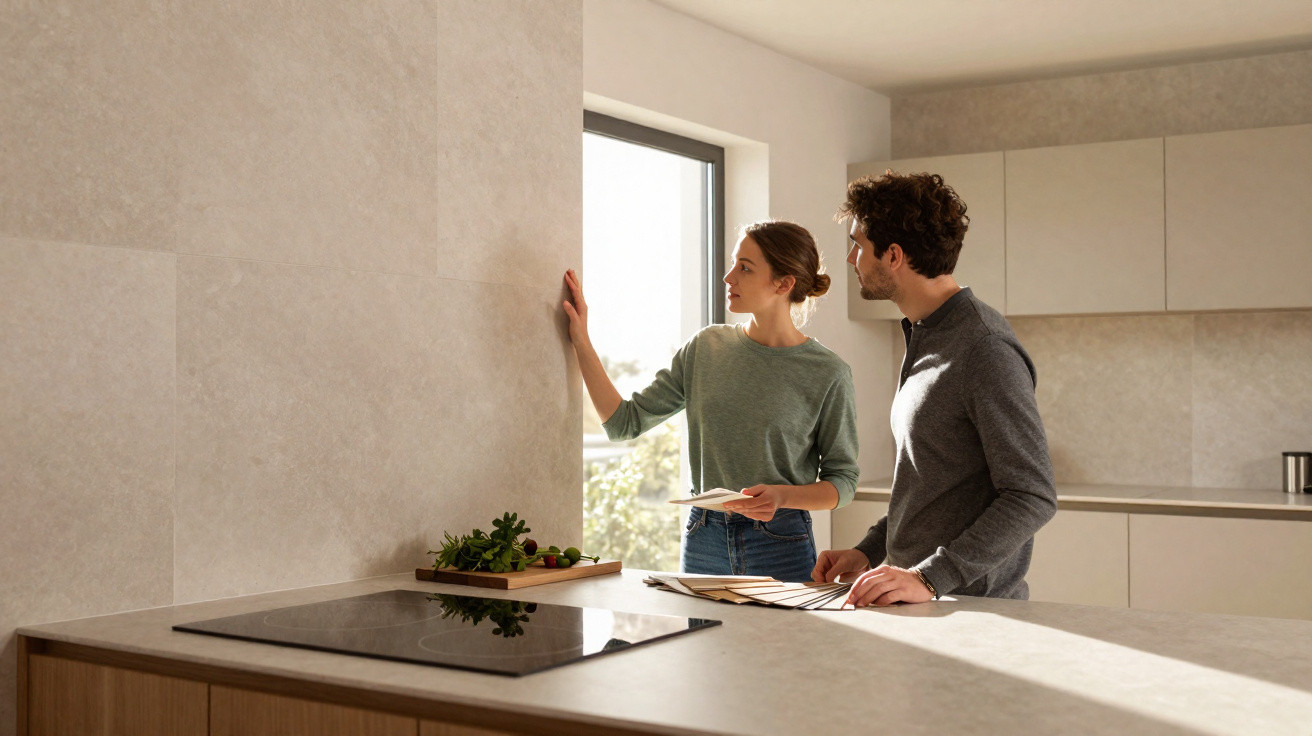
For city residents and those planning a house, the new construction materials offer several tangible effects. Buildings often feel more comfortable because timber and plant-based boards buffer moisture. Rooms are less likely to overheat in summer, while warmth remains indoors longer during winter.
Lightweight components also make refurbishment and extensions easier. Loft flats, timber additions on existing buildings and modular extensions can be delivered more quickly with these materials, without major intervention in the structural design.
Local authorities working towards CO₂ targets are therefore looking increasingly closely at this development. Neighbourhoods built with timber and plant-based construction materials can lock away large quantities of carbon dioxide over the long term. Every primary school constructed from timber and plant-based composite boards rather than concrete acts as a small additional CO₂ store.
How safe is it really?
Many concerns focus on fire, water and pests. Modern timber and fibre components behave differently in a fire than non-specialists might expect: thick beams and boards char at the surface, protecting their core. Their load-bearing capacity remains in place for longer, helping evacuation and rescue.
Multi-layered construction, ventilated cavities and controlled vapour barriers provide protection against moisture. Properly designed and installed walls can achieve service lives comparable with solid construction. Standards already require mineral or specially protected components in sensitive areas, such as below ground level or where surfaces are exposed to splash water.
Pests such as insects and rodents become less of a concern when components are sealed, coated with indigestible finishes or separated by mineral layers. In laboratories, researchers are testing long-lasting yet as non-toxic as possible protective treatments to avoid undermining the environmental balance.
What is already possible – and what comes next
Private clients can already switch many parts of a house to plant-based construction materials: insulation made from cellulose flakes or hemp fibres, internal walls using engineered timber boards, timber-clad façades, or fibre boards based on natural materials. These products are commercially available and hold standard approvals.
The real revolution lies in combining them with digital planning. Building Information Modelling (BIM) and precise prefabrication make it possible to tailor components exactly, reduce off-cuts and channel residual materials into new components. In this way, the cycle linking agriculture, food and construction continues to close.
For tenants and owners, the change is likely to begin gradually: first individual products will appear, then entire walls, and later complete modules. Within a few years, anyone standing in a new-build home could be surrounded by a material they currently know mainly from their own kitchen cupboard – without recognising it at first glance.




Comments
No comments yet. Be the first to comment!
Leave a Comment