
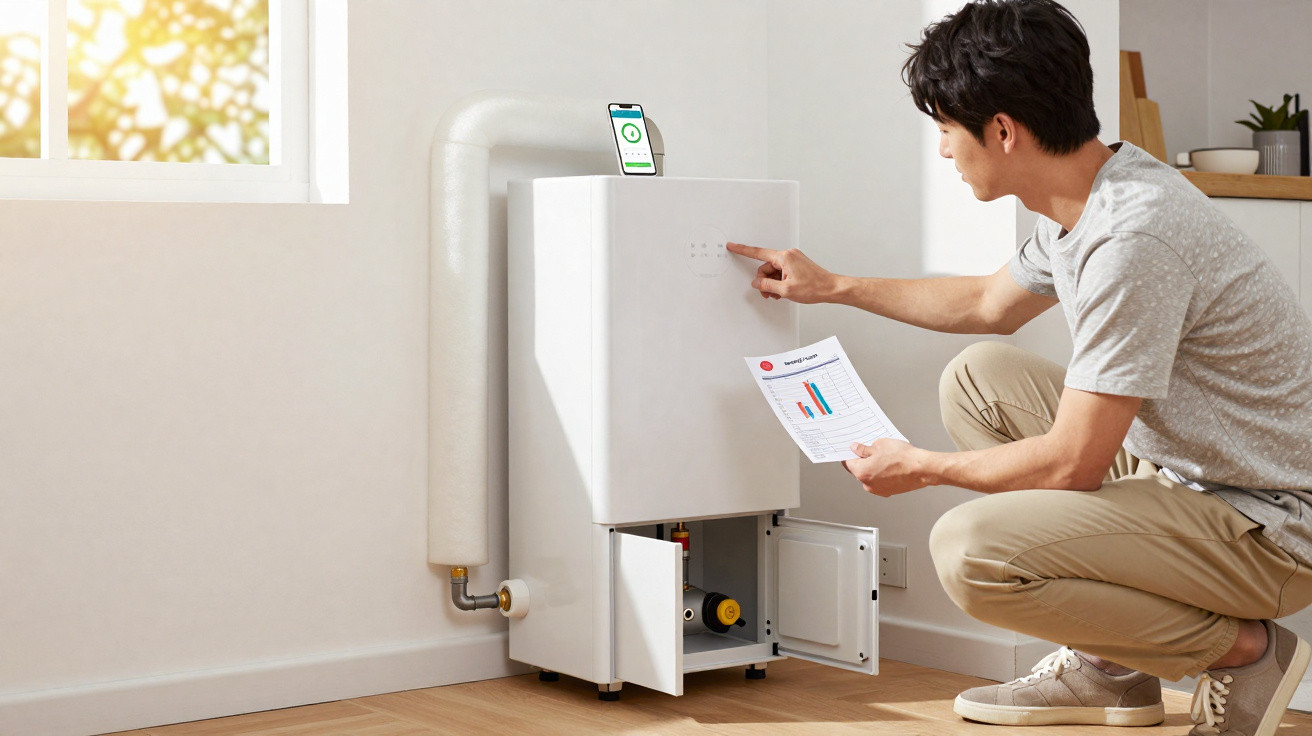
A conventional electric boiler has long been regarded as an electricity guzzler. Modern heat pump boilers, often referred to as “thermodynamic water heaters”, are designed to tackle this issue. They draw on ambient heat to warm water far more efficiently. However, if the system is poorly planned, badly positioned or incorrectly configured, it can still consume more electricity than most people would like – and that is where eight common electricity-cost traps arise.
Why hot water can account for up to one fifth of your electricity costs
When people consider their electricity bill, heating, the fridge and lighting are usually the first things they look at. Hot water is easily overlooked. Yet, in many households, water heating represents 15 to 20 percent of total electricity consumption.
A correctly sized and properly adjusted heat pump boiler can reduce this share substantially. Compared with a standard electric boiler, it typically uses only one third of the energy. Measurements for a 200-litre cylinder illustrate this:
- Electric boiler: around 3,500 kWh per year (approximately €700 at 20 cents/kWh)
- Heat pump boiler: 800 to 1,300 kWh per year (approximately €160 to €260)
This can mean savings of up to €500 a year – provided the unit operates at its best. In real-world installations, that is often exactly where problems begin.
“A heat pump boiler only saves significant money when its location, size, temperature and operating mode are properly matched to the household and the building.”
Electricity cost trap 1: Choosing the wrong cylinder capacity
The first mistake is often made before installation: selecting a cylinder of the wrong size. Both undersizing and oversizing can prove costly.
A boiler that is too small: expensive emergency operation
If the cylinder is undersized, it may run out of hot water before everyone has showered. The electric backup heater then takes over. It operates almost as inefficiently as an old electric boiler and uses a considerable amount of electricity.
- A family of 4 with frequent showers: 200 litres is often the minimum
- Frequent baths or a large bathtub: allow for 250 to 300 litres
- A single person or couple with typical showering habits: 150 to 200 litres is often sufficient
Manufacturers provide guideline figures that can serve as an initial reference point. Anyone who regularly triggers “emergency operation” should have the capacity checked.
A boiler that is too large: hidden standby losses
An oversized cylinder must keep a large volume of water hot continuously, even when it is not used every day. This leads to unnecessary standing losses. Heat gradually escapes through the insulation while the boiler repeatedly reheats the water.
As a rule of thumb, it is better to choose a slightly tight capacity than one that is substantially oversized – provided users are willing to adjust their showering habits slightly.
Electricity cost trap 2: The wrong room – location matters too
Heat pump boilers take their energy from the surrounding air. The warmer that air is, the more efficiently the system performs. This is an area in which many installations make crucial mistakes.
A cold corner instead of a temperate room
Installing the unit in an unheated, cold room or a draughty cellar wastes potential. The heat pump then has to work much harder to heat the same quantity of water.
More economical locations include:
- A utility room
- A garage with a base temperature above freezing
- A heated cellar room or an adjoining room near the heating system
The room must remain frost-free. In genuinely cold cellars, part of the system’s advantage can otherwise disappear.
Too little air: the unit is “starved”
The integrated heat pump needs an adequate volume of air to function properly. Fitting it inside a tiny, airtight cupboard is therefore problematic.
“If the heat pump boiler is installed in a very small, poorly ventilated room, efficiency falls – and in extreme cases, operating faults may occur.”
Pay attention to the following:
- Do not enclose the unit in a completely sealed cupboard
- Provide grilles or ventilation openings in doors and walls
- Ensure there is sufficient room volume; if in doubt, ask the installer
Electricity cost trap 3: Insufficient insulation for the cylinder and pipes
Heat that escapes without being used costs real money. This applies equally to the cylinder and the pipework.
- If the outside of the cylinder feels noticeably warm, an additional insulation jacket can often be worthwhile.
- Uninsulated hot-water pipes in cold cellars or service shafts lose a great deal of energy.
Simple pipe insulation from a DIY shop can cut hot-water costs by up to ten percent, while requiring very little investment.
Electricity cost trap 4: Setting the water temperature too high
Many users raise the target temperature well above what is needed because they worry about the water being too cold – and pay extra for it every month.
Most manufacturers recommend a range of 50 to 55 degrees Celsius. This is sufficient for comfort and hygiene. Every additional degree above this can increase electricity costs for hot water by around seven percent.
“Anyone who permanently sets 60 degrees instead of 50 degrees can, in extreme cases, raise their hot-water costs by almost one third.”
For hygiene reasons, temperatures below 50 degrees should not be used permanently. Many units allow regular “hygiene cycles” to be configured, briefly heating the water to a higher temperature to help prevent Legionella.
Electricity cost trap 5: The wrong mode – permanent boost instead of Eco
Almost every heat pump boiler offers several operating modes. These have a direct effect on electricity consumption.
- Eco or heat-pump mode: The standard setting, which mainly uses ambient heat. This is where the greatest savings are achieved.
- Boost or rapid mode: Heats water quickly using the electric backup heater. Useful after numerous showers, but very energy-intensive.
- Away mode: Lowers the temperature during holidays or longer periods away from home.
A major mistake is leaving boost mode on permanently. The unit then behaves almost like an ordinary electric boiler, meaning the additional investment in the heat pump barely pays for itself.
Electricity cost trap 6: Unsuitable time programmes
Timers are intended to save electricity, but poor settings can have the opposite effect.
Many tariffs offer cheaper overnight electricity or lower-cost time windows. Heat pump boilers should ideally run during these periods. At night, however, the air temperature in the installation room is often lower, reducing the heat pump’s efficiency.
“The ideal approach is a mix of cheaper electricity periods and the warmest possible ambient air, for example in the late afternoon or early evening in a lightly heated room.”
A sensible arrangement could look like this:
- Schedule most of the heating for the cheapest tariff periods.
- Move a small proportion to time windows when the room is at its warmest.
- Align showering routines roughly with the heating schedule so that hot water is available when needed.
Electricity cost trap 7: Neglecting maintenance
Heat pump boilers need less maintenance than conventional heating boilers, but they still require some care. The air filter is one frequently underestimated point.
When the filter at the air inlet becomes clogged, the heat pump has to work much harder. Electricity use rises and service life may decrease. A brief cleaning routine every few months is generally enough:
- Switch off the unit and isolate it from the electricity supply.
- Remove the filter from the upper section of the heat-pump unit.
- Clean it with lukewarm water and a little mild washing-up liquid.
- Leave it to dry before refitting it.
In areas with hard water, it is also worth regularly checking for limescale deposits in the cylinder and inspecting the safety valve assembly. Limescale insulates heating surfaces, increasing energy demand.
Electricity cost trap 8: Everyday habits undermine the technology
Even the most efficient heat pump boiler has limits if hot water is needlessly allowed to run down the drain. This is often where the largest savings opportunities lie, at no cost at all.
- Take short showers rather than regular baths
- Fit water-saving shower heads and tap aerators
- Repair small leaks and dripping taps promptly
- Roughly coordinate shower times with the cylinder’s heating schedule
“Every litre of hot water saved directly reduces electricity consumption – without any loss of comfort when the technology is used intelligently.”
How the individual factors reinforce one another
The most interesting results come when several measures are combined. For example, someone who lowers the temperature from 60 to 52 degrees, insulates the pipes, uses Eco mode permanently and takes only short showers is adjusting four factors at once.
The effect accumulates: lower cylinder losses, a smaller temperature lift for the heat pump, fewer reheating cycles through consistent use of Eco mode, and simply lower everyday hot-water demand. On the electricity bill, these improvements can add up to a clearly noticeable amount.
Key terms explained briefly
Heat pump boiler / thermodynamic water heater: A unit that uses energy from the air, much like a heat pump, to heat water. Inside is a small refrigerant circuit comparable to that of a refrigerator, but operating in reverse.
Coefficient of performance (COP): A measure of how efficiently the heat pump operates. A COP of 3 means that one unit of electricity produces three units of heat. This figure depends heavily on the ambient temperature and the settings.
Those who understand their unit, choose its installation location wisely, check the settings and make small adjustments to their habits can make far better use of the technology – and reduce their electricity bill noticeably without having to give up hot water.



Comments
No comments yet. Be the first to comment!
Leave a Comment