
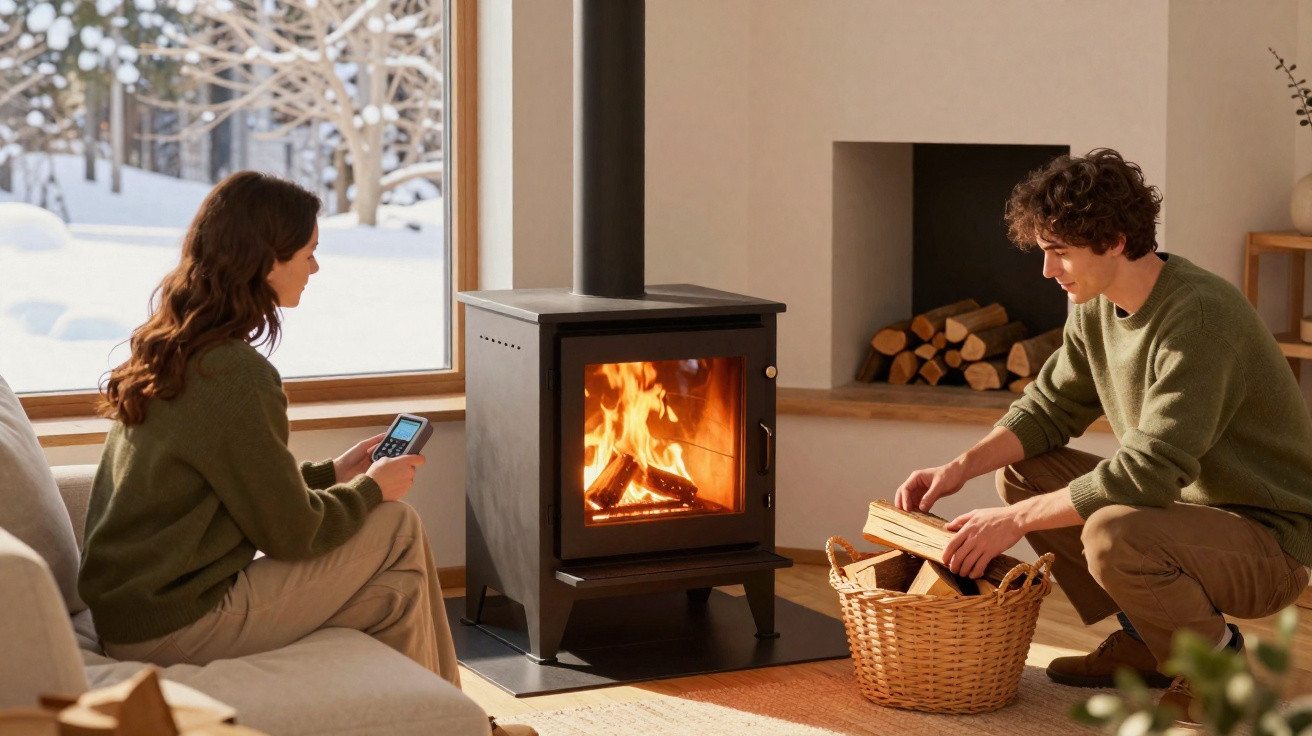
The gap between the romance of a crackling fire and the actual heating requirement is often considerable. Anyone intending to heat 80 to 120 m² of living space mainly with wood should establish in advance how many stacked cubic metres or loose cubic metres of firewood they will realistically need. Depending on the stove, insulation and location, consumption can range from just a few stacked cubic metres to twice that amount.
What your firewood requirement really depends on
The seemingly straightforward question, “How many stacked cubic metres do I need?”, has no single standard answer. Several aspects work together:
- Living area: 80 m² requires noticeably less energy than 120 m² – obvious, but frequently underestimated.
- Insulation: Well-insulated homes retain heat, whereas poorly insulated properties continually lose it through walls, windows and the roof.
- Heating appliance: A modern wood-burning stove and an open fireplace differ enormously in their fuel consumption.
- Region and climate: In cooler upland areas, the stove will run far longer than in milder locations.
- Wood species and quality: Hardwood provides more heating energy per stacked cubic metre than soft conifer wood.
- Heating habits: Maintaining a room at 20 degrees rather than 24 degrees makes a noticeable difference over several months.
“Anyone who wants to plan their firewood requirement properly must consider at least the living area, insulation standard, stove type and wood species.”
Typical consumption ranges by stove type
The heating appliance’s efficiency has the greatest effect. A modern stove extracts substantially more heat from the same wood than an open fireplace does.
Modern wood-burning stove with high efficiency
A current stove with a high efficiency rating, often above 75 percent, is a dependable option for many detached homes:
- approximately 80 m², well insulated: roughly 3–4 stacked cubic metres per heating season
- 100 m², normally insulated: around 4–6 stacked cubic metres
- 120 m², reasonably well insulated: usually 5–7 stacked cubic metres
Those using the stove only as supplementary heating alongside a gas system or heat pump will naturally require considerably less wood.
Fireplace insert or closed fireplace
A closed fireplace insert sits between a conventional stove and an open fireplace in terms of efficiency. Its fuel use rises noticeably:
- approximately 80 m², moderately insulated: about 5–7 stacked cubic metres
- 100 m²: around 6–8 stacked cubic metres
- 120 m², less well insulated: 7–9 stacked cubic metres
Open fireplace as the main heat source – an expensive option
An open fireplace may look impressive, but it is of little use as an efficient heating system. Much of the warmth escapes through the chimney:
- 80 m², poor insulation: often 10–12 stacked cubic metres or more
- 100 m²: approximately 12–15 stacked cubic metres
“Anyone seriously intending to heat with wood should choose a closed stove with high efficiency – open fireplaces are genuine wood guzzlers.”
Insulation is crucial: the same area, half the consumption
The condition of the building envelope determines whether heat remains indoors or literally goes out of the window. Consider these two examples for around 100 m² of living space with a modern wood-burning stove:
- Well-insulated house (new windows, insulated roof, no draughts): 4–6 stacked cubic metres
- Older property without energy-efficiency refurbishment: easily 8–10 stacked cubic metres for the same level of warmth
If it feels as though you “always have to put another log on”, it is worth looking beyond saving on wood. New windows, sealed doors or extra insulation in the top-floor ceiling may also be worth considering.
Which wood species are worthwhile for 80 to 120 m²
Not all firewood delivers the same heating performance. Energy content per stacked cubic metre varies considerably.
| Wood species | Type | Characteristic | Suitability as the main fuel |
|---|---|---|---|
| Oak | Hardwood | Very high density, long-lasting embers | Very good |
| Beech | Hardwood | Attractive flame pattern, plenty of heat | Very good |
| Ash, hornbeam | Hardwood | Similar to beech, high calorific value | Very good |
| Birch | Medium-hard wood | Faster flame, pleasant scent | Good, mainly as a mix |
| Spruce, fir | Conifer wood | Burns quickly, throws many sparks | Better suited as kindling |
For a flat of 80 to 120 m² that must stay reliably warm for months, beech, oak and comparable hardwoods are particularly suitable. They burn more slowly, provide more energy and, through cleaner combustion, are kinder to the stove as well.
Why dry wood is twice as valuable
Moisture content matters at least as much as the wood species. Freshly cut wood often contains 40 to 60 percent water. Before it can heat the room, that water must evaporate, which uses energy.
- Recommended residual moisture: below 20 percent
- Required storage time: depending on the species, two to three years of well-ventilated drying
- Result of excessively damp wood: poor draw, little heat, a soot-covered viewing window and more fine particulate matter
“Those with enough storage space can save real money with their own properly dried wood and noticeably improve heating performance.”
How to store firewood correctly
To prevent a purchased winter supply from rotting or becoming mouldy, you need a well-planned storage area:
- Keep wood off the ground by placing it on pallets or a supporting base.
- Leave the end faces open so that wind can pass through.
- Protect only the top with a tarpaulin or roof, keeping the sides as clear as possible.
- Avoid wrapping it completely in airtight plastic, which traps moisture.
- Order wood as early as possible in spring so it can dry further before winter.
A supply of 6 to 8 stacked cubic metres of wood quickly needs a sizeable storage space. Anyone with only a small garden or balcony should factor this into their plans early on.
How much firewood is actually needed for 80 to 120 m²?
Using the usual conditions, broad guide figures can be calculated. Each applies where wood is the main heat source during the heating season:
- 80 m², well insulated, modern stove, hardwood: about 3–5 stacked cubic metres
- 100 m², normally insulated, modern stove: around 4–6 stacked cubic metres
- 120 m², reasonably well insulated, closed stove: generally 5–7, rising to 8 stacked cubic metres in colder areas
- Poorly insulated older properties of this size: up to 8–10 stacked cubic metres, depending on stove output
For anyone heating with wood for the first year, allowing for a little reserve is a sensible approach. One stacked cubic metre too many is far less stressful than having to order urgently in the middle of January – prices often rise at peak times, and not every supplier can deliver at short notice.
Practical ways to reduce firewood consumption
A few everyday habits can noticeably cut consumption without leaving the home cold:
- Avoid overheating rooms – every degree lower saves energy.
- Keep doors to seldom-used rooms closed.
- Always run the stove with a full, clean air supply rather than turning it down to “a low flame”.
- Match heating periods to when people are at home instead of heating continuously.
- Schedule regular stove servicing and chimney cleaning.
Anyone also taking a few simple insulation measures – replacing door seals, sealing roller-shutter boxes and insulating radiator recesses – will often see the result in their woodpile as early as the following season.
What terms such as stacked cubic metre and loose cubic metre mean
The units used when buying firewood are often confusing. In brief:
- Stacked cubic metre (rm): one cubic metre of neatly stacked wood, including the gaps between logs
- Loose cubic metre (srm): one cubic metre of loosely tipped wood; it contains more air and less wood
- Solid cubic metre (fm): one cubic metre of pure wood, with no gaps
Many suppliers now sell loose cubic metres, while older consumption figures are often stated in stacked cubic metres. Anyone comparing prices should therefore check the unit carefully or ask the supplier.
For everyone aiming to keep 80 to 120 m² warm with wood, an honest assessment is worthwhile: how well insulated is the property, how efficient is the stove, and what wood is available? With realistic assumptions, a small reserve in storage and a dry wood supply, winter need not become an anxious time – either for heating or for your bank balance.



Comments
No comments yet. Be the first to comment!
Leave a Comment