
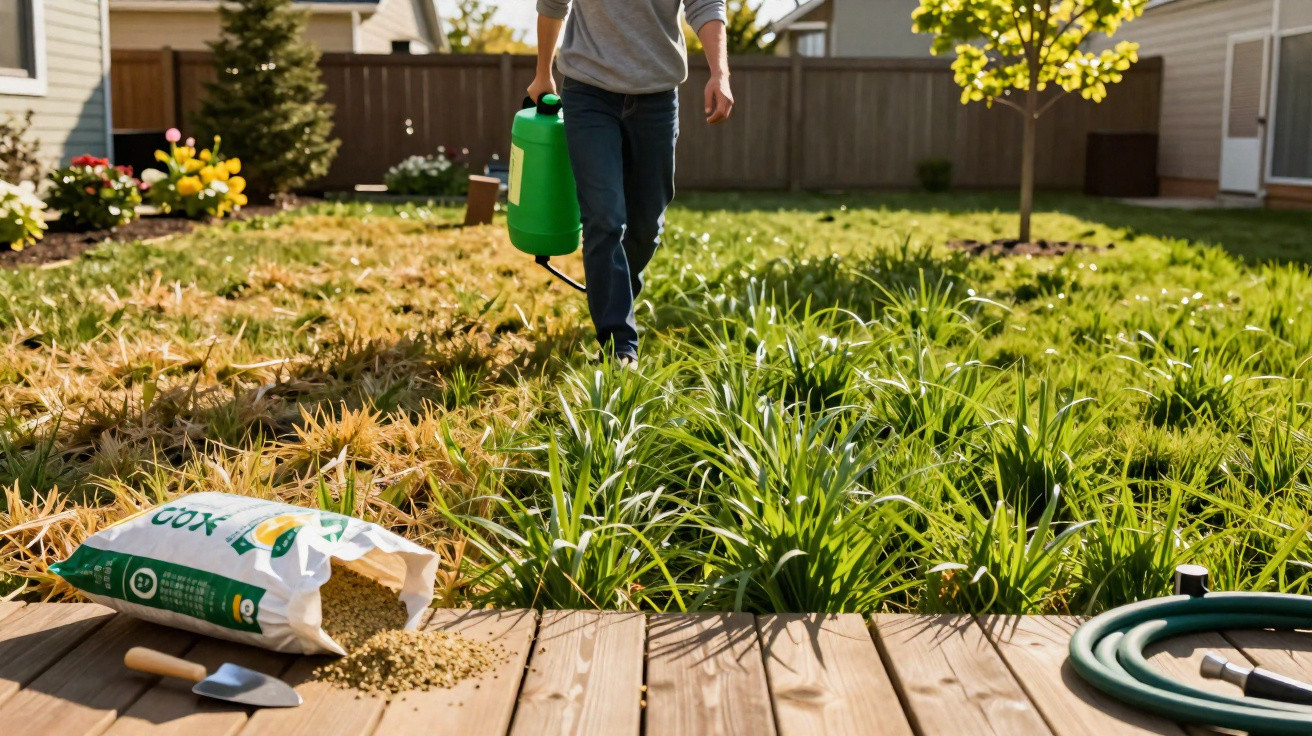
Winter can leave its mark on a lawn, but the right spring fertiliser can turn a dull patch back into rich green turf.
In March, many amateur gardeners simply wheel the lawnmower out of the shed and hope that will do the job. Yet the real key to a thick, hard-wearing lawn lies beneath the surface, at root level – and choosing the suitable fertiliser at the right time is crucial.
Why spring fertiliser determines the look of your lawn
After winter, a lawn often appears patchy, yellowed and sparse. In most cases, this is the result of a lack of nutrients. Grass needs nourishment much as an athlete does: without a regular supply, it declines.
Lawn fertiliser packs typically display an NPK value. This indicates the proportion of:
- N – nitrogen: promotes growth and a deep green colour
- P – phosphorus: supports and encourages root development
- K – potassium: helps the lawn withstand drought and disease
“Anyone who fertilises their lawn purposefully in spring lays the foundation for all the months that follow – mistakes are difficult to put right later.”
As a broad guideline, fertilising twice each year is sufficient: once in spring and again in late summer or autumn. Heavily used areas, such as lawns used for play, benefit from a third, lighter application in early summer.
The right time: when the lawn is genuinely “hungry”
A date on the calendar such as March is only a rough guide. Soil temperature is what matters. Grasses only begin growing actively again once the soil consistently reaches around 10 to 12 degrees, and that is when an application of nutrients becomes worthwhile.
In many areas, this period falls between March and April. It can arrive earlier in milder locations, while colder regions may not reach it until May. Several clear warning signs indicate that the lawn needs feeding:
- the grass looks pale rather than a rich green
- the lawn seems thin and lacks density
- moss patches are spreading despite regular mowing
If these signs appear, mowing alone is not enough: apply fertiliser deliberately. Without nourishment, grass blades remain fine and weak, allowing weeds and moss to take over.
Organic, organo-mineral or mineral: which fertiliser suits spring?
For most family gardens, an organic lawn fertiliser is particularly suitable. It relies on natural ingredients such as:
- dried poultry manure products
- guano (bird droppings from particular deposits)
- horn meal or horn shavings
- dried blood meal or feather meal
These ingredients release nutrients gradually and evenly. This reduces the risk of scorching while providing lasting nourishment. Organic fertiliser also supports life in the soil: microorganisms become more active and, over time, improve the soil structure.
Compost and lawn topsoil: “topdressing”
One especially soil-friendly approach is known as “topdressing”, often simply described as covering the lawn with compost or lawn topsoil. The process is as follows:
- Lightly scarify the lawn where necessary to loosen thatch and moss.
- Spread a very thin layer of well-matured compost or specialist lawn topsoil.
- Work it in with a rake, ensuring the grass blades are not completely covered.
This gives soil microorganisms food, helping them loosen the earth and release nutrients gradually. Anyone aiming for a particularly natural garden can achieve a great deal over the long term by combining organic fertiliser with a compost topdressing.
Organo-mineral lawn fertiliser: a quick start with lasting results
Gardeners looking for visible improvement quickly often choose organo-mineral lawn fertilisers. These combine natural ingredients with mineral nutrient salts. A typical spring lawn fertiliser, for instance, may have an NPK ratio of 10-2-4.
What does this mean in practice?
| Component | Role in spring |
|---|---|
| High nitrogen content (N) | delivers a rapid green-up and encourages new growth and density |
| Low phosphorus content (P) | is enough because most soils have already stored sufficient amounts |
| Moderate potassium content (K) | improves resilience for a dry spring |
Because of the mineral element, the lawn will generally look greener after only a few days, while the organic component keeps the effect steady for weeks.
Purely mineral lawn fertilisers: power with risk
Shops also stock highly concentrated, purely mineral products, such as NPK 30-5-5 or formulations containing more potassium for late spring. These mixtures are like energy drinks for a lawn: powerful, but with side effects if used incorrectly.
“Mineral fertiliser requires precise dosing and the right timing – otherwise, scorched patches and overburdened soil may result.”
If using a mineral fertiliser, observe these important rules:
- Never apply it during hot weather or in strong sunshine.
- Follow the dosage on the pack precisely rather than applying it “by feel”.
- Always spread it on slightly moist soil.
- Water thoroughly afterwards so that the granules dissolve.
For beginners, and for gardens where children or pets play, organic or organo-mineral products are often the less stressful option.
Read your lawn’s condition and adjust fertiliser accordingly
No two lawns are the same. A closer look makes it easier to tailor spring fertilising to its needs.
A lawn that is dense but slightly pale
When the lawn is generally full but has lost its rich green tone, a light application of organic fertiliser is often enough. A simple kitchen item can also help: coffee grounds.
Dried coffee grounds can be spread thinly over the lawn and lightly raked in. Alternatively, mix around 250 grams with roughly 15 litres of water and use it for watering. This adds some nitrogen and supports soil life – ideal as a modest freshening boost.
A tired, yellowing lawn with bare patches
If the lawn has yellow areas, moss cushions and bare spots, it needs more than fertiliser alone. A small treatment programme is then worthwhile:
- Scarify the lawn to remove thatch and moss.
- Apply a thin layer of compost or lawn topsoil.
- Spread organo-mineral spring fertiliser (e.g. 10-2-4) according to the pack instructions.
This combines nutrients, soil improvement and aeration. A few weeks later, the lawn will usually look noticeably fresher and denser.
Young lawns need patience
Newly sown grass cannot tolerate a full dose of fertiliser. A cautious approach is best:
- Do not fertilise for the first time until after several mowing sessions.
- Use only around half of the recommended amount.
- Choose gentler, organic products where possible.
This prevents scorching and supports young roots without overwhelming them.
How to apply lawn fertiliser correctly: step by step
Even the best fertiliser is of little use if it is spread incorrectly. The following practical sequence has proved effective:
- Mow the lawn: avoid cutting it extremely short; 4 to 6 centimetres is ideal.
- Remove moss and thatch: scarify troublesome areas or loosen them with a rake.
- Lightly moisten the soil: fertilise after rain or following a brief watering.
- Apply the fertiliser: use a spreader where possible to create an even result.
- Protect the edges: keep clear of patios, paths and flower beds.
- Water thoroughly after spreading: this dissolves the granules and carries them into the upper soil layer.
When spreading by hand, work in two directions – once lengthways and once across – while splitting the amount in half. This helps prevent stripes and patches.
Why soil life, pH and water also shape the result
Fertiliser is only one part of lawn care. Three factors influence how effectively nutrients reach the grass:
- Soil life: earthworms and microorganisms turn organic matter into nutrients available to plants. Constantly using only mineral fertiliser weakens these helpful organisms.
- pH level: moss readily establishes itself in strongly acidic soils. A soil test will show whether an application of lime is worthwhile.
- Water: without sufficient moisture, nutrients remain “stuck” in the soil. The lawn needs water, particularly after fertilising.
Observing your lawn carefully in spring will save plenty of trouble later. A quick check after every mow is enough to spot changes in colour, density and any emerging problem areas.
It is useful to make a brief note of when fertiliser was applied and which product was used. This makes it easier to make targeted adjustments the following year. Over time, many garden owners find that using less product at precisely the right moment produces better results.




Comments
No comments yet. Be the first to comment!
Leave a Comment