
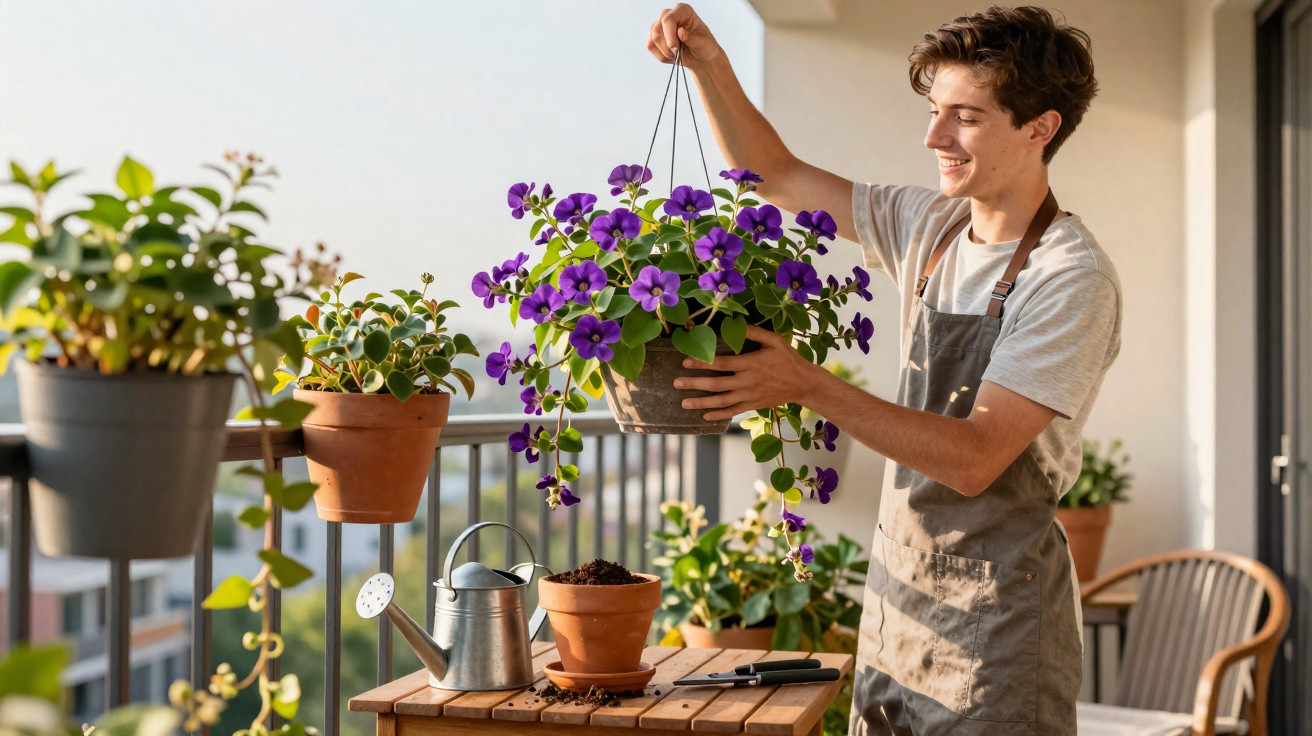
Robust in shade, surprisingly late-summer-like, and easy to manage.
Many people opt for petunias or fuchsias, which demand plenty of care. A South African perennial fills gaps when other plants are fading and delivers another bold display in autumn.
Why gardeners want it now
The insider tip is Plectranthus ‘Magic Mona Purple’, often sold as ‘Mona Lavender’. Developed by De Wet Plant Breeders in South Africa, it belongs to the mint family. It grows into a compact, densely branched shrub suited to pots and hanging baskets.
In a container, the plant reaches around 60 to 70 centimetres in height and 60 to 75 centimetres across. Rather than producing long trailing stems, it forms a closed, sturdy mound. Its leaf tops are deep green, while their undersides have a purple sheen. This two-tone foliage noticeably brightens even shady spots.
Its greatest asset: purple flower spikes in autumn – precisely when many summer plants are calling it a day.
How it differs from petunias and fuchsias
This perennial provides structure rather than trailing growth. One specimen reliably fills a 25–30-centimetre hanging basket. It does not need daily deadheading, only the occasional trim. Bees and other pollinators consistently visit its flowers while temperatures remain mild.
Position and climate
A site in bright shade or partial shade is ideal. The plant tolerates morning sun, but midday heat on south-facing balconies puts it under stress. East- or north-facing positions work immediately, as does a spot beneath a lightly shaded tree canopy.
As a frost-sensitive perennial, it thrives outdoors year-round in USDA zones 10–11. In Central Europe, it should be grown in pots and moved outside after the last frosts. Before the first frost, bring it in promptly to a bright windowsill or conservatory.
If the thermometer drops towards 0 °C, the plant should move indoors – this will keep it vigorous for years.
Planting and compost
A pot or basket with reliable drainage holes prevents waterlogging. The growing medium should be nutrient-rich, loose and permanently well aerated.
- Recommended mix per pot: 60% high-quality potting compost, 20% mature compost and 20% drainage material (perlite, pumice or fine expanded clay).
- A 25–30 cm hanging basket needs 5–7 litres of growing medium for each plant.
- Water thoroughly after planting, then allow excess water to drain away.
Annual care calendar
| Month | Task |
|---|---|
| March–April | Raise young plants, root cuttings, and keep them somewhere bright and frost-free. |
| May | Move outside after the last frosts, first allowing plants to acclimatise in shade. |
| June–August | Water evenly, apply liquid feed every 14 days, and lightly pinch out the tips. |
| September–October | Main flowering period; remove faded blooms and bring plants in earlier during cool nights. |
| November | Move indoors, check for pests, and trim back lightly. |
| December–February | Keep bright and cool (12–18 °C), water moderately, and do not feed. |
Watering, feeding and pruning
Keep the growing medium evenly moist. Once the top two centimetres have dried out, water deeply until water runs out from the base. Empty saucers after 10 minutes so that the roots can access air.
From May to September, use a liquid fertiliser for flowering plants every 14 days. Alternatively, a moderately dosed slow-release fertiliser applied in spring works reliably for four to five months.
A light prune in spring encourages branching. It is also worth removing spent flower spikes after flowering. This helps the plant produce fresh shoots more quickly and retain its compact form.
Water, yes; waterlogging, no: fresh growing medium encourages flowers, while wet roots hold the plant back.
Overwintering without the drama
Before temperatures turn cold, inspect leaves and stem joints carefully for mealybugs or scale insects. Cutting the plant back by one third saves space and makes care easier. Indoors, Plectranthus prefers plenty of light at 12–18 °C.
Water sparingly over winter, but do not allow the root ball to dry out completely. Resume feeding only in spring. Turn the pot by a quarter every two weeks so that the crown develops evenly.
Propagation is quick and easy
Cuttings root reliably. Take non-flowering shoot tips measuring 8–10 centimetres long. Remove the lower leaves and insert the base of each cutting into a 1:1 mix of perlite and seed compost.
At 20–22 °C in bright, indirect light, roots form within two to three weeks. A clear cover or freezer bag keeps humidity high. Air it briefly every day to prevent fungal problems.
Common problems and solutions
- Leaf scorch: avoid direct midday sun and choose a shadier position.
- Drooping shoots: check the growing medium and water deeply if it has dried out.
- Yellow leaves despite moisture: improve pot drainage and, if necessary, switch to low-lime water.
- Root rot: stop waterlogging, remove affected parts, and use fresh growing medium.
- Spider mites/mealybugs in winter: rinse plants off early and use yellow sticky traps and oil-based sprays selectively.
Design: hanging baskets that perform into autumn
‘Magic Mona Purple’ fills the centre as a structural perennial. Trailing plants around the edge create softer transitions, while foliage plants reinforce the purple theme. Choose companions for partial shade with similar watering needs.
- Spillers: ivy (Hedera helix), creeping Jenny (Lysimachia nummularia ‘Aurea’), and Dichondra ‘Silver Falls’ in lightly shaded positions.
- Fillers: coral bells (Heuchera), begonias for shade, and Carex ‘Evergold’ as a fine-textured grass.
- Accents: white or lavender lobelias in cooler, partially shaded areas.
Recipe for sturdy hanging baskets: 1 perennial in the middle, 2 fillers beside it, 3 trailers around the edge – and the autumn display is complete.
Useful facts: names, origin and hardiness
Both names appear in shops: ‘Magic Mona Purple’ and ‘Mona Lavender’. Each refers to this compact, autumn-flowering Plectranthus line. The species originates from South Africa, where frost-free winters are common. In Germany, it therefore works as a perennial container plant with an indoor winter rest.
Two more practical details
Explanation of the term: USDA zones indicate average annual minimum temperatures. Zone 10 begins at around –1 °C, while zone 11 is above +4 °C. Gardeners in colder areas should use containers and bring plants indoors in good time.
Example calculation for a 30 cm hanging basket: 7 litres of growing medium, 1 main Plectranthus plant, 2 companion plants and 3 trailers. On warm days, water requirements are around 1–1.5 litres per watering. Half a teaspoon of liquid fertiliser per 5 litres of water every two weeks is enough to maintain richly saturated colour.
Comments
No comments yet. Be the first to comment!
Leave a Comment