
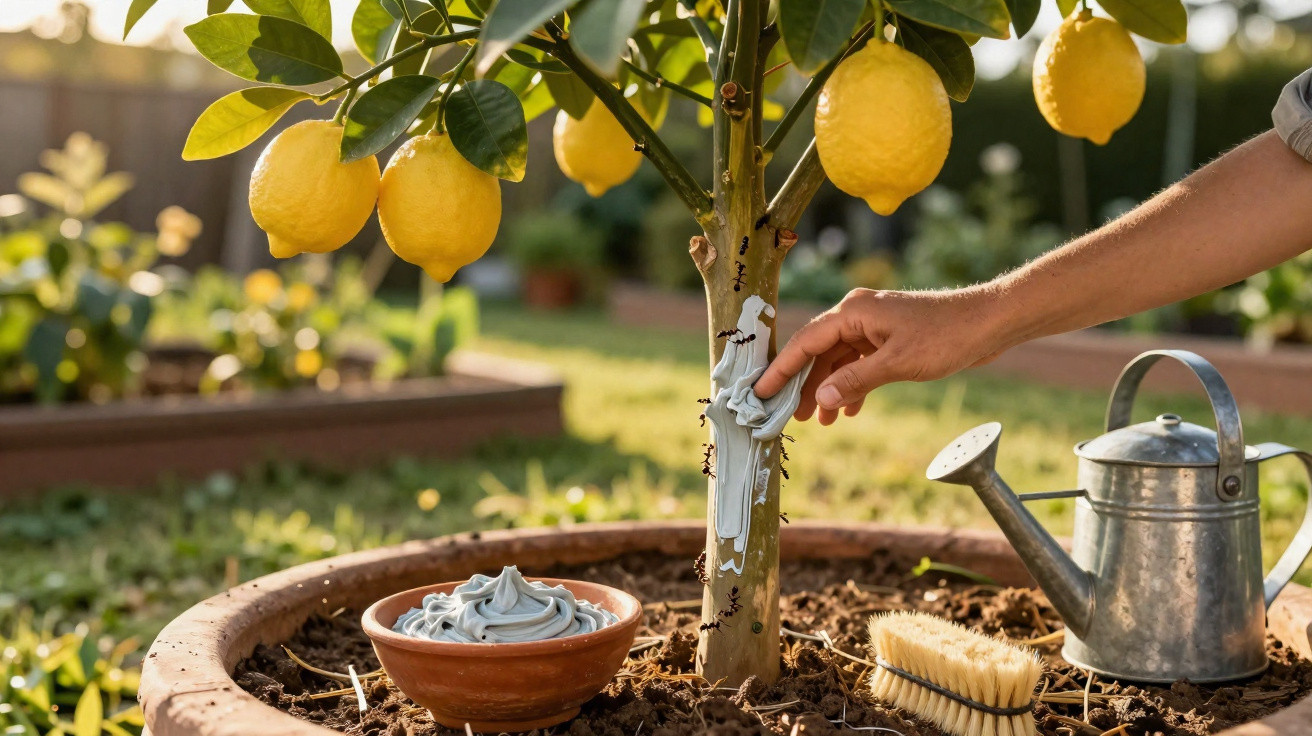
Applying wood ash to the lemon tree trunk mixed with water is a traditional gardening method, used chiefly to create a physical barrier against ants climbing the tree. Once dry, the powdery coating can make it harder for these insects to move across the bark. This is particularly relevant when ants are linked to aphid colonies on new shoots and leaves.
What is the purpose of applying ash to a lemon tree trunk?
Its most commonly cited purpose is to hinder ants travelling between the ground and the canopy. Ash is not a conventional insecticide: when mixed with water and brushed around the base, it dries into a fine-textured film on the bark.
This may help because certain ants have a close association with aphids. They feed on the sugary substance produced by these tiny insects and may protect them from natural predators. As a result, seeing many ants climbing a lemon tree is also a reason to inspect young leaves, shoots and leaf undersides for this pest.
How should ash paste be prepared correctly?
Only suitable ash and water are needed. The aim is to make a mixture with the consistency of thick paint, so that it adheres to the trunk without immediately running off. It can be prepared as follows:
- use only ash that has cooled completely;
- place a small amount in a container;
- add water gradually;
- stir until it becomes a thick paste;
- gently remove loose soil from the base of the trunk;
- apply a thin band around the bark;
- allow the coating to dry naturally.
Which type of ash can be used on a lemon tree?
This method should use only clean wood ash. Ash from painted, varnished or treated timber, plywood, chipboard, plastic, or materials exposed to chemicals may contain contaminants and must not be applied to trees or soil.
Even clean wood ash should be used sparingly. It contains minerals such as potassium and calcium, and has an alkaline effect that can raise soil pH. University extension services advise caution because excessive applications can substantially change the soil’s chemistry.
What precautions prevent harm to the lemon tree?
The intention is to create a narrow barrier, rather than cover much of the trunk with a thick crust. Rain and watering will gradually wash the mixture away, but repeated treatments can also carry ash into the soil surrounding the roots. The following precautions help reduce that risk:
- do not build up thick layers on the bark;
- avoid applying it to wounds or damaged areas;
- do not spread large quantities of ash around the roots;
- avoid frequent use in soil that is already alkaline;
- check the canopy for aphids, scale insects and other pests;
- do not treat the paste as a replacement for proper infestation control.
Does ash alone solve ant and other pest problems?
No. Ash paste should be regarded as a temporary, supplementary physical barrier. If the lemon tree has curled leaves, distorted new growth, sticky honeydew, dark sooty mould or large numbers of insects, the cause must be identified before deciding how to manage it. An aphid infestation, for instance, will not disappear merely because fewer ants are climbing the trunk.
The most plausible benefit of this method is that it makes a route used by ants more difficult without immediately resorting to chemical products. Since ash can also alter pH when it reaches the soil, it must be applied locally and in moderation. To keep a lemon tree healthy, monitoring its leaves, shoots, bark, drainage and pest presence remains more important than repeatedly using any homemade remedy indiscriminately.




Comments
No comments yet. Be the first to comment!
Leave a Comment