
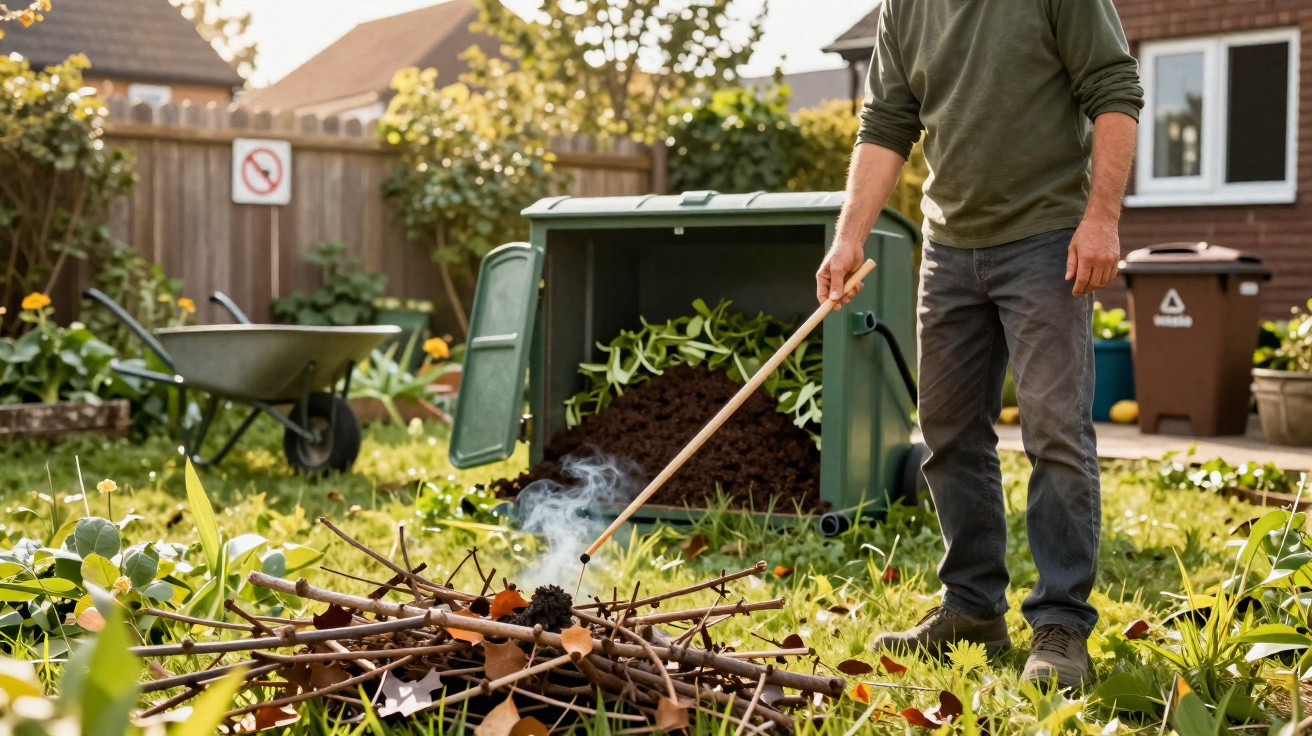
In many local authorities, the transitional period for burning leaves and garden cuttings ends on 31 March. Anyone whose garden is still producing smoke after that date could face a fine. Several German federal states are also tightening their rules considerably, in some cases moving towards a complete ban. To look after a garden lawfully and avoid trouble, residents now need an alternative way to deal with their waste.
31 March deadline: what will no longer be allowed in the garden
From a legal perspective, the position is straightforward: the Circular Economy Act generally prohibits the burning of garden waste. German federal states, districts and local authorities can permit fires for limited periods only through exemptions. In many areas, these exemptions are now coming to an end.
“In numerous local authorities, the fire season ends as early as 31 March – anyone lighting up afterwards risks hefty penalties.”
Common rules include:
- tree and shrub cuttings may be burned only until 31 March
- an extension is sometimes allowed, but only until 15 April at the latest
- burning is permitted only at specified times of day
- minimum distances from buildings, roads and neighbouring properties must be maintained
- approval from, or notification to, the local authority may be required
Once these deadlines have passed, a clear prohibition applies in most cases. Anyone who still fills a fire bowl with branches and leaves must expect more than complaints from neighbours: official enforcement action may follow.
Why garden fires face increasingly strict restrictions
The main reason is air-quality protection. What may appear to be a “natural fire” is, on closer inspection, a major source of pollution.
Burning damp leaves, twigs and shrubs produces, among other things:
- particulate matter that can penetrate deep into the lungs
- nitrogen oxides and carbon monoxide
- organic compounds that irritate mucous membranes
For people with asthma, COPD or cardiovascular conditions, another “leaf fire” next door can become a genuine ordeal. Closing windows, bringing washing back inside and stopping children from playing in the garden are situations many nearby residents know all too well.
There is also a second issue that is becoming increasingly important in policy: climate protection and the circular economy. Plant material is a valuable biological resource. When it is burned, its nutrients quite literally disappear into smoke and ash. Composting, by contrast, turns the material into humus, which stores carbon in the soil over the long term and improves soil quality.
Saxony-Anhalt example: burning after March comes at a cost
The effects of this stricter approach are particularly clear in German federal states such as Saxony-Anhalt. Many local authorities there permit the burning of garden waste only up to 31 March. Afterwards, the options are a compost heap, food and garden waste bin, or household waste recycling centre – open fires are off limits.
Anyone who ignores the rules commits an administrative offence. Each local authority sets its own fines, which typically run into three figures. If complaints are made, the fire service is often called out, and the cost of that attendance may also be charged.
“A quick look at the local by-law can save several hundred euros – and help keep the peace with the neighbours.”
Mecklenburg-Western Pomerania applies the brakes: complete ban from 2029
In Mecklenburg-Western Pomerania, the direction of travel is unmistakable. The state’s environment ministry has announced a complete ban on burning garden waste from 1 January 2029. After that, only regulated disposal and recovery systems will be permitted, in line with federal waste law.
Until then, local authorities are being brought into line gradually: tighter conditions, fewer exemption days and, in some places, an effective ban already. For property owners, this means changing established habits before doing so becomes expensive and complicated.
How to find out what is still permitted locally
Because every German federal state, and often every local authority, sets its own rules, there is no universal answer. Regulations can even differ from one town or village to another within the same district.
Useful sources of information include:
- the local authority website, including by-laws on waste disposal, garden fires and traditional fires
- the district council or environmental department
- the local fire service, which generally knows the rules well
- the town hall service helpline
Important: many regulations explicitly refer to “plant waste from garden and landscape maintenance”. Household rubbish, bulky waste and treated timber must never be put on a fire – doing so immediately puts you in the realm of criminal offences.
What happens if people light fires anyway?
Anyone who fails to comply with the requirements may face several consequences:
- a fine from the local authority or district council
- liability for costs if the fire service attends
- civil disputes with neighbours over smoke nuisance
- possible restrictions on future use of the property
Insurers may also scrutinise claims closely if a fire causes damage and began with an unauthorised blaze. Anyone who lit a fire independently and without permission may ultimately be left to deal with the consequences alone.
The better option: making sensible use of garden waste
Rather than throwing everything on the flames, plant material can easily be returned to the natural cycle. Three routes are suitable for most households.
1. Your own compost heap
For larger gardens, a compost heap at the rear of the property is often the most convenient option. It can take:
- leaves
- finely cut shrub trimmings
- grass cuttings, well mixed rather than layered thickly
- uncooked plant-based kitchen waste
After a few months, this creates valuable humus for flower beds, raised beds and containers. Anyone wishing to speed up the process can alternate coarse and fine material, using a garden shredder if needed.
2. The local food and garden waste bin
Where a food and garden waste bin is provided, it is the simplest option for smaller gardens. Leaves, small branches and plant cuttings can be cleared away in one easy step, then centrally processed into compost or energy.
It is important to put only items in the bin that the waste-collection calendar permits. Plastic, stones and soil do not belong there and make disposal more expensive.
3. Household waste recycling centres and local composting facilities
After major pruning work or tree felling, anyone faced with large quantities of material is best advised to take it to a household waste recycling centre. Many local authorities accept substantial amounts of shrub cuttings and root material there, processing them into woodchip or compost.
“Anyone delivering waste separately and properly sorted supports a modern circular economy – while avoiding smoke, odour and stress.”
Common misunderstandings about garden fires
A number of persistent misconceptions surround this issue. Here is a quick reality check:
- “I can do whatever I want on my own property.” This is untrue. Air-quality and waste legislation apply everywhere, including private land.
- “If I call it a campfire, it is allowed.” Authorities consider what is being burned, not what the fire is called. If shrub cuttings are on it, waste law applies.
- “Once a year cannot be that bad.” Many local authorities no longer tolerate garden fires at all. Even a “traditional fire” can cause problems if the local by-law does not provide for it.
Practical tips for gardening without fire
Anyone who has previously burned waste regularly will need to adjust a few routines. Simple measures can make this easy:
- cut shrub trimmings into small pieces as you prune, rather than storing metre-long branches
- leave autumn leaves beneath shrubs as mulch instead of removing every last one
- use some dead wood as an insect habitat or a brushwood pile for hedgehogs
- share a garden shredder with neighbours to reduce costs
These steps substantially reduce the volume of waste. At the same time, mulch improves the soil, protects it from drying out and provides habitat for beneficial wildlife.
Why giving up garden fires pays off in the long term
Avoiding garden fires delivers more than cleaner air. Compost returns nutrients to the soil, reduces the need for bought fertiliser and supports healthy soil life. Earthworms, micro-organisms and fungi help create loose soil and vigorous plants.
Relations with neighbours also become more relaxed. There are no clouds of smoke on a Saturday afternoon, no smell of burning in the bedroom and no toddler needing to be taken indoors from the sandpit because they are coughing. This effect is especially noticeable in densely built-up residential areas, such as new-build estates or rows of terraced homes.
Those who keep the 31 March deadline in mind and switch early to composting, food and garden waste bins, and household waste recycling centres will avoid more than fines. The garden becomes more sustainable, the air clearer – and the next spring starts without an argument over fire.


Comments
No comments yet. Be the first to comment!
Leave a Comment